
America’s AI boom is running into a powerful new force: local and political resistance to the massive data centers that power it. While communities push back against new facilities, a different group of companies stands to benefit. These firms help solve the physical problems the backlash creates. Technology analyst Michael Robinson calls this shift the Backlash Boom.
Robinson has followed technology from inside Silicon Valley for more than 40 years. He argues that most investors are reading the AI backlash incorrectly. Millions of Americans are fighting to keep large AI data centers out of their communities. At the same time, a smaller set of companies could collect billions by helping Big Tech overcome the obstacles that resistance creates.
For years the main questions around artificial intelligence were straightforward. How large could the technology grow? How much capital would companies commit? How many data centers would be needed? How much electricity would the build-out require?
Those questions have changed. The AI boom expanded so quickly that communities, state governments, utilities, and Congress are now pushing back.
The Scale of the Backlash
Recent surveys show how widespread the resistance has become. In a Gallup survey conducted in March, 71 percent of U.S. adults said they opposed an AI data center being built in their area. A separate national survey from the University of Pennsylvania found that opposition to local data centers rose 12 percentage points in just four months.
Americans may still want the benefits of artificial intelligence. Many simply do not want a giant facility in their own backyard. That opposition is already rewriting the rules for the technology industry.
In Virginia, data centers became a central issue in the 2025 governor’s race. Rising electricity costs helped turn rapid growth into a statewide political fight. After the election, the new governor announced a plan to give communities greater influence over data-center decisions and to shield residents from higher power bills.
New York imposed a temporary halt on new hyperscale data centers while officials developed stricter rules. New Jersey’s governor proposed measures requiring data centers to cover a larger share of the power and grid upgrades they need.
The resistance reached a new intensity on November 3. In Texas, voters rejected the incumbent and elected a candidate who had campaigned on pausing new data-center construction until stronger rules were in place. In Piqua, Ohio, 67 percent of voters approved a ban on new data centers and removed three city commissioners who had backed a disputed project. In Bloomington, Illinois, nearly 22,000 voters—78 percent—supported a moratorium on large facilities.
From state capitals to small towns, the message is clear. Big Tech can no longer treat local approval as automatic. The practical results are already visible. Goldman Sachs research reported in October showed that 86 U.S. data-center projects had been canceled or seriously delayed since the beginning of the year. Of those, 76—nearly nine out of ten—were tied directly to local opposition. That equals more than one major project stopped or delayed every four days.
These delays are not minor inconveniences. Each one creates another problem that must be solved—and paid for.
Power Demands Have Exploded
A recent 60 Minutes investigation highlighted how dramatically power needs have grown. Only two years earlier a large data center might have required around 5 megawatts. Today a new AI facility can demand as much as 1,000 megawatts—up to 200 times more power. Many of these projects are moving into communities never designed to support that level of demand.
The physical reality is straightforward. An AI data center cannot be downloaded or coded into existence. It requires land, water, cooling systems, transmission capacity, and enormous amounts of electricity. Increasingly it also requires something that has become harder to obtain than power itself: permission.
In Hazle Township, Pennsylvania, a developer seeking approval for a large data-center campus offered eligible households $10,000 each if the project moved forward and the first facility opened. With roughly 4,500 households eligible, the total could reach $45 million. The episode illustrates a broader point. Permission itself is becoming a cost of doing business in the AI build-out.
Who Pays for the Infrastructure?
Communities are not only asking whether they want these facilities nearby. They are asking who should pay for the extra power, grid upgrades, and other costs. On September 16 the U.S. House passed a bill by a 417–3 margin calling on state regulators to consider rules that would require large data centers to cover the additional power and grid expenses they create rather than shifting those costs onto ordinary ratepayers. Two weeks later 57 senators voted to advance the measure. It fell three votes short of the threshold needed. Some opponents argued the bill did not go far enough.
The pattern is consistent across different concerns—electricity, water, noise, or higher utility bills. For the companies building AI infrastructure the outcome is the same: another problem they must pay someone to solve.
The Backlash Boom: Spenders and Receivers
Big Tech is not walking away from the AI race. Instead, many of the largest players are paying more to keep building. Amazon signed a long-term agreement with Generac for backup power that could involve purchases of up to $8 billion. The announcement moved Generac’s stock higher in after-hours trading. One company writes the check; another receives it.
Robinson describes this pattern as the Backlash Boom. Big Tech encounters a physical or political obstacle, spends large sums to overcome it, and a different set of companies collects the payments. The spending is not disappearing. It is being redirected.
This creates two distinct groups. The Spenders—Amazon, Microsoft, Google, Meta, Oracle and others—are making the large AI bets and committing hundreds of billions of dollars. McKinsey has estimated that nearly $7 trillion could be invested in data centers worldwide by 2030. Of that total, roughly $1.3 trillion could go toward the power, cooling, and electrical infrastructure required for AI.
The Receivers are the companies that get paid to make those bets physically possible. They supply the power systems, cooling equipment, grid connections, generation capacity, and other solutions the Spenders need. As opposition grows, the list of problems the Spenders must solve keeps expanding: insufficient grid capacity, excess heat, limited water, missing transmission lines, community resistance, and the need for electricity years before traditional utilities can deliver it.
Robinson summarizes the dynamic with a simple equation: Obstacle equals bill.
Seven major technology companies—Amazon, Google, Meta, Microsoft, OpenAI, Oracle, and xAI—have already signed the White House Ratepayer Protection Pledge. Under the pledge they agree to build, bring, or buy the additional power their data centers require and to cover the cost of new infrastructure needed to deliver it. The initiative later expanded to include utilities, developers, and state leaders. More than 300 organizations have joined. Recent statements from the administration have reinforced the expectation that large new data centers should supply their own electricity and, where possible, return excess power to the grid or community.
The cost of building AI infrastructure continues to rise. Anthropic, the company behind Claude, has disclosed infrastructure contracts that could total as much as $807 billion over coming years. According to its IPO filing, more than $220 billion is already committed under agreements the company cannot cancel. Even if AI demand falls short of projections, some of those payments remain due. The Spenders carry the risk; the companies building the supporting systems get paid.
Looking for Problems That Force Spending
Robinson’s long-standing approach is to identify the problems a new technology creates and then locate the companies being paid to solve them. Rather than focusing only on which firm will produce the best AI model, he looks for the physical bottlenecks that force large capital outlays.
One of the most pressing is reliable electricity available on a useful timeline. AI operators do not simply need more power at some future date. They need dependable power at specific locations, at the right volume, and soon enough to keep expensive facilities from sitting idle. Robinson refers to this as Certain Power.
A data center can be ready, the servers installed, and customers waiting, yet still sit unused if the local grid cannot deliver electricity for years. Every day of delay means costly AI chips generate no revenue. Google has backed advanced nuclear projects expected to begin delivering power around 2030. That timeline does not help a facility that needs electricity today. Big Tech can construct data centers faster than the broader power system can expand.
Real-world consequences are already appearing. Australian operator NextDC cut its financial forecasts after a critical electricity connection was suspended, removing roughly $98 million in expected revenue. The stock fell 42 percent in a single session.
One lesser-known company recently installed a power system for an Oracle data center that was operational in 55 days. Oracle later expanded the relationship. The company is not simply selling electricity; it is selling speed—the ability to move from “wait for the grid” to “turn it on.” With opposition slowing traditional timelines and every month of delay carrying real costs, that capability has clear value.
On-site solutions do not replace the need for nuclear power, new generation, transmission upgrades, and broader grid work. The larger AI becomes, the more physical challenges it creates—and the more capital flows toward the companies that solve them.
Earlier Winners in AI Infrastructure
The pattern is already visible in the market. Since ChatGPT launched in November 2022, some of the strongest performers have not been the companies designing AI models or manufacturing the leading chips. They have been firms solving the physical problems created by rapid growth.
Modine Manufacturing supplies cooling equipment that keeps large data centers from overheating. Its data-center sales rose 73 percent last year to more than $1 billion. One major customer reserved capacity for more than $4 billion in potential future sales. The stock has risen as much as 1,426 percent since early 2023.
Lumentum provides technology that moves data between chips. In its most recent quarter revenue jumped 109 percent to more than $1 billion. The stock has climbed as much as 2,049 percent since early 2023.
EMCOR Group installs electrical systems, cooling, backup power, and related infrastructure. Its backlog of contracted work reached a record $17 billion, up nearly 44 percent in one year. The stock has advanced 536 percent since early 2023.
These companies were already being paid to solve infrastructure problems before the current wave of community and political resistance intensified. As opposition grows, the same category of businesses stands to see further demand.
Robinson previously highlighted Vertiv, a maker of power and cooling systems critical to data-center operations, and Comfort Systems USA, which installs heating, cooling, electrical, and mechanical systems for large facilities. Both have benefited from the physical build-out of AI infrastructure. Vertiv was noted around $92 in July 2024 and later rose as much as 313 percent. Comfort Systems USA was noted near $695 in September 2025 and nearly tripled over the following eight months. Past performance is not a guarantee of future results, but the examples illustrate why infrastructure suppliers have been an important part of the AI story.
Power Distribution and Cooling
Every AI data center faces two immediate physical problems: getting electricity controlled and distributed safely inside the building, and removing the intense heat the chips produce.
Generating power is only the first step. That electricity still has to be managed, protected, and delivered to the servers without interruption. One company that specializes in this kind of electrical equipment recently won a single data-center order worth more than $400 million—the largest in its history. The project includes on-site power generation, exactly the type of solution Big Tech needs when local grids and communities cannot keep up. The same firm has booked hundreds of millions more in data-center work, and its backlog recently hit a record $2.4 billion, up 69 percent from a year earlier.
Once the chips are running, heat becomes the next constraint. Higher-powered processors packed more densely make traditional air cooling less effective. Liquid cooling, which carries heat away more efficiently, is growing rapidly. A second company that supplies critical components for these advanced cooling systems has already announced its third manufacturing expansion in three years, adding more than 400,000 square feet of capacity. Management has directly linked the growth to AI and high-performance computing demand.
As communities demand clearer answers about electricity and water use, more efficient cooling becomes even more valuable. The sequence is simple: more AI chips require more power, more power creates more heat, and more heat requires better cooling. Each step creates a bill that specialized companies can collect.
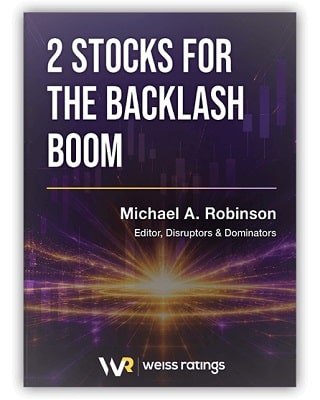
These two problems—power distribution and heat removal—are the exact focus of the special report 2 Stocks for the Backlash Boom. The report names the two companies, provides their tickers, and lays out the research on why they sit in the path of this spending.
The Grid Constraint
Even with strong electrical systems and cooling inside the building, the electricity still has to reach the data center. America’s grid was never designed for facilities that can draw as much as 1,000 megawatts. Critical equipment needed to expand transmission capacity can take years to obtain. The median wait from applying for a grid connection to actually producing power has stretched to roughly five years.
That delay is expensive when AI companies are racing to bring new capacity online. With communities and lawmakers increasingly insisting that Big Tech pay for the grid upgrades it needs, another large bill is being created.
One company that builds and upgrades electric-grid infrastructure sits directly in the middle of this work. It connects new power sources to the places that need the electricity. Its total backlog recently reached $53.4 billion, with nearly $44 billion coming from its electric business. Not every project is driven by AI, yet the AI build-out is adding major new demand to a system that already requires enormous investment. Every new data center needs connection capacity; every new power plant needs transmission lines.
This is the precise problem covered in the special report The AI Grid Bill. The report identifies the company helping expand and modernize the grid and explains why it could benefit as developers are forced to fund more of the infrastructure themselves.
Generating the Power Itself
Transmission lines can move electricity, but they cannot create it. AI operators want large amounts of power on timelines measured in months and a few years, not a decade. That pressure is pushing them toward natural gas, nuclear, solar, on-site generation, and even the restart of older plants.
One company that manufactures the equipment used to generate and move large volumes of electricity is already seeing AI demand in its order book. In the first half of 2026 its electrical-equipment business booked more than $5 billion in data-center orders—more than double the full-year total for 2025. Company-wide backlog recently stood at $176 billion. Most of that work is not AI-specific, which is part of the appeal: the firm benefits from the broader national need for more generation and transmission capacity even if some AI forecasts prove optimistic.
A second route is to sell the electricity itself. One company recently signed a 20-year agreement with Meta covering more than 2,600 megawatts of nuclear power from three plants in Ohio and Pennsylvania. The deal helps meet Meta’s growing AI power needs. Google, Microsoft, and Amazon have also entered nuclear-related arrangements. Large technology companies are moving beyond simply buying power from the existing grid and toward helping finance additional generation.
These two approaches—selling the equipment that creates and moves power, and selling the power itself—are the focus of the special report 2 Stocks for AI’s Coming Power Bill. The report names the two companies, provides their tickers, and details why they are positioned to collect as Big Tech spends to secure more electricity.
The Free Ticker: Bloom Energy
One company that has demonstrated the ability to deliver power quickly is Bloom Energy (NYSE: BE). It recently installed a fuel-cell system at an Oracle data center that was operational in 55 days. Oracle later expanded the commercial relationship. Bloom manufactures solid-oxide fuel-cell systems that convert fuel into electricity through an electrochemical process rather than traditional combustion. The units can be placed near the facilities that need the power.
Across the industry, developers are discovering that securing reliable electricity can be more difficult than obtaining the chips themselves. Bloom is positioning itself to address that bottleneck. The company is not without risks—its shares can be volatile, its systems carry costs and limitations, and it faces competition. Still, it directly targets one of the most urgent constraints in the current AI build-out: obtaining usable power on a timeline that matches the pace of data-center construction.
Bloom Energy (BE) is the free name that can be researched independently. The broader opportunity, however, extends beyond any single firm.
Five Companies and Three Special Reports
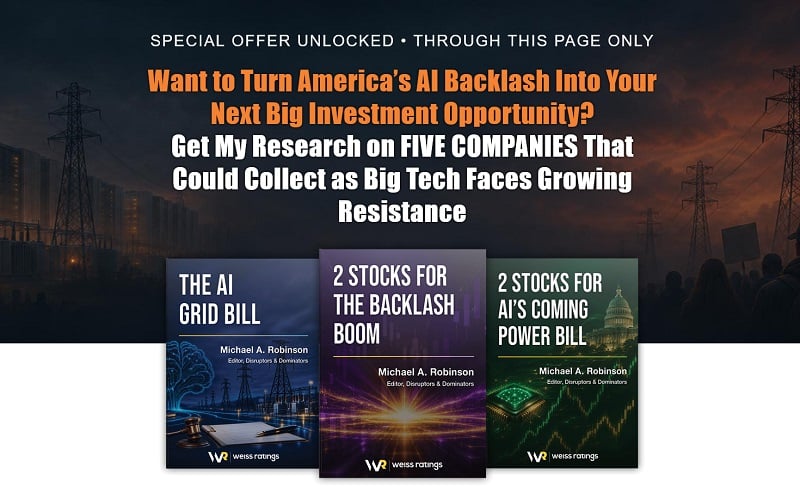
Robinson has identified five companies he believes are positioned to benefit as the backlash forces additional spending on power distribution, cooling, grid upgrades, generation equipment, and electricity supply itself. Details on these names appear in three special reports:
- 2 Stocks for the Backlash Boom covers two firms focused on electrical distribution and advanced liquid cooling.
- The AI Grid Bill examines a company helping expand and modernize the electric grid.
- 2 Stocks for AI’s Coming Power Bill looks at two businesses involved in generation equipment and the sale of electricity.
Together the reports address the main physical bottlenecks that communities and regulators are forcing Big Tech to confront. The research combines technology analysis with independent financial evaluation from Weiss Ratings, a firm that does not accept payment from the companies it rates.
These materials are available to new members of the Disruptors & Dominators newsletter. A standard annual subscription is $129. A current offer provides 12 months of the newsletter plus the three Backlash Boom reports for $49. Membership includes monthly issues, alerts, access to the research archive, and related Weiss Ratings content. A 365-day money-back guarantee applies; even if a subscription is canceled, the three reports may be retained.
Ready To Try it? Get Disruptors & Dominators Here – $49
Why the Shift Matters for Investors
The public opposition to large AI data centers is real. Concerns about electricity bills, water use, local land, and the distribution of costs are legitimate. Yet the resistance is not stopping the overall build-out. It is changing who pays for the solutions and which companies receive those payments.
The Spenders continue to commit large sums because they remain deeply invested in the AI race. Every new regulatory requirement, community demand, or grid delay becomes another invoice. The companies equipped to solve those problems—the Receivers—sit in the path of that redirected capital.
Robinson’s long career has focused on locating the less obvious suppliers and infrastructure providers that make major technology transitions possible. Earlier examples include recognizing Bitcoin’s potential when it traded near $300 and recommending Nvidia in 2016 at a split-adjusted price of roughly 80 cents. More than 130 recommendations since 2013 have later produced triple-digit gains, according to the track record he cites. The model portfolio has shown an average gain of 32.80 percent per stock, including losers. Past results do not guarantee future performance.
The current environment offers a similar dynamic: a major technology wave creating physical constraints, political pressure raising the cost of those constraints, and specialized public companies positioned to be paid for the solutions.
Investors interested in the infrastructure side of the AI story rather than only the model developers or chip makers may find the Backlash Boom framework useful. The free name, Bloom Energy (BE), provides a concrete starting point. The broader set of five companies and supporting research is available through the special reports and newsletter for those who want the full analysis.

Big Tech is not standing still. Neither are the companies working to solve the growing list of physical and political obstacles. The Spenders take the risk. The Receivers get paid. That is the core of the Backlash Boom.