Gold has already delivered one of the strongest multi-year runs in recent memory. After a needed pause, the stage is set for the next leg higher. Many of the world’s most successful investors and institutions are positioning for it. The question is no longer whether gold can move higher. The question is how most people will try to capture the move—and how a much quieter approach has historically produced larger, more consistent gains with lower operational risk.
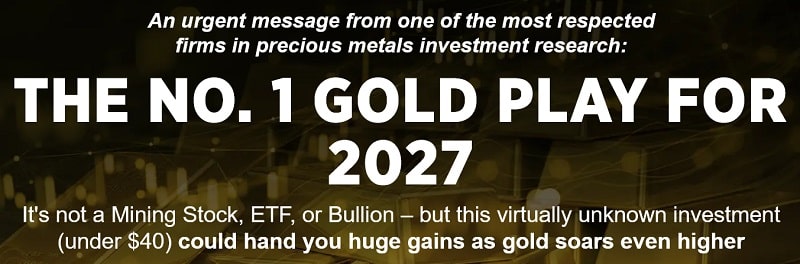
The best way to participate is not by buying bullion, a gold ETF, or a typical mining stock. It is by owning a share of the production stream itself through a royalty company. One such company currently trades for less than $40 a share. Stansberry Research’s Commodity Supercycles team identifies it as the single best gold-related investment available right now for the coming years.
Gold’s Recent Strength and the Case for Higher Prices
Over the past five years gold has outperformed the S&P 500, the Dow, and the Nasdaq. That fact alone surprises many investors who assume equities always lead. The outperformance occurred even while stocks enjoyed a strong bull market of their own. The implication is straightforward: the forces supporting gold have been powerful enough to push it ahead of risk assets for an extended period.
Major banks have published targets that would have seemed aggressive only a few years ago. J.P. Morgan has pointed to levels above $6,000 per ounce. Bank of America analysts have outlined scenarios in which gold reaches $8,000. Other independent voices have suggested even higher figures over a longer horizon. Whether gold ultimately settles near $5,000, $8,000, or higher is less important than the direction and the magnitude of the trend that is already underway.
Several large, well-known investors have made their positions clear. David Einhorn of Greenlight Capital has stated that gold should significantly outperform the Nasdaq over the next three to five years. Egyptian billionaire Naguib Sawiris has recommended that a meaningful portion of a portfolio belong in gold and has added substantially to his own net worth through the metal in a single year. John Paulson has allocated the overwhelming majority of a multi-billion-dollar fund to gold-related holdings and has argued that gold is preferable to holding dollars. Ray Dalio has described a paradigm shift in the gold market and has compared current conditions to earlier historic turning points—the 1970s break from the gold standard and the early-2000s recovery from multi-decade lows. Seth Klarman has simply noted that it is prudent to hold some gold.
These are not fringe voices. They are among the most successful capital allocators of the past several decades. When they speak in the same direction at the same time, it is worth paying attention.
Central banks form an even larger buyer. According to the World Gold Council, central banks purchased 289 metric tons of gold in the second quarter of 2026—a record. China alone added 21 metric tons in one recent month, its largest monthly purchase in more than three years. Bloomberg has reported that central banks plan to increase gold holdings further in the coming year at the highest percentage rate recorded since 2018. These institutions control far more capital than all the world’s billionaires combined. Their steady accumulation removes supply from the market and signals that official institutions view gold as a necessary reserve asset in the current environment.
Macro conditions reinforce the case. Consumer savings have been drawn down. Student loan balances exceed $1.9 trillion. Credit-card debt has reached a record $1.3 trillion. National debt stands above $40 trillion. Everyday costs—groceries, energy, utilities—have risen sharply for many households. Geopolitical tensions in Europe and the Middle East remain elevated. Nearly every major currency has been subject to expansionary policy. In an environment of high debt, persistent deficits, and currency debasement, gold has historically served as a store of value and a hedge.
History shows that once a gold bull market gathers momentum, the gains tend to be large. Across the distinct upcycles since 1975, most have produced at least a doubling from the cycle low. The current cycle still appears early by that standard.
Why Most Investors Will Miss the Best Part of the Move
When gold rises, the public response is predictable. People buy physical coins and bars. They buy the large, liquid ETFs that track the metal. They buy mining stocks, often the most heavily promoted names. These approaches can work. They are not, however, the highest-probability or highest-reward path for most individual investors.
Physical gold and ETFs give direct exposure to the price of the metal. They also require storage, insurance, or management fees, and they generate no income. Mining stocks offer leverage to the gold price because a rising gold price expands margins at producing mines. That leverage cuts both ways. Mines face rising costs, permitting delays, labor issues, political risk, and operational accidents. A single problem at a key asset can erase years of gains. Many mining equities have underperformed the metal itself over full cycles for exactly these reasons.
There is a third path that most investors never consider: owning a royalty or stream on production. Instead of owning the mine or the metal, the investor owns a contractual right to a percentage of the gold (or other metals) produced, or a right to purchase a portion of production at a fixed or formula price. The mining company does the hard work. The royalty holder collects a share of the output or revenue with far lower capital intensity and operational risk.
This structure has produced some of the strongest long-term results in the entire natural-resource sector.
The Royalty Model: How Pierre Lassonde Created a Better Way
The modern gold royalty business traces back to Pierre Lassonde. A Canadian engineer who moved to the United States, Lassonde recognized the mineral potential of Nevada and understood that most investors preferred not to take on the full risks of exploration and development. In the early 1980s he and a partner paid $2 million for a 4 percent interest in the future production of a Nevada property. That property became the Goldstrike mine, one of the largest and most successful gold operations in North America.
The royalty generated enormous cash flow for decades with almost none of the capital expenditure, operating cost, or environmental liability that the mine operator carried. Lassonde formalized the approach by founding Franco-Nevada. Early investors who stayed with the company through subsequent cycles turned modest sums into life-changing wealth. A $100 investment at the public debut could have grown to more than $32,000. A $5,000 investment could have become roughly $1.6 million.
Franco-Nevada today is a multi-billion-dollar company with hundreds of royalties and streams across the globe. It employs only a few dozen people yet generates high margins because its cost structure is minimal. The company does not run trucks, dig pits, or negotiate labor contracts. It finances operators in exchange for a claim on future production and then collects.
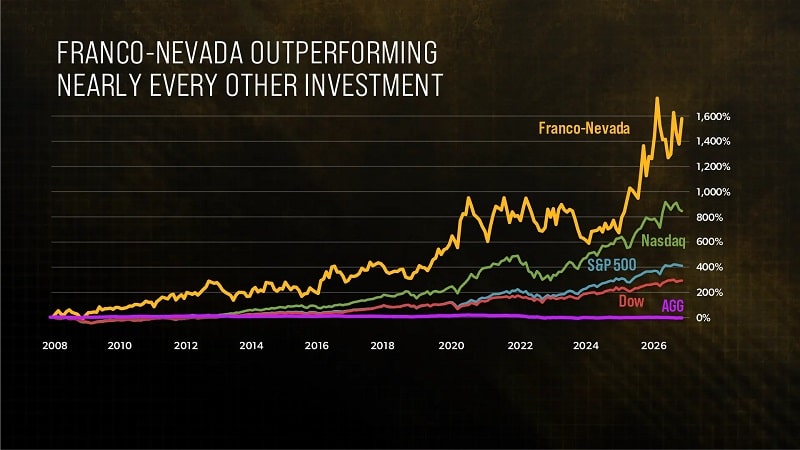
Royal Gold followed a similar path. Founded in the 1980s and shifted toward precious-metals royalties shortly afterward, it has delivered multi-thousand-percent returns over multi-decade periods while the broader equity market returned far less. Both Franco-Nevada and Royal Gold remain excellent businesses. They are also large. Franco-Nevada’s market value sits above $45 billion. Royal Gold is valued in the tens of billions. At those sizes, only very large transactions move the needle. Smaller, high-quality royalty opportunities often pass them by.
That creates an opening for a newer, smaller royalty company.
Why a Smaller Royalty Firm Offers Greater Upside Today
The company highlighted by Commodity Supercycles trades for less than $40 a share. It is led by executives who previously built one of the world’s largest silver royalty businesses into a multi-billion-dollar enterprise. The team has assembled a portfolio of royalties and streams on mines in Brazil, Turkey, Ghana, Argentina, Canada, the United States, and other jurisdictions.
Because the firm is still small, a single mid-sized deal that would be immaterial to Franco-Nevada or Royal Gold can meaningfully increase its cash flow and valuation. The company can negotiate more favorable terms on smaller transactions that the larger players ignore. With low overhead and a lean staff, incremental revenue drops largely to the bottom line.
Diversification is already present. Multiple assets across different countries and operators reduce the impact of any single mine underperforming or shutting down. The business model remains the same one that worked for Lassonde and for Royal Gold: provide capital to operators in exchange for a lasting claim on production, then collect for years or decades with minimal ongoing cost.
In prior commodity cycles, companies that sat in this sweet spot—proven management, growing portfolio, still-modest valuation—have delivered the largest percentage gains. The same setup exists again.
Central Bank Demand and the Supply Picture
Central bank buying is not a short-term phenomenon. After years of net sales in the 1990s and early 2000s, official institutions reversed course. They have been net buyers for more than a decade, and the pace has accelerated. When the largest and most sophisticated holders of reserve assets steadily increase their gold positions, the signal is clear. They view the metal as necessary insurance against currency risk, geopolitical uncertainty, and the long-term consequences of high sovereign debt.
At the same time, new mine supply grows slowly. Discoveries of large, high-grade deposits have become rarer. Permitting timelines have lengthened in many jurisdictions. Existing mines face grade decline and rising costs. The combination of steady official demand and constrained supply growth supports higher prices over time.
Silver faces its own structural deficit. Industrial demand from solar, electronics, and electrification has grown while primary mine supply has struggled to keep pace. The gold-to-silver ratio has spent extended periods near historically elevated levels. When that ratio has corrected in the past, silver has produced sharp moves of its own. Commodity Supercycles covers both metals because the same macro forces that lift gold often lift silver, sometimes with greater leverage.
Historical Perspective: What Prior Cycles Teach
Commodity markets are cyclical. Periods of underinvestment are followed by periods of scarcity and rising prices. The last major commodity supercycle in the 2000s produced multi-hundred-percent and multi-thousand-percent gains in many resource equities. Investors who owned the right royalty and streaming companies captured a large share of those gains with less volatility than pure mining equities.
Franco-Nevada’s early track record is one example. Royal Gold’s multi-decade compounding is another. Both demonstrated that a well-structured royalty portfolio can compound for decades while the underlying metal price fluctuates. The current environment—high debt, currency expansion, geopolitical risk, and official-sector accumulation—shares important features with earlier periods that produced strong gold markets.
No cycle is identical. Risks always exist. Mining operations can face unexpected problems. Commodity prices can reverse. Currency and interest-rate regimes can shift. Past performance does not guarantee future results. What history does show is that when the setup is favorable and the vehicle is a high-quality royalty company, the probability of meaningful gains rises substantially compared with many other approaches.
How the Royalty Structure Reduces Risk Relative to Mining Stocks
A traditional mining company must raise large amounts of capital, navigate permitting, build infrastructure, hire labor, manage environmental compliance, and operate the mine for years before free cash flow appears. Cost overruns are common. Political risk in certain jurisdictions can change the economics overnight. A single operational setback can cut production and cash flow sharply.
A royalty company faces none of those direct costs. Its primary risk is that the underlying mines produce less than expected or that gold prices fall. Because the portfolio is diversified across many assets, the failure of any one mine is diluted. Margin structures are high because overhead is low. Many royalty contracts are structured so that the royalty holder benefits from both volume growth and price increases. In rising gold markets the cash flow growth can be substantial.
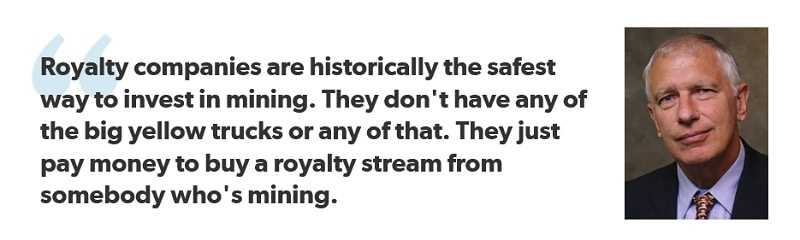
Doug Casey, a long-time mineral investor, has summarized the advantage simply: royalty companies do not own the big yellow trucks. They own a claim on the output. That difference has historically made them safer and more profitable over full cycles.
The Current Opportunity and Why Timing Matters
Gold has already risen substantially from its cycle lows. Many investors therefore assume the easy gains are behind them. History suggests the opposite is often true. The largest percentage moves frequently occur in the middle and later stages of a bull market as broader participation increases and as institutional and official buying continues. Getting positioned early in a high-quality royalty company still trading at a modest absolute price gives the investor the chance to participate in that later acceleration.
The company detailed in Commodity Supercycles’ special report currently trades under $40. That low absolute price means a given percentage gain produces a large absolute return on a modest capital outlay. It also means the company remains accessible to individual investors who prefer not to commit large sums to any single position.
Stansberry Research’s analysts have spent years studying the precious-metals sector. They have traveled to mining districts, met operators and executives, and examined the contractual details of royalty and streaming agreements. The conclusion of that work is that the under-$40 royalty firm represents the clearest combination of quality, growth potential, and valuation available in the gold space today.
What Commodity Supercycles Provides
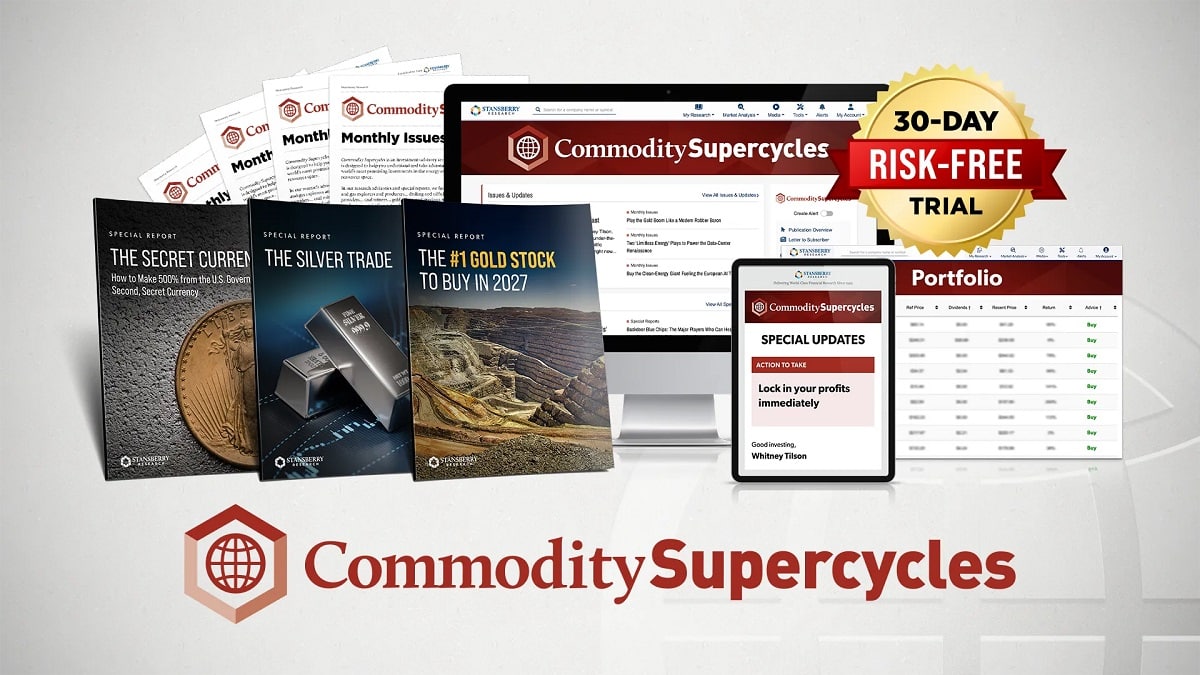
Commodity Supercycles is Stansberry Research’s dedicated service focused on the major cycles in gold, silver, energy, and other natural resources. The service is led by experienced analysts, including contributions from Whitney Tilson, a well-known investor and commentator. Subscribers receive a monthly letter with new ideas and updates, access to a model portfolio of current recommendations, and a full archive of prior research.
New subscribers currently receive three special reports:
- The No. 1 Gold Stock to Buy in 2027, which names the under-$40 royalty company and provides the full investment thesis, risks, and position-sizing guidance.
- The Silver Trade, which examines the structural deficit in silver and identifies a vehicle positioned to benefit if the gold-to-silver ratio normalizes.
- The Secret Currency, which covers a form of gold and silver investment historically favored by wealthy families and institutions that is distinct from bullion, mining stocks, or ETFs.
A one-year subscription is available at a substantial discount to the regular price, with a 30-day full money-back guarantee. The guarantee allows any new subscriber to review the reports, the model portfolio, and the monthly letters and decide whether the research is useful. If not, a full refund is available within the first 30 days.
The research does not promise specific returns. It does identify what the team considers the highest-probability ways to participate in the current gold and silver setup using the royalty and related structures that have worked in prior cycles.
Putting the Pieces Together
Gold is in a multi-year bull market supported by official-sector buying, high sovereign debt, currency expansion, and geopolitical uncertainty. Traditional vehicles—bullion, ETFs, and mining stocks—offer exposure but come with higher costs, lower margins, or greater operational risk. The royalty model pioneered by Pierre Lassonde and refined by companies such as Franco-Nevada and Royal Gold has delivered superior long-term results with a cleaner risk profile.
A newer, smaller royalty company trading under $40 sits in the position that earlier royalty firms occupied when their largest gains were still ahead. It has experienced management, a growing portfolio of assets, low overhead, and the ability to close deals that larger competitors pass over. Commodity Supercycles has researched this company thoroughly and presents it as the single best gold-related investment available for the period ahead.
Investors who want the details—the name, the ticker, the specific royalties, the valuation, and the recommended approach—can obtain them in the special report included with a trial subscription. The same subscription provides ongoing coverage of gold, silver, and other resource opportunities as the cycle develops.
The gold market does not wait for perfect consensus. The investors and institutions already positioning for higher prices are not waiting either. The royalty structure gives ordinary investors a practical way to participate with a margin of safety that pure mining equities rarely provide. The company trading under $40 is the clearest expression of that structure available today.
For readers who prefer to see the full analysis, the special reports, and the model portfolio before committing capital, the Commodity Supercycles trial is the direct next step. The research is available immediately upon subscription, and the 30-day guarantee removes the financial risk of reviewing the work.
Gold’s next leg higher will reward those who own the right vehicles. The royalty company detailed by Commodity Supercycles is designed to be one of those vehicles.