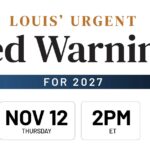
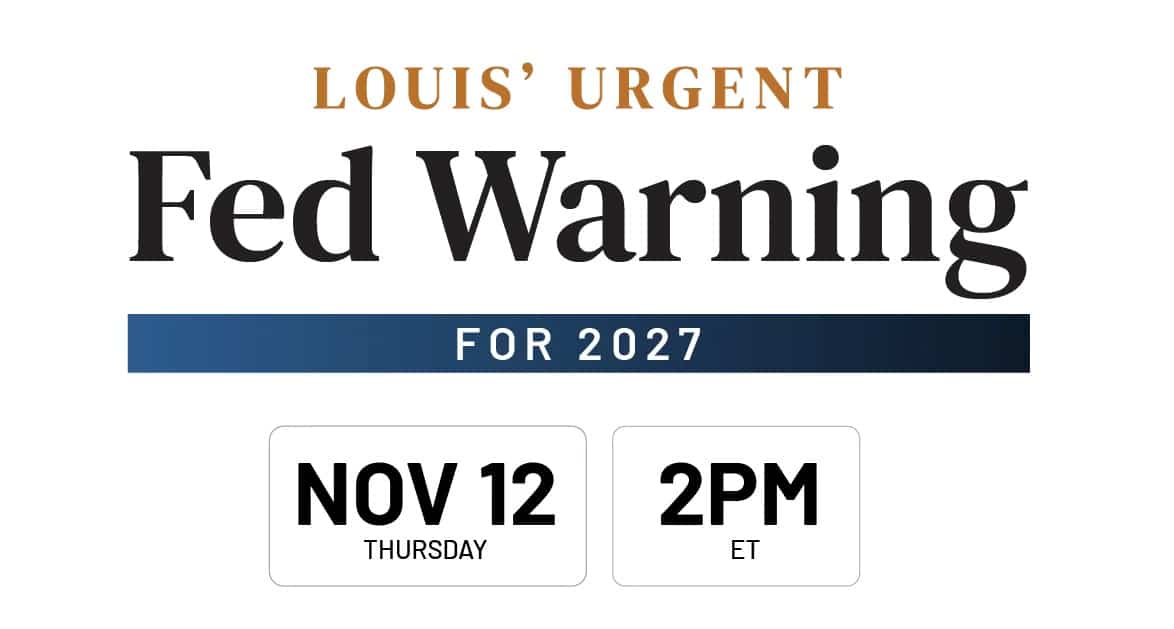
Louis Navellier has spent more than four decades building a reputation as one of the more consistent quantitative stock pickers in independent research. On Thursday, November 12, 2026, at 2 p.m. Eastern, he is hosting a free online presentation titled Fed Warning 2027. The session focuses on what the Federal Reserve’s next policy moves could mean for investors in 2027, the risks facing broad index portfolios, and a practical framework for identifying stocks that may continue to perform even if the overall market becomes more selective and volatile.
The core message of the event is straightforward. Navellier believes the Fed has already set in motion a market environment that historically produces a clear shift in leadership and returns. He argues that anyone holding a broad basket of stocks or a simple index fund faces a difficult year in 2027. At the same time, he contends that the same conditions that create pain for the average stock create concentrated opportunity for a smaller group of higher-quality names. The presentation is designed to explain that shift, show how his proprietary Stock Grader system has historically identified the winners and losers in similar periods, and give attendees two specific recommendations: one stock his system currently rates highly for 2027 and one popular name he believes investors should avoid.
Registration for the free event also grants temporary, unrestricted access to Stock Grader so that participants can run their own holdings through the system before the live session. Navellier and InvestorPlace frame the combination of the live briefing and the tool access as preparation for what they describe as a critical window that begins in mid-to-late November 2026 and extends into 2027.
The Central Claim: A Fed-Driven Market Shift with Historical Precedent
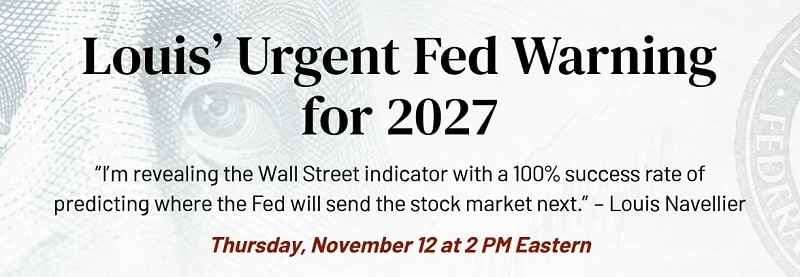
Navellier’s warning rests on a simple historical observation. Over the past 40 years, certain sequences of Federal Reserve policy actions have been followed by measurable changes in market breadth, leadership, and returns. He states that the current sequence carries a 100 percent historical success rate in signaling a major shift. The details of the precise indicator and the supporting data are reserved for the November 12 presentation, but the practical implication he draws is clear: the market is moving from a period in which gains were relatively broad into one in which gains become increasingly concentrated in a smaller number of stocks while a larger portion of the market experiences losses.
He describes the current environment as already containing a “hidden bear market.” According to Navellier, roughly 60 percent of the stocks in the S&P 500 are already in significant drawdowns even while the headline index has been supported by a narrower group of leaders. This divergence is not unique in market history, but Navellier argues it is becoming more pronounced as the Fed’s policy path continues to evolve. The post-midterm period produced an initial warning shot in the form of a sell-off. He expects the next phase of Fed action to amplify that dynamic beginning around November 19, 2026, and into the following year.
The practical consequence for most investors, in his view, is that passive exposure to the broad market or to a large basket of stocks becomes less effective. Index investors may experience a year of underperformance or outright losses even if a handful of high-quality names continue to rise. The opportunity, he says, lies in identifying the stocks that remain fundamentally strong and are positioned to benefit from the same forces that pressure the majority.
Stock Grader is the quantitative and fundamental screening system Navellier has used throughout his career. The system evaluates more than 6,000 stocks and assigns each a letter grade from A to F. A-rated stocks are labeled Strong Buy, B-rated stocks Buy, C-rated stocks Hold, D-rated stocks Sell, and F-rated stocks Strong Sell. The grades are produced by combining factors that Navellier’s research has found to be most correlated with subsequent stock returns. The system processes large volumes of data each year; the promotional materials state that more than $8 million has been invested in the data infrastructure that feeds the model.
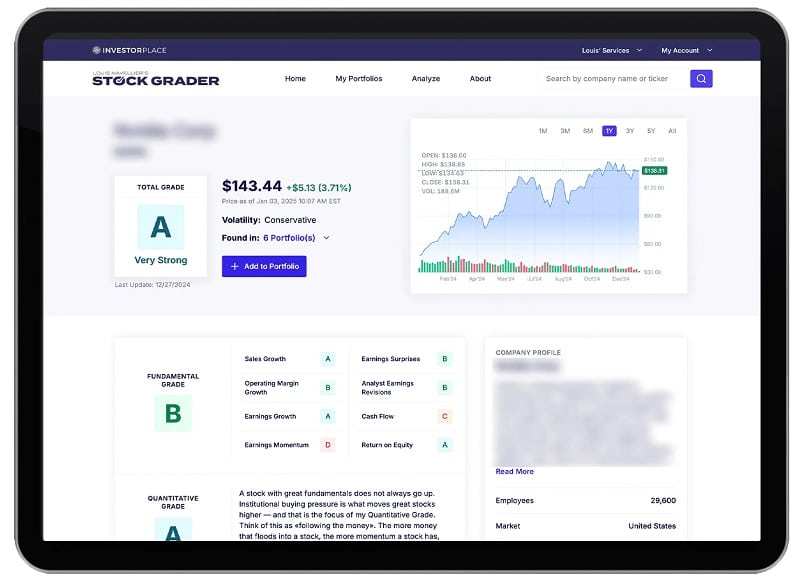
Navellier presents several performance claims for the system. Since 1998, the A-rated stocks identified by Stock Grader have collectively outperformed the S&P 500 by a ratio of 14 to 1. The system has assigned an A grade to a high percentage of the top-performing stocks in the S&P 500 for multiple consecutive years, including through both bull markets and significant drawdowns. In the current year, Stock Grader issued Buy or Strong Buy ratings on all 25 of the top-performing stocks. Specific examples cited in the event materials include a 254 percent gain on SanDisk over four months, a 276 percent gain on Seagate Technology over seven months, and a 466 percent gain on Micron.
These results are offered as evidence that the system is particularly useful in environments where market leadership narrows. When gains concentrate in fewer stocks, the ability to separate fundamentally superior names from the larger group of underperformers becomes more valuable. Navellier argues that the same characteristics that allowed Stock Grader to identify winners in previous difficult periods—dot-com excess, the 2008 financial crisis, the 2020 market bottom—make it well suited to the conditions he expects in 2027.
During the free access period leading up to the November 12 event, registrants can enter any ticker and receive the current Stock Grader rating. Navellier encourages investors to run every holding in their portfolios through the system promptly. The goal is to identify any names that already carry lower grades and may be vulnerable to further pressure as the “hidden bear market” expands.
Navellier began publishing research in 1980. His early work centered on the same combination of fundamental and quantitative factors that later became Stock Grader. In college he was assigned a project to construct a portfolio that mirrored the risk and sector weights of the S&P 500 using fewer than 500 stocks. The resulting portfolio unexpectedly outperformed the index, which led him to refine the approach into a systematic method for isolating stocks with superior return characteristics without necessarily increasing risk.
Over the subsequent decades he recommended a large number of stocks that produced multi-bagger returns. The event materials highlight early recommendations of Netflix, Amazon, and TJX Companies, among others, and state that he has recommended at least 171 stocks that would have produced a minimum tenfold return, with an average gain across those names exceeding 6,000 percent. He also cites a stretch of 14 consecutive years without a losing year in the strategies he managed.
Equally important to the current warning are the times he urged caution. The materials note that he warned of a sharp sell-off before Black Monday, described the late-1990s technology market as a bubble waiting to burst, recommended reducing risk ahead of the 2008 financial crisis, and flagged problems at Enron before its collapse. These episodes are presented as evidence that the same system that identifies winners can also highlight elevated risk.
Navellier’s clients over the years have included high-profile individuals, and his former management company grew to more than $1 billion in assets under management. One of his ETF portfolios received a top ranking from Morningstar. Access to the full Stock Grader system has historically carried a price of $2,500; the current free trial is an unusual offer tied to the urgency of the November 12 briefing.
The Agenda for the November 12 Presentation
The live event is structured to move from diagnosis to action. Navellier plans to open with an explanation of why the Fed’s next moves are setting the stage for 2027 as a whole. He will present the historical indicator that, in his analysis, has a perfect track record over the past 40 years of signaling the market’s subsequent direction after similar Fed actions. The goal is to give participants a clear sense of both the opportunity window and the period in which the current bull-market phase is most likely to end.
He will then introduce what he describes as a new application of Stock Grader specifically designed for the current environment. The approach is intended to help investors identify the shrinking group of stocks that continue to show superior fundamental characteristics while avoiding the growing number of names being pulled into the broader decline. The materials state that this is the first time he is sharing this particular method publicly.
Two free recommendations form a central part of the presentation. One is a stock that Stock Grader currently indicates could rank among the top performers of 2027. The other is a popular name that Navellier believes could rank among the worst performers of the year and that he recommends avoiding. Attendees are advised to have pen and paper ready to record the tickers.
Additional topics include why broad index investors are particularly exposed in 2027, a discussion of how a relatively small group of market participants can influence the behavior of larger institutions and policymakers, and practical guidance on cash positioning and portfolio construction in an uncertain rate environment. Navellier emphasizes that several of the necessary adjustments should be made before the end of the year rather than waiting until January.
A free report valued at $299 is promised to those who stay for the full presentation. The report is described as detailing a handful of stocks with elevated potential in 2027. Separate from the live event, registrants who provide a U.S. mobile number can also receive a Roadmap to 2027 VIP report that outlines Navellier’s larger predictions for the year and highlights two time-sensitive stocks.

Why the Timing Matters
Navellier stresses that the window for preparation is relatively short. He expects the next phase of Fed-driven pressure to become more visible beginning around November 19, 2026. Waiting until December or January, in his view, risks missing the period in which positioning can still be adjusted with relatively less friction. The free Stock Grader access is available immediately upon registration and remains open until the live event, giving participants several days to review their holdings.
The broader context he describes includes conflicting signals around artificial intelligence investment, warnings from large banks that equities appear expensive and over-concentrated, and the persistent influence of inflation on both policy and corporate decision-making. These factors, combined with the Fed’s trajectory, create an environment in which passive strategies that worked well in previous years may underperform. Selective, fundamentals-driven stock selection, by contrast, is presented as the more reliable path.
Practical Steps Recommended Before the Event
The promotional materials outline a clear sequence for anyone who wants to prepare:
- Register for the free November 12 event. Registration requires only an email address and carries no purchase obligation.
- Immediately use the temporary Stock Grader access to evaluate every ticker in the current portfolio. The emphasis is on identifying any names that already carry D or F grades and may be vulnerable.
- Review the free Roadmap to 2027 report if the VIP option is claimed.
- Add a calendar reminder for 2 p.m. Eastern on November 12 and plan to join a few minutes early to test audio and connection.
- Attend the full live session to receive the two stock recommendations and the additional free report.
Navellier closes many of the promotional pieces with a direct statement: investors who take these steps will be better positioned to navigate 2027 than those who remain fully exposed to broad market indexes without a filtering process. He notes that the last time a comparable market structure appeared, in 2022, he issued 22 recommendations that would have at least doubled and, in several cases, produced gains of six times or more—during a year when many investors experienced losses of 20 percent or greater.
Putting the Claims in Context
Independent research services routinely present strong historical performance numbers and urgent warnings. Readers should treat the specific return figures, the 100 percent historical accuracy claim, and the projected 2027 outcomes as statements made by Navellier and InvestorPlace rather than independently verified forecasts. Past performance of any screening system, including Stock Grader, does not guarantee future results. Market conditions change, data inputs evolve, and even high-quality quantitative models can experience periods of underperformance.
That said, the underlying observation about market breadth is not unique to this presentation. Periods in which a small number of stocks drive the majority of index returns while a large percentage of individual names lag have occurred repeatedly. When that pattern coincides with shifts in monetary policy, the result has often been a more selective environment in which stock-picking skill, or at least a disciplined filtering process, matters more than it does in broad, rising markets.
Navellier’s long career and the public nature of many of his past recommendations make it possible for interested investors to examine the historical record for themselves. The free access to Stock Grader and the free live presentation lower the cost of evaluating whether the current framework is useful for an individual portfolio.
What Attendees Can Expect to Walk Away With
By the end of the November 12 session, participants should have:
- A clearer understanding of the specific Fed-related indicator Navellier is watching and the historical pattern it has followed.
- A practical method for using Stock Grader to separate stocks that still show strong fundamental characteristics from those that appear vulnerable.
- The names and tickers of one stock he views as a potential 2027 leader and one he views as a potential major underperformer.
- Guidance on cash management and portfolio construction for an environment in which gains may remain concentrated.
- Access to additional written materials that expand on the live discussion.
Whether an individual investor ultimately acts on the recommendations is a personal decision that should take into account overall financial goals, risk tolerance, time horizon, and existing portfolio construction.
Final Considerations Ahead of the Event
The markets of late 2026 continue to display the mixed signals that have characterized much of the year: strong performance in a relatively narrow group of names, persistent inflation concerns, ongoing debate about the durability of artificial-intelligence-related capital spending, and a Federal Reserve that remains data-dependent. Navellier’s thesis is that these conditions are not random noise but the early stages of a more decisive shift that will define 2027 returns.
His proposed response is not to abandon equities but to become more selective about which equities to own. The free Stock Grader access and the November 12 presentation are offered as tools for making that selection process more systematic. Investors who find the historical claims and the current market diagnosis persuasive have a low-friction way to examine the system and hear the detailed argument. Those who remain skeptical can still use the free access period to test the grades against their own holdings and decide whether the framework adds useful information.
In either case, the central practical suggestion remains the same: review current positions with a critical eye before the next phase of Fed-related market pressure becomes more visible. The window Navellier describes is measured in weeks rather than months. For investors who want to hear the full case directly from him, the free event on November 12 at 2 p.m. Eastern is the scheduled opportunity.
Registration is available through the Fed Warning 2027 landing pages maintained by InvestorPlace. Attendees are advised to join a few minutes early, have a way to record ticker symbols, and stay for the full session to receive the promised materials. The combination of immediate tool access and the live briefing is designed to leave participants better prepared for the market conditions Navellier expects in 2027—whether those conditions ultimately prove as challenging for broad indexes as he forecasts or develop along a different path.