Stansberry Venture Technology is a high-end research service built around one simple idea: give regular investors a venture-capital-style edge in the most explosive areas of the market using publicly traded stocks. At the center of this service is analyst Dave Lashmet, a technology and biotech specialist who has spent nearly two decades tracking breakthrough innovations, traveling to conferences and briefings, and turning early technical insight into specific stock ideas.
What makes this particular moment unique is that his work is being framed around a massive catalyst: the SpaceX IPO, the rise of direct-to-cell satellite communications, and a U.S. government–backed laser network known as “Project Blackjack.” The current presentation positions Stansberry Venture Technology as the place to go if you want to move beyond the hype surrounding Elon Musk and SpaceX and focus instead on the little-known company that may be years ahead of Starlink in the race to build a space-based Internet.
The core promise of Stansberry Venture Technology
Stansberry Venture Technology is designed for a very specific type of investor: someone who wants exposure to early-stage, high-upside technology plays but prefers the liquidity and transparency of public markets over private venture capital. The service’s central promise is to identify “venture-style” opportunities in listed stocks—situations where a relatively small stake, such as 1,000 or 2,000 dollars, could potentially grow into 5,000, 10,000, or more if the thesis proves correct.
Dave describes this as building an “engine of growth” in your portfolio. The idea is not to put all your capital into speculative names, but to allocate a small slice—perhaps 5% to 10%—to carefully selected companies with massive upside potential. If even one or two of these positions become multi-baggers, they can materially influence your long-term wealth, while the losses from ideas that do not work out remain contained.
This approach mirrors how some of the wealthiest families and institutions invest. The presentation notes that family offices like the Rockefellers, large corporates like Comcast, and even the CIA (via its In-Q-Tel arm) have historically committed capital to early-stage companies with disruptive potential, fully aware that not every bet will pay off—but that the winners can be life-changing. Stansberry Venture Technology is essentially a way for an individual investor to adopt a similar philosophy without needing a venture fund or insider access.
Who is Dave Lashmet?
 A big part of the appeal of this advisory is the analyst himself. Dave Lashmet was the first analyst Porter Stansberry ever hired, and Porter credits him with finding more 1,000% winners over the past 20 years than anyone else he has worked with. Before joining Stansberry, Dave worked with NASA’s communications team and built his research style around going directly to the source—scientific conferences, government briefings, meetings with doctors, engineers, and executives—rather than relying on secondhand Wall Street reports.
The presentation highlights a few key elements of his track record:
-
He recommended Nvidia back in 2016, after visiting the company’s headquarters, giving readers a chance at gains over 1,400% as the stock became one of the world’s most important AI companies.
-
In the space sector alone, Dave has made thirteen recommendations with an average return of about 155% across open and closed positions as of March, with one name up over 1,100%.
-
He recommended Globalstar in 2024—before rumors and then confirmation that Amazon would buy the company—leading to a closed gain of around 357% for subscribers.
-
He has identified other big winners like Loxo Oncology (taken over by Eli Lilly), Maxar Technologies (bought out by private equity), and drug and technology plays tied to the GLP‑1 weight-loss boom.
Internally, Stansberry compares Dave’s five-year results to some of the world’s top hedge funds. The presentation claims that Stansberry Venture Technology’s average annualized return of around 39% over the last five years has beaten well-known managers like Bill Ackman and the Maverick Long Enhanced fund, and even outperformed a flagship Sequoia Capital venture fund. While those comparisons are presented in a marketing context and naturally come with disclaimers, they support the narrative that this is not a typical mass-market newsletter.
Testimonials from subscribers reinforce this picture. One reader notes that Dave’s Nvidia call “secured the retirement” of their family, another says “Lashmet has made me millions,” and a retired radiologist writes that his family “has become wealthy” because of Dave’s research, while acknowledging the high risks involved.
The SpaceX IPO, Starlink, and the Project Blackjack setup
The current presentation is structured around what the publisher calls “the mother of all IPOs”: the anticipated public offering of SpaceX. SpaceX has reportedly filed confidentially for an IPO, and financial press coverage has suggested a potential valuation around 1.75 trillion dollars—placing it alongside the largest companies in the S&P 500 by market value. At such a valuation, SpaceX would be priced more richly than nearly any major tech stock in history on a price-to-sales basis, far above the 1–5x revenue multiples typical of mature companies and even beyond the 10–20x levels seen in fast-growth names.

The key, according to Dave, is that SpaceX’s true business engine is not the rockets—it is Starlink. Starlink is the company’s satellite communications network, already serving millions of users around the world in places where conventional carriers cannot reach. The presentation cites figures such as:
-
21 million airline passengers and 20 million cruise-ship travelers receiving connectivity via Starlink in a year.
-
10 million regular users, with the customer base adding roughly 21,000 new users per day as of last December and the potential to double within a year.
-
Starlink accounting for up to 80% of SpaceX’s revenue, leading one analyst to say Starlink is “the only reason” the lofty valuation is defensible.
Starlink’s importance became impossible for governments to ignore during Russia’s invasion of Ukraine, when the destruction of phone towers and energy infrastructure left millions without connectivity—until Starlink was activated in the country, allowing people to send messages, call for help, and receive emergency warnings. For investors, this demonstrated how critical space-based communications could become, both commercially and militarily.
The next step in this evolution is direct-to-cell (D2C) technology. As Dave explains, D2C allows phones to connect via satellites for text and voice even when no traditional carrier signal is available. Apple’s SOS feature, which uses satellite connectivity to enable emergency messaging from remote locations, is an early proof of concept. Over time, this kind of technology could:
-
Replace or significantly disrupt traditional phone carriers like Verizon, AT&T, and T‑Mobile.
-
Bring Internet access to billions of people currently lacking reliable network coverage.
-
Enable new services through smartwatches and other devices, ultimately making “Dick Tracy”-style always-connected wearables possible without conventional carriers.
One analyst from Fierce Networks is cited as saying this segment could double in size every year for the rest of the decade—an exponential path that explains why Starlink is so pivotal to SpaceX’s valuation and why any superior technology is such a threat.
From dial‑up to lasers in orbit
To help readers visualize the opportunity, the presentation draws a parallel with the evolution of the terrestrial Internet. In the 1990s, dial‑up connections limited what users could do online, but companies like America Online still managed to turn early believers into millionaires: at its peak, AOL turned 10,000 dollars into roughly 2.8 million. Broadband, via cable providers like Charter Communications, later turned that same stake into hundreds of thousands of dollars as Americans upgraded from dial‑up. Then fiber optics came along, and Corning—the maker of the actual glass cables—saw returns that could have turned 10,000 dollars into more than 1.7 million.
Dave argues we are at a similar “dial‑up stage” in space. Apple’s current satellite network can support SOS messages and basic communication, but not high-bandwidth tasks like streaming. Meanwhile, Starlink is using high-frequency V‑Band radio signals between satellites to provide Internet in the sky—good enough to deliver free Wi‑Fi on some long-haul flights, but still ultimately limited by the constraints of radio.
The logical next step is lasers. By using light rather than radio waves to transmit data between satellites, a network can massively increase its capacity—what engineers call bandwidth. Dave uses a simple analogy: radio is like a garden hose, while lasers are more like the Mississippi River. You can even “split” the light into different colors (wavelengths), sending separate streams of data simultaneously, which adds still more capacity. In rough terms, he estimates that laser-based systems can handle about ten times more bandwidth initially, with the potential to reach two thousand times broader capacity over time.
This is where Project Blackjack comes into play. In 2018, the U.S. Defense Advanced Research Projects Agency (DARPA)—the same organization that helped birth GPS, the Internet (as ARPANET), and technologies like Siri—decided to pursue a laser-based satellite network to create a superfast, secure communications grid in space. That project, called Project Blackjack, awarded a major contract to a small, virtually unknown company to design and deploy this network.
According to Dave’s research, this company:
-
Is launching a laser-based network in the near term.
-
Offers capacity roughly ten times greater than what Starlink can currently deliver.
-
Has been effectively “accelerated” by DARPA’s funding and technical support, putting it potentially five years ahead of SpaceX in this crucial area.
-
Already has contracts with at least one G7 nation and has been approved as a supplier for President Trump’s “Golden Dome” space-defense project.
If Starlink is the AOL or early broadband of space, Project Blackjack’s company is being positioned as the early fiber-equivalent—an infrastructure play that could define the next generation of connectivity.
Why a tiny company could sit at the heart of the SpaceX story
The presentation makes a bold but simple argument: if SpaceX’s valuation and future are heavily tied to Starlink, and if a smaller company controls technology that is ten times more powerful than Starlink’s current system, then Elon Musk cannot ignore it. The company already has at least one contract with SpaceX, which suggests the relationship is not purely theoretical.
History shows what can happen when a small firm controls a crucial asset that SpaceX or its rivals need:
-
EchoStar owned spectrum (airwaves) that Starlink wanted for its global network. SpaceX struck a massive deal to secure access, and EchoStar’s stock surged from about 15 dollars to 127 dollars in less than a year—a gain of more than 700%, creating over 110,000 dollars in profit for someone with 1,000 shares.
-
Globalstar operated a satellite network used by Apple’s SOS system, giving it a direct link to hundreds of millions of iPhone users. When reports emerged that SpaceX was interested in buying the company, and later when Amazon stepped in as a buyer, the stock more than quadrupled over less than two years. Stansberry Venture Technology subscribers were guided into and out of Globalstar for a gain of around 357%.
With Project Blackjack, the stakes are arguably even higher. Unlike spectrum or an existing satellite constellation, the laser-based network could become the backbone of space-based broadband and defense communications—a core infrastructure layer rather than an add-on. That helps explain why Dave believes:
-
Governments may resist letting SpaceX buy this company outright, preferring to keep it as an independent competitor and strategic supplier.
-
Multiple powerful players—G7 governments, NATO, and large tech companies—could be involved in contracts, partnerships, or co-funding arrangements.
-
A single announcement out of an event like the G7 Leaders’ Summit could move the stock 100% or more in a very short time if it suddenly becomes “front-page news.”
According to the presentation, two major world leaders already discussed this company by name at a prior G7 meeting as they mapped out plans for a secure direct‑to‑cell network, and one G7 country has awarded it a significant military contract.
The June 15 G7 catalyst and the SpaceX IPO window
Timing is a central part of the current pitch. Dave and publisher Matt Weinschenk repeatedly emphasize that the window around the upcoming G7 Leaders’ Summit and the expected SpaceX IPO represents an unusually concentrated cluster of catalysts.
Three key dates or drivers stand out:
-
The early stage of the space-investment boom
Investment in the broader space industry has recently doubled over a three-month period, reflecting both institutional and retail enthusiasm. Companies tied to satellite networks, launch services, and space-based data are attracting more capital and attention as the market anticipates the SpaceX IPO. -
The June 15 G7 summit
This meeting of the leaders of the U.S., Canada, U.K., Germany, France, Japan, Italy, and the EU is presented as a potential inflection point. Dave believes it could bring news about expanding Project Blackjack’s scope beyond its initial contract, possibly to include broader NATO or multi-country adoption, especially given the emphasis on secure communications and increased defense spending. -
The transition of Stansberry Venture Technology into an Alliance‑only service
At midnight on June 15, the publisher plans to move Dave’s work behind a 34,000‑dollar Alliance paywall, making this the last opportunity to subscribe directly at a substantially lower price. The argument is that after this date, only the firm’s most committed and well-capitalized clients will have ongoing access to new recommendations.
Taken together, these factors create a sense of urgency. If you accept the premise that the next phase of the space race could mint multiple 10‑baggers over the coming years, then being positioned before headlines around Project Blackjack and SpaceX dominate financial media may give you a significant advantage.
What you get when you subscribe
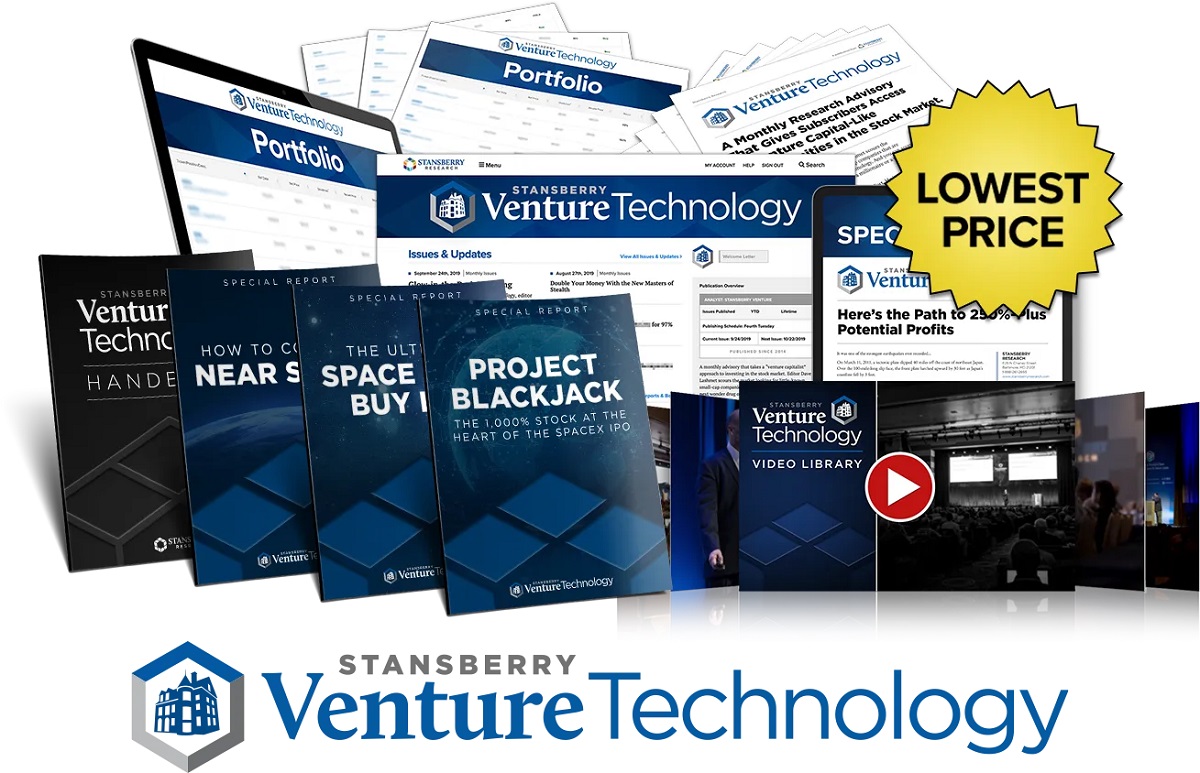
The current offer is structured as a comprehensive package built around both the Project Blackjack story and the broader space‑technology opportunity. When you join Stansberry Venture Technology under this promotion, you receive:
One year of Stansberry Venture Technology
This is the flagship advisory itself. Each month, Dave sends out a new “Venture Opportunity,” typically a stock recommendation or major update aimed at giving you a venture-capital-style edge in an emerging technology trend. The emphasis is on underfollowed, high-upside situations where a modest initial stake can potentially multiply if the thesis plays out.
Over the life of the service, Dave has written more than 300 research reports and has given readers nearly 50 different chances to double, triple, or 10x their money. Many of those wins have come from spotting companies whose products or technologies were vital to larger players—like Eli Lilly’s need for Loxo Oncology’s cancer drugs, or the defense sector’s use of Maxar’s satellite imaging.
Featured special report: “Project Blackjack – The 1,000% Stock at the Heart of the SpaceX IPO”
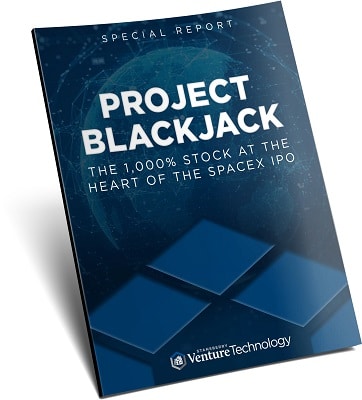
This is the centerpiece of the presentation. Inside this report, you get:
-
Dave’s full research on the company’s technology, contracts, and competitive position relative to Starlink and other rivals.
-
His analysis of the potential upside, including why he believes it could be the “single biggest investment opportunity in the space sector today” and a candidate for a 1,000% return over time if events unfold as he expects.
This is billed as his final public buy call, making it a sort of capstone recommendation from his years of work in space and advanced communications.
Bonus report: “The Ultimate Space Race Buy List”

In addition to the Project Blackjack stock, Dave provides a report containing seven more space-related recommendations drawn from the Stansberry Venture Technology model portfolio. These companies span different parts of the space stack, from communications to infrastructure and services, and Dave says he believes there is at least one more potential 10‑bagger among them.
Given that his average gain across all space-sector recommendations has been around 155%, the report is framed as a way to build a diversified “space infrastructure portfolio” rather than put everything into a single name. If you believe the space economy is at the 1995 stage of the Internet, this report is essentially your early-stage buy list.
Bonus report: “How to Conquer Near Space”
“Near space” is roughly 80 to 160 miles above Earth, a zone packed with satellites and critical infrastructure but often overlooked by mainstream investors. In this third report, Dave highlights another company already holding contracts with DARPA and the European Space Agency, positioning it as a key player in the commercialization and defense use of near-space operations.
For investors, this offers yet another angle on the broader theme: not just the laser backbone or the primary communications constellations, but the companies that provide vital services in the crowded orbital environment where much of this activity occurs.
Member-exclusive: The Stansberry Venture Technology Handbook
The handbook is essentially Dave’s playbook. It explains his philosophy for identifying high-upside opportunities, managing risk, and thinking like a venture capitalist in public markets. It covers how he sources ideas—from conferences and lab visits to government presentations—and how he converts complex scientific and technical information into simplified investment theses.
For serious readers, this is useful not just as a guide to his picks, but as a framework you can apply to your own research. It helps you understand why certain themes appear in the portfolio and how to evaluate them with a long-term mindset.
Immediate access to Dave’s full model portfolio (40+ open recommendations)
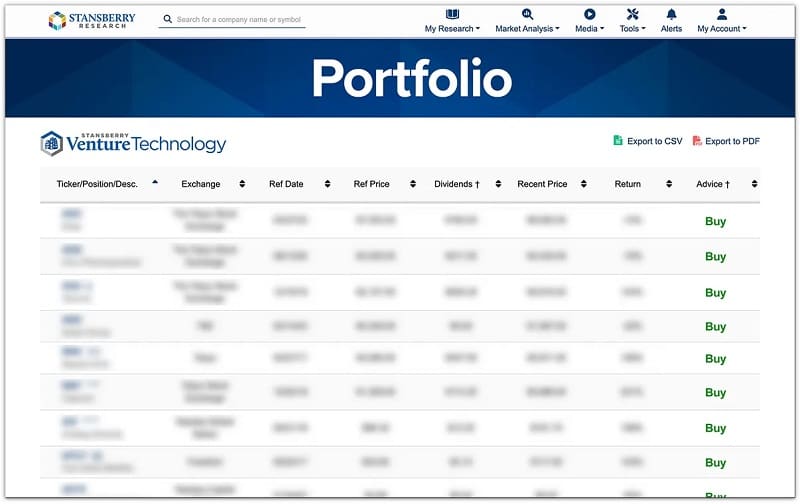
On joining, you are not limited to the new SpaceX-related ideas. You also get immediate access to every open position in the Stansberry Venture Technology model portfolio. These positions span multiple sectors Dave follows closely, including:
-
Defense and aerospace.
-
Biotech and cutting-edge pharmaceuticals.
-
AI infrastructure and other advanced technology enablers.
The value here is that you can build a portfolio from multiple themes at once. Some ideas may be early in their life cycle; others may already have meaningful gains and be in a “hold” phase. The presentation notes that across all open and closed positions, Dave has given readers nearly 50 chances to at least double their money over the past 12 years.
Immediate access to Dave’s library of special reports and videos
As a former college professor and seasoned presenter, Dave is described as one of the most engaging speakers on Stansberry’s staff. Subscribers get access to his backlog of:
-
Special reports on past big themes (like the GLP‑1 weight-loss drug revolution).
-
Video presentations where he breaks down complex technology topics into understandable language.
This archive can be especially helpful if you want to understand how his thinking has evolved and how he has navigated previous cycles in biotech, tech, and space.
Stansberry’s 30-day satisfaction guarantee
The offer is backed by a 30-day satisfaction guarantee. That period covers the run-up to and immediate aftermath of the June 15 G7 summit, as well as early market action around the SpaceX IPO theme. During that window, you can:
-
Read the full Project Blackjack report.
-
Review all bonus reports and the handbook.
-
Study the model portfolio and archival research.
If you decide the service is not for you, you can request a refund within those 30 days under Stansberry’s stated policy. While that does not remove investment risk, it does give you time to evaluate the depth and style of the research.

Pricing, scarcity, and why the publisher is raising the bar
Stansberry Venture Technology is presented as one of the firm’s most exclusive and successful products. According to the publisher, only about 1% of Stansberry readers have ever had access to Dave’s work, in part because the firm deliberately keeps the audience small so that his recommendations do not become overcrowded. The message is that if tens of thousands of people piled into the same small caps at once, subscribers would not see the full upside.
Given the five-year track record and the concentration of big winners in space, biotech, and other sectors, the publisher has decided to move Stansberry Venture Technology into the company’s Alliance membership—a package that grants access to all Stansberry services and carries a price tag of about 34,000 dollars. Going forward, the only way to access Dave’s new research after the deadline will be to join this high-end group.
The current promotion, however, allows new readers to join Stansberry Venture Technology directly at a fixed price of 2,499 dollars for a year. The key points of the offer are:
-
The 2,499 price is said to be the “lowest and final entry price” this membership will ever have.
-
If you join before the stated deadline, you can lock in that rate for renewals, insulating you from future price hikes.
-
After June 15, any new subscribers will need to pay the full Alliance rate, which is more than ten times higher, to get access to the same research.
From a subscriber’s perspective, the decision comes down to whether you value a steady stream of high-risk/high-reward technology ideas enough to justify that upfront cost. If you are an active investor in disruptive themes, one or two successful positions over a multi-year period could theoretically pay for many years of subscription fees. But if you are unlikely to act on the ideas, the service is not designed to be cheap entertainment—it is built for proactive, risk-tolerant investors.
Who Stansberry Venture Technology is (and is not) for
The presentation itself is quite candid about the kind of reader the service is targeting. Dave says bluntly that only a small fraction of people are psychologically prepared to act on the type of ideas he presents. These investors:
-
Accept that early-stage, high-upside opportunities come with substantial uncertainty and volatility.
-
Are comfortable with a strategy where some positions fail or stagnate, while a minority drive most of the returns.
-
Prefer to be early, even if it means short-term discomfort, rather than wait for mainstream confirmation and miss much of the upside.
The service is not meant for:
-
Ultra-conservative, income-focused investors who prioritize capital preservation and steady dividends.
-
People who want a simple buy-and-hold list of blue chips or index funds.
-
Readers who are uncomfortable with drawdowns or with owning stocks in emerging technologies that may face regulatory, competitive, or execution risks.
In contrast, it is ideal for readers who:
-
Follow sectors like space, AI, defense, biotech, and next-generation communications with genuine curiosity.
-
Want a research partner who digs into technical and scientific detail but translates it into clear, actionable investment theses.
-
Understand the power of asymmetric risk/reward and want a curated “engine of growth” to complement a more conservative core portfolio.
If you see yourself in that description, Stansberry Venture Technology is tailored to your mentality. It is built for people who would have wanted help recognizing AOL, Charter, Corning, or Nvidia early—not just buying them after they hit front-page status.
Why consider subscribing now
If you strip away the marketing language, there are a few grounded reasons someone might seriously consider subscribing to Stansberry Venture Technology at this particular moment:
-
You want a structured way to participate in the space communications and laser-network story.
Rather than guessing your way through the SpaceX narrative, the Project Blackjack report and associated buy list give you a specific roadmap of companies connected to the same trend—but with potentially far more upside than SpaceX stock itself. -
You value a proven thematic framework.
Dave has a documented history of spotting big trends early—from GLP‑1 drugs to obscure space plays that were later acquired or revalued. If you like the idea of having someone constantly scanning biotech labs, defense briefings, and tech conferences on your behalf, this service gives you a direct pipeline to that work. -
You want access before the service becomes exclusive to Alliance members.
Once the transition to the 34,000‑dollar Alliance-only model is complete, there is no direct, lower-priced path to new recommendations. Locking in access at 2,499 while the window is open is financially meaningful if you plan to follow the research for several years. -
You appreciate having a concentrated “engine of growth” inside a broader portfolio.
The engine-of-growth concept is a proven framework in wealth management: a small slice of high-upside exposure can create far-reaching effects on your overall portfolio outcomes. Stansberry Venture Technology is specifically designed to identify and manage that slice for do‑it‑yourself investors. -
You want more than just stock tips.
Between the handbook, the special reports, the archive of research, and the ongoing monthly letters, you are getting an education in how to think about frontier technology investing—not just a ticker symbol and a buy-up-to price.
Conclusion
Stansberry Venture Technology is not aimed at everyone, and it does not pretend to be. It is a premium, high-risk, high-upside advisory service for investors who want to get in front of major technological shifts and are comfortable with the volatility and uncertainty that come with that ambition. The current focus on SpaceX, Starlink, and Project Blackjack showcases exactly what the service does best: dig beneath the headlines, identify the small company with outsized strategic importance, and present a clear, researched case for why it could be a multi-bagger.
If you are the kind of investor who feels a twinge of regret looking back at early-stage opportunities you missed—whether in the early Internet, in Nvidia’s AI surge, or in the first wave of GLP‑1 winners—this is the type of research that can help you avoid repeating that pattern. You are not buying certainty; you are buying access to a disciplined, battle-tested process of finding and evaluating asymmetric opportunities.
With the SpaceX IPO drawing global attention to space infrastructure, the G7 summit looming as a potential catalyst for Project Blackjack, and the service itself about to move behind a much higher-priced membership tier, the case for acting now is straightforward. If you have both the risk tolerance and the curiosity to explore this corner of the market, Stansberry Venture Technology offers a rare chance to plug into one of the most aggressive, opportunity-focused research pipelines available to individual investors today.
FAQ: Stansberry Venture Technology & Project Blackjack
What is Stansberry Venture Technology?
Stansberry Venture Technology is a premium research advisory that targets early-stage, high-upside technology stocks, with a focus on sectors like space, defense, biotech, and AI infrastructure. It aims to give subscribers a venture-capital-style edge using publicly traded companies.
Who is Dave Lashmet and why should I listen to him?
Dave Lashmet is the editor of Stansberry Venture Technology and a long-time Stansberry analyst known for deep, on-the-ground research. He’s credited with finding multiple 1,000%‑type winners and a long list of doubles and triples in cutting-edge tech and biotech.
What exactly is Project Blackjack?
Project Blackjack is a Pentagon-backed laser-based satellite network originally developed under DARPA. In the current offer, Lashmet spotlights a little-known public company he says is at the core of this project and believes it could be a potential 10‑bagger tied to the SpaceX/Starlink story.
How is this better than just buying SpaceX when it IPOs?
The thesis is that SpaceX’s valuation already bakes in huge expectations, while the smaller companies supplying critical technology—like the one at the center of Project Blackjack—may offer much greater upside from a lower base, with more room for re‑rating as news hits.
What do I get if I subscribe now?
You get a year of Stansberry Venture Technology, the Project Blackjack special report, additional space‑race and near‑space reports, Dave’s model portfolio with 40+ open recommendations, his research archive, and a 30‑day satisfaction window to review everything before committing long term.