

Venturing into AI stocks can be as exhilarating as it is complex. Whether you’re a seasoned investor or new to the tech landscape, understanding fundamental analysis is crucial. This technique goes beyond numbers, exploring the underlying health of AI companies and their potential for growth. In this guide, we’ll unravel how fundamental analysis can help identify lucrative opportunities in AI stocks, weigh its benefits, and caution against potential risks. Equipping yourself with these insights ensures you make informed, strategic decisions that could lead to significant returns in the constantly evolving world of artificial intelligence investments.
Key Highlights
- AI stocks require thorough fundamental analysis to understand growth potential and market dynamics.
- Integrating AI tools with traditional analysis offers deeper insights and predictive accuracy.
- AI-driven financial platforms enhance risk assessment through sophisticated modeling techniques.
- Balancing technological trends with financial insights is crucial for strategic investment.
- Understanding market volatility helps navigate potential risks in AI investments effectively.
Understanding Fundamental Analysis for AI Stocks
Investing in artificial intelligence stocks can seem daunting, but understanding fundamental analysis simplifies things. This analysis focuses on evaluating a company’s inherent value by examining various fundamental data points, such as financial metrics and company financials. It allows investors to identify potentially profitable stocks by deciphering the sustainability of a company. By delving into detailed financial modeling and insight-driven investment research, investors apply fundamental techniques tailored explicitly for AI companies. The journey begins with decoding what makes up fundamental data for AI stock analysis, followed by appreciating the indispensable role of financial metrics when evaluating these companies.
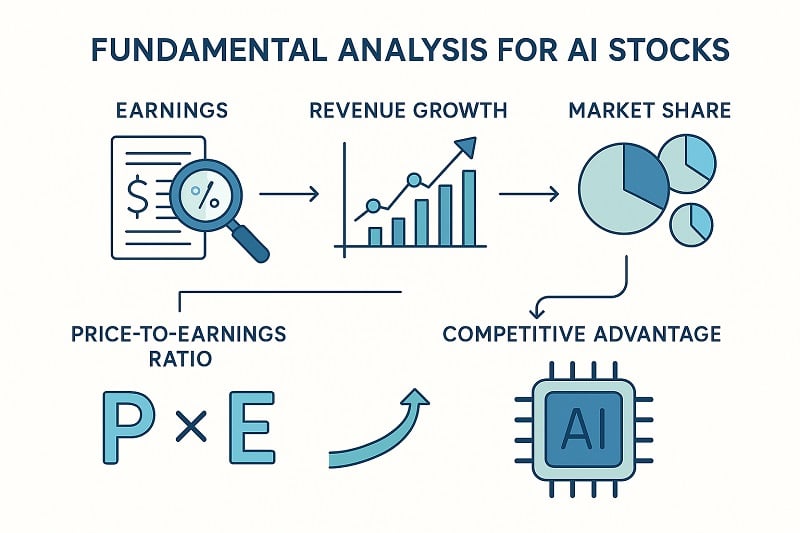
What Constitutes Fundamental Data in AI Stock Analysis?
When dipping your toes into AI stock analysis, grasping what fundamental data entails is crucial. Fundamental data is a combination of quantitative and qualitative elements that provide insight into an AI company’s financial health and future potential. This includes financial metrics such as revenue, profit margins, and earnings growth, which give a snapshot of how effectively a company manages its resources. But it doesn’t stop at financial numbers. Analysts also delve into qualitative aspects like market position, competitive advantage, and technological innovation – all crucial for understanding an AI firm’s potential to disrupt and dominate its sector.
Beyond numbers, the narrative surrounding an AI company is significant. Is the leadership team forward-thinking? Are their AI-based solutions setting industry benchmarks? These questions help build a comprehensive narrative supported by the data collected. In dynamic sectors like AI, understanding a firm’s technological vision is vital. Fundamental research therefore becomes a hybrid exercise, balancing the hard data with nuanced company evaluations to identify those well-poised for growth.
Moreover, the use of ai-enhanced fundamental analysis tools has become increasingly popular. These tools facilitate more sophisticated investment research by enabling deeper dives into subtle data patterns that might go unnoticed with traditional methods. This makes it easier to place financial modeling into a broader strategic context, ultimately fostering better risk assessment and earning predictions. So, when engaging with AI stocks, equip yourself with both robust data-gathering techniques and an understanding that insightful analysis often goes beyond the surface.
The Role of Financial Metrics in Evaluating AI Companies
Financial metrics serve as the backbone of evaluating AI companies’ stock potential. These metrics, derived from company financials, offer essential insights into both current performance and future prospects. Metrics like return on equity, debt-to-equity ratios, and cash flow statements are tools that help investors understand how efficiently a company is operating. They shed light on the core health and operational efficiency of a company, translating raw fundamental research data into understandable stock evaluation terms.
By focusing on these financial ratios, investors can make informed judgments about the intrinsic value of an AI company. The stock evaluation process relies heavily on uncovering whether a company can sustain growth in revenue and profits while managing risks and liabilities. With AI companies, this often involves understanding not just financial performance but how these metrics indicate a company’s technological execution and adoption in the market.
Furthermore, many investors are now leveraging ai-enhanced fundamental analysis techniques to model scenarios and predict future performance trends. This includes using algorithm-based financial modeling to simulate market conditions and assess a company’s strategic responses. Such models help in presenting a clear picture of a company’s adaptability to ever-changing tech landscapes and market fluctuations.
Ultimately, effective investment research should not only compile financial metrics but also weave them into a comprehensive analysis framework. This approach enables investors to foresee potential market shifts and identify investment opportunities before they become apparent to the broader market. By aligning fundamental analysis with a deep understanding of AI’s unique landscape, investors can better position themselves to capitalize on opportunities without falling prey to unexpected risks.
Integrating Artificial Intelligence in Stock Analysis
Incorporating artificial intelligence into stock analysis can revolutionize how investors evaluate potential investments. AI-enhanced fundamental analysis techniques seamlessly integrate with traditional methods, offering a deeper dive into company health via advanced data analytics. Understanding how AI tools augment these processes provides actionable insights, transforming abstract data into clear investment strategies. Exploring the practical benefits offered by AI technologies lets investors devise robust strategies for effective decision making. Whether you’re looking at financial modeling or analyzing industry shifts, AI offers crucial advantages for informed investment research, reshaping the landscape for stock evaluation in profound ways.
How AI Enhances Traditional Fundamental Analysis Techniques
Artificial intelligence significantly amplifies traditional fundamental analysis by introducing algorithms that process vast datasets with speed and precision. This integration of AI facilitates real-time analysis of financial metrics, allowing investors to react swiftly to market shifts. AI doesn’t just streamline data crunching; it also identifies patterns and insights that might otherwise go unnoticed with manual methods. Technologies like machine learning allow for more precise predictions concerning a company’s financial health, offering a comparative advantage in the crowded field of stock analysis. These AI-enhanced techniques bring a new layer of depth to understanding underlying fundamental data, uncovering opportunities that a traditional approach might overlook.
For instance, AI technologies can analyze correlations between a company’s financial indicators and external factors like market trends at incredible speeds. Investors benefit from this rapid analysis by accessing a multi-dimensional view of investment prospects, which supports better strategic decisions. AI tools can evaluate thousands of variables synchronously, thereby paving the way for sophisticated financial modeling that’s highly adaptable to market conditions. With AI, investment research becomes not only faster but also more nuanced, presenting investors with comprehensive scenarios to better navigate risks and opportunities.
Moreover, the enhanced precision of AI tools means they can assist investors in dissecting complex financial data into understandable narratives. This allows for a detailed yet simplified evaluation of a company’s strategic position and potential industry impact. By integrating AI into traditional methods, investors aren’t just relying on past data but are equipped to forecast trends and outcomes more accurately. This positions them advantageously, enabling proactive investment strategies that align with long-term growth potential. Consequently, AI brings about a paradigm shift, elevating the reliability and depth of fundamental analysis for better investment outcomes.
Key AI Tools for Investor Analysis and Decision Making
Utilizing key AI tools in investor analysis equips professionals with the ability to unlock insights that drive decisive action. Platforms equipped with artificial intelligence capabilities allow investors to synthesize vast amounts of data, generating real-time updates and analysis. These insights refine the investment research process, making AI-enhanced fundamental analysis a cornerstone of modern financial evaluation. Tools like natural language processing (NLP) help decipher complex financial documents to extract pertinent information quickly and accurately. This improves the efficiency of analyzing companies and forecasting their technological trajectories in the highly volatile AI sector.
AI-driven financial modeling platforms not only facilitate quicker data interpretation but also provide a level of flexibility that traditional techniques lack. Investors can simulate various economic and market scenarios, assessing how different factors might impact the performance of AI-driven companies. This capability supports better risk mitigation strategies by allowing investors to visualize potential outcomes and plan accordingly. As technology evolves, these tools continuously update and refine their algorithms, keeping pace with rapid market changes and ensuring informed decision making.
Furthermore, the integration of machine learning models automates the process of detecting anomalies and trends in stock evaluation metrics, providing an extra layer of security and predictability. This automation lets investors focus on generating strategic insights rather than getting caught up in data collection. With AI platforms, you can delve deeper into the industry landscape, understanding how different technologies within the AI realm will influence company valuations and market dynamics. AI therefore serves as both a guiding light and a protective shield, enabling investors to make confident, informed decisions that align with their investment strategies while staying ahead of the curve in a technologically advanced market.
Benefits of Fundamental Analysis in AI Investments
Fundamental analysis plays a pivotal role in the realm of AI investments, offering a comprehensive approach to dissecting a company’s core value and growth indicators. By examining company financials and financial metrics, investors can gain critical insights into long-term growth prospects and potential risks associated with AI stocks. This analysis also aids in effective stock evaluation, enabling investors to make informed decisions based on solid data and ai-enhanced fundamental techniques. From investment research to financial modeling, the benefits are vast and practical, helping investors navigate the complex landscape of AI stocks with greater confidence.
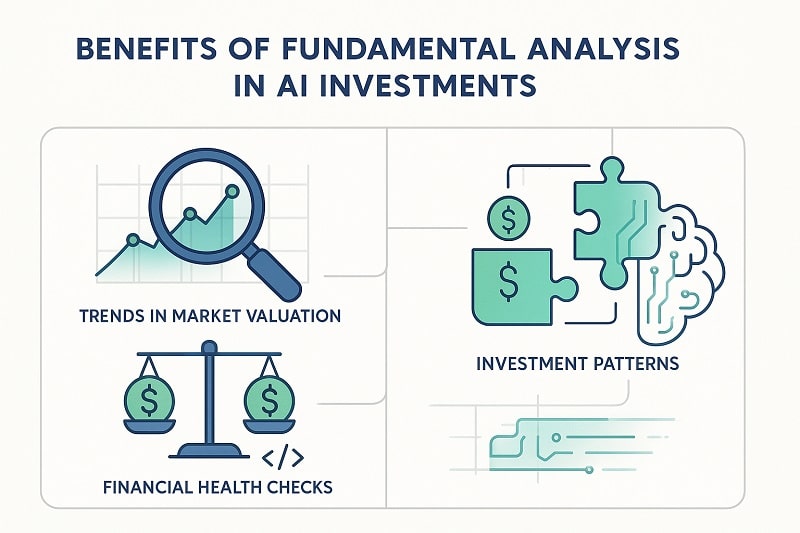
Identifying Long-Term Growth Potential in AI Stocks
Unpacking the long-term growth potential of AI stocks requires a deep dive into their undercurrents, blending both quantitative and qualitative fundamentals. This process starts with investment research that scrutinizes a company’s financials, examining metrics such as earnings growth, revenue streams, and profit margins – all essential for assessing a company’s capacity to sustain growth over time. Financial modeling plays a crucial role here, providing a framework to simulate future earnings scenarios based on historical performance and current market trends. The use of ai-enhanced fundamental analysis tools can reveal hidden growth trajectories that aren’t immediately visible through traditional techniques, by leveraging algorithmic insights to pinpoint emerging opportunities within AI’s rapid technological advancements.
Moreover, understanding the broader market and technological landscape is instrumental in identifying long-term growth prospects. Fundamental analysis extends beyond numbers to include industry position and competitive advantage. AI companies poised for substantial growth typically demonstrate a robust technological pipeline and vision, driving them ahead of the market curve. Assessing these elements offers investors valuable insights into future market leaders, ensuring they align their portfolios with firms set to thrive. Further, artificial intelligence plays a transformative role in deciphering complex data, making investment research more nuanced and detailed. Its ability to process vast amounts of market data in real time refines predictions about future growth potential, giving investors a strategic edge.
Additionally, the narrative around AI companies, marked by innovation and strategic foresight, significantly influences their valuation and growth potential. Questions around their market influence, technological impact, and leadership team’s direction are cornerstone aspects that, when answered, provide a cohesive picture of an AI stock’s future trajectory. Investors, thus, benefiting from a thorough stock evaluation process, can better gauge how a company’s technology portfolio will contribute to sustained revenue and profit growth. By integrating financial metrics with qualitative insights, investors craft a strategic framework that effectively anticipates long-term gains, keeping their assets aligned with the most promising AI ventures.
Opportunities for Risk Mitigation with AI Analysis
Risk mitigation is an integral aspect of any investment strategy, particularly within the volatile AI sector. Through ai-enhanced fundamental analysis, investors are better equipped to identify and counteract potential risks by tapping into advanced financial modeling and investment research techniques. These sophisticated tools assess financial metrics with precision, offering a comprehensive risk profile of potential investments. By dissecting company financials, investors can identify red flags and potential vulnerabilities, such as excessive debt, cash flow inconsistencies, or overvalued equity, that might pose long-term threats.
Moreover, AI-driven analysis enables investors to act proactively rather than reactively. Investing in AI stocks necessitates an understanding of not only the present financial health but also the possible future fluctuations within the tech landscape. AI technologies excel in stress-testing investment scenarios, simulating various market conditions to predict how external factors might influence stock performance. This predictive capability empowers investors to make data-driven decisions, prioritizing investments that align with both their risk tolerance and growth aspirations.
Another major benefit lies in AI’s ability to streamline the process of gathering and analyzing crucial financial data. Automating elements like risk modeling allows for quicker and more accurate decisions, freeing investors to focus on strategic analysis and opportunity identification. With ai-enhanced techniques, investors can juxtapose current market data against historical trends, unveiling patterns that help in forecasting potential pitfalls and aligning investment strategies accordingly. Risk mitigation also includes ongoing monitoring, where AI continuously evaluates data, ensuring investors remain informed of any abrupt shifts or emerging threats.
Thus, fundamental analysis fortified with AI insights positions investors strategically, allowing them to navigate the AI investment landscape with enhanced clarity and assurance. By understanding the inherent risks and leveraging the predictive power of AI, investors are armed not only with detailed insights but also with effective tools to balance risks against potential rewards. The key lies in constant adaptation and vigilance, ensuring portfolios are resilient against industry volatilities while capitalizing on the transformative potential of AI-driven innovations.
Risks Associated with Investing in AI Stocks
Investing in AI stocks offers exciting opportunities but also entails inherent risks that investors must navigate strategically. Understanding market volatility and technological uncertainty is crucial, as these factors can significantly impact your portfolio. Balancing fundamental insights with technological trends positions investors to manage these risks while staying informed of potential disruptions. Investors need to be well-versed in fundamental analysis to evaluate AI stocks effectively and utilize financial modeling to anticipate future market movements. It’s vital to keep an eye on technological trends that could impact company valuations, ensuring informed decisions amidst the ever-evolving AI landscape.
Understanding Market Volatility and Technological Uncertainty
When investing in AI stocks, comprehending the nuances of market volatility and technological uncertainty becomes essential. Market volatility is often amplified in the tech sector, particularly with AI companies that are constantly vying for the next big breakthrough. Rapid innovations can lead to substantial market shifts, creating potential risks for investors who aren’t prepared for such changes.
Financial modeling plays a crucial role in this context, allowing investors to simulate various market scenarios and test how different factors might impact their investments. This approach lets investors visualize the potential consequences of their investment decisions, offering insights into how market volatility can affect stock prices. By leveraging financial ratios and detailed financial data from companies, one gains a comprehensive understanding of an AI firm’s financial health, helping to mitigate the risks associated with market uncertainties.
Moreover, technological uncertainty adds another layer of complexity. As AI technologies continue to evolve, predicting which innovations will succeed or fail becomes challenging. Fundamental analysis enables investors to assess a company’s technological pipeline and innovation capacity, ensuring a strategic approach to navigating these uncertainties. Investment research and detailed insights into a company’s technological trajectory provide investors with valuable information to anticipate whether a company’s AI efforts will translate into market success or not.
Ultimately, understanding market volatility and technological uncertainty in the realm of AI stocks requires a blend of thorough research, informed analysis, and strategic foresight. By equipping themselves with robust fundamental analysis techniques and staying vigilant about industry advancements, investors can optimize their portfolios to balance risks while capitalizing on AI’s transformative potential.
Balancing Fundamental Insights with Technological Trends
Balancing fundamental insights with ever-shifting technological trends is a critical strategy for any investor looking to thrive in the AI stock arena. Fundamental analysis provides a solid foundation for evaluating a company’s financial health and long-term viability through key financial ratios, but recognizing the influence of technological trends adds a dynamic element to this evaluation. These trends can redefine how companies operate and generate value, and investors must integrate this knowledge into their investment strategies.
One of the primary benefits of blending fundamental analysis with an understanding of technological trends is the ability to anticipate potential market shifts. By utilizing ai-enhanced investment research tools, investors can track emerging trends in real-time, allowing for timely adjustments to their investment approach. This proactive stance helps align portfolios with companies poised to leverage technological advancements, while also offering a safeguard against sudden market disruptions.
Investors should delve beyond traditional financial modeling to include insights into a company’s adaptability to technological changes. This involves assessing how well an AI company is positioned for innovation, its market impact potential, and its competitive edge within the sector. By understanding these factors, investors gain a comprehensive perspective that goes beyond numbers, incorporating the strategic vision and technological foresight of a company.
Additionally, the continuous nature of technological evolution in AI demands that investors remain informed and agile. Stagnation could render even fundamentally sound companies obsolete if they fail to adapt to technological advancements. Therefore, investors must integrate ongoing technology assessments into their regular analysis, ensuring that their investments align with both current market conditions and anticipated technological progressions.
In conclusion, balancing fundamental insights with technological trends requires a multifaceted approach that combines solid financial analysis with a forward-thinking view of technological developments. By adopting such a strategy, investors can better position themselves to capture growth opportunities and mitigate risks, ultimately fostering more resilient and prosperous investment portfolios in the AI sector.
Investing in AI stocks via fundamental analysis equips you with a solid foundation to make informed decisions. By evaluating the company’s financial health, growth potential, and market position, you reduce the risks associated with volatile markets. Understanding these metrics empowers you to capitalize on opportunities and diversify your investment portfolio while mitigating potential losses. Dive deeper into market analysis or download our comprehensive guide to further enhance your investment strategy. Remember, informed investing is smart investing, embrace the power of knowledge and elevate your AI stock investments to new heights.
FAQ: Fundamental Analysis Tips for AI Stocks: How It Works, Benefits, and Risks
What is fundamental analysis, and why is it crucial for investing in AI stocks?
Fundamental analysis involves evaluating a company’s financial health and growth potential. It’s crucial for AI stocks because it helps investors identify profitable opportunities by assessing both quantitative data, like revenue and margins, and qualitative factors, such as market position and innovation.
How do AI-enhanced tools improve fundamental analysis in stock evaluation?
AI-enhanced tools process large datasets quickly, uncovering patterns and insights that might be missed manually. This enhances predictive accuracy, helping investors make informed decisions faster and with greater precision, especially in a rapidly evolving AI market.
What role do financial metrics play in evaluating AI companies’ stock potential?
Financial metrics like return on equity and cash flow statements are essential for assessing an AI company’s operational efficiency and growth prospects. These metrics translate raw data into understandable insights, guiding investment decisions by highlighting strengths and vulnerabilities.
How can AI technologies transform traditional stock analysis methods?
AI technologies integrate with traditional methods by offering advanced data analytics capabilities. They provide real-time analysis, identify subtle data patterns, and facilitate more nuanced financial modeling, thereby offering a deeper and more adaptive approach to stock analysis.
What are the risks associated with investing in AI stocks, and how can they be mitigated?
AI stocks are subject to market volatility and technological uncertainty. Mitigating these risks involves using fundamental analysis to assess a company’s financial health and conducting ongoing technology evaluations to anticipate changes. AI-driven tools assist in modeling various scenarios to prepare for potential market shifts.