
In early 2026, with markets sending mixed signals and AI continuing to reshape entire industries, many investors are searching for strategies that can deliver consistent gains without the stomach-churning risk of long-term buy-and-hold positions. Enter Mosaic Trader, a brand-new research service from MarketWise featuring Josh Baylin and his proprietary Shadow Data Indicator. Launched just days ago, this service promises to identify short-term trading opportunities in tech stocks—specifically those poised for significant moves within 90 days—by tapping into data sources that most investors overlook.
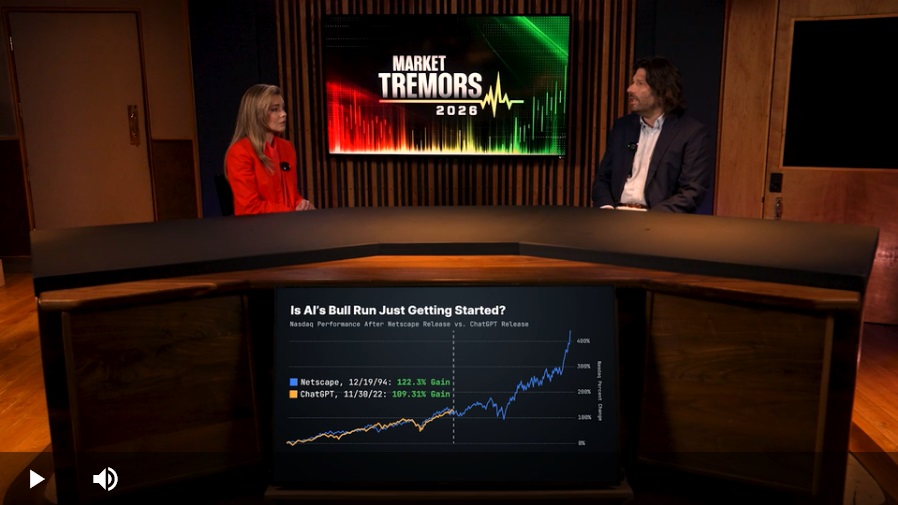
This review examines whether Josh Baylin’s research holds up, based on the detailed claims, backtested results, and real-world examples shared during a recent MarketWise Market Tremors 2026 exclusive event. We’ll break down the strategy, its performance metrics, the man behind it, and how the service works in practice. By the end, you’ll have a clear picture of what Mosaic Trader offers and whether it could be a fit for your investing approach in today’s volatile environment.
Who Is Josh Baylin and Why Should You Pay Attention?
Josh Baylin brings a rare combination of experience to the table. He spent years as an investigative reporter before moving into finance, eventually tracking $200 million positions at SAC Capital—one of the most successful and envied hedge funds in history, founded by Steve Cohen. Baylin earned invitations to high-profile events, including the White House Correspondents’ Dinner, and rubbed shoulders with figures like Elon Musk, Steve Ballmer, Larry Page, and Sergey Brin. He has been featured in Forbes, Bloomberg, and TechCrunch, and even provided expert testimony before a Congressional committee on technology.
What makes his background stand out is the breadth of his career. He has traveled to 37 countries across six continents in pursuit of market edges. He consulted for the billionaire Koch brothers and turned down job offers from not one but two legendary traders: George Soros and Steve Cohen. Instead of staying on Wall Street, Baylin moved his family 2,700 miles away to build something new.
His early days as a reporter taught him to dig for hidden truths. That investigative mindset carried over into finance. At SAC Capital, he learned to hunt for informational edges that others missed. Later, he worked at a SoftBank-backed robotics firm and even founded a wearables technology company. These experiences gave him firsthand insight into the technological changes that happen behind the scenes long before they reach the public.
Baylin’s career also includes prescient calls. He predicted the iPhone’s impact when most analysts doubted Apple. He foresaw the rise of bitcoin and the “SaaSpocalypse” that hit software stocks in early 2026. Now, with Mosaic Trader, he is bringing that same edge to everyday investors for the first time.
Understanding the Shadow Data Indicator: The Heart of Mosaic Trader
At the core of Mosaic Trader is the Shadow Data Indicator, or SDI. This is not a traditional stock-picking system based on earnings calls, SEC filings, or mainstream media headlines. Instead, it monitors a specific type of market data that most people outside the tech and investing worlds do not even know exists.
The SDI draws from the “mosaic theory” of investing. This approach gathers small, publicly available but obscure pieces of information and assembles them into a complete picture. Baylin discovered a sprawling online repository containing technical data voluntarily shared by 1.8 million companies. By parsing this data with a custom algorithm, the SDI isolates anomalies that signal when innovative tech companies are about to release something new and exciting.
These anomalies often appear weeks before any public announcement. The system then issues clear buy signals for stocks likely to rise dramatically in the next 90 days. It is designed to capitalize on the stock market’s well-documented tendency to overreact to news in the short term before prices revert to the mean—a pattern confirmed by studies such as the 1998 paper “A Model of Investor Sentiment” by Nicholas Barberis and colleagues.
Importantly, the SDI focuses almost exclusively on tech stocks. It currently scans 145 specific companies each week. When a signal triggers, Baylin personally reviews it against strict criteria before sharing it with subscribers. The strategy is straightforward: get the signal, hold for 90 days, sell, and repeat. This short holding period reduces exposure to long-term market swings and helps lock in gains before overreactions fade.
The indicator is emotionless. It does not read The Wall Street Journal, follow political headlines, or panic during sell-offs. It simply looks for those specific anomalies in the data. This makes it particularly well-suited to the current market, where individual stock volatility has reached absurdly high levels and dispersion—the gap between winners and losers—is widening.
Backtested Performance: What the Numbers Show
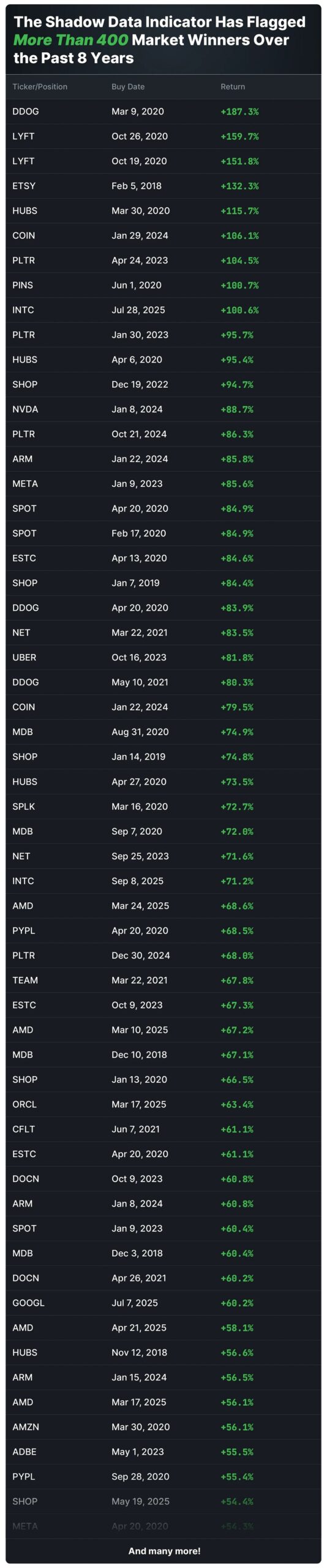
One of the most compelling aspects of the Shadow Data Indicator is its extensive backtesting. According to the data presented, the system identified at least 442 winning trades from December 2017 through the present, even during the bear markets of 2018, 2020, and 2022. That averages roughly one signal per week.
The performance metrics are striking. In backtests, a $10,000 position in each trade would have grown to $617,808 over that period. The strategy delivered 68% annualized gains for eight years—far outpacing the S&P 500’s roughly 12.6% hedge-fund average in 2025 and the index fund’s long-term returns.
The Sharpe Ratio, a key measure of risk-adjusted returns, provides further insight. The S&P 500 index fund has posted a Sharpe Ratio of about 0.69 since late 2019. A ratio above 1 is considered solid; 1.5 to 2 is outstanding. The SDI achieved 3.36—meaning it generated roughly five times the return of the S&P 500 for the level of risk taken.
Here are some specific examples from the backtested track record:
- Datadog (DDOG): Flagged in March 2020, right before the COVID market collapse, it delivered a 187% gain in 90 days.
- Lyft (LYFT): Picked up in October 2020 amid pandemic restrictions, it surged 159% (or 160% in one cited instance) in 90 days.
- Etsy (ETSY): Signal fired in February 2018 after a CEO shakeup sent the stock down 14%. It rose 132% in the following 90 days.
- Coinbase (COIN): Multiple signals, including one that produced a 106% gain.
- Pinterest: 100% to 101% gain in 90 days.
- HubSpot: Multiple signals averaging around 40% per trade, with one at 115%–116%.
- Nvidia (NVDA): 88% to 89% gain in 90 days.
- Palantir (PLTR): Nearly 105% in 90 days.
- Intel (INTC): 105%–106% gain.
- Shopify (SHOP): 94% gain.
- Confluent: 61% gain.
- Rackspace Technology: 442% in one week after an AI partnership announcement (though the system focuses on 90-day windows).
- Sandisk: Nearly 1,000% in six months.
These wins occurred across bull markets, bear markets, and periods of extreme uncertainty. In 2020, the strategy more than doubled portfolios—over six times the market’s return that year and more than ten times the average hedge fund. Even in the brutal 2022 bear market, it delivered an average 15% gain per trade in just 90 days, beating the S&P 500’s long-term average annual return of roughly 10% (6.7% inflation-adjusted).
The win rate stands at 64%, higher than the 55%–63% typical for top hedge-fund traders, according to Steve Cohen’s own comments. Not every trade wins, of course—losses are part of any strategy—but the short 90-day horizon and focus on anomalies help limit downside.
The 2026 Market Environment: Why Timing Matters Now
The launch of Mosaic Trader comes at a pivotal moment. The AI bull market, now in its fourth year, continues to drive record capital spending by Big Tech. Data-center construction is at all-time highs. Yet uncertainty is also at historic levels. The World Uncertainty Index shows today’s conditions dwarfing events like 9/11, the 2008 financial crisis, or COVID.
Individual stock volatility is extreme. Hedge funds are shorting at the fastest pace in years, and even household names like Nvidia, Meta, and Amazon have seen selling from top investors such as Ray Dalio, Ken Griffin, and Stanley Druckenmiller. Software stocks experienced the “SaaSpocalypse” earlier this year, with single announcements wiping out tens of billions in market cap—IBM dropped 13% in one day after an Anthropic update, and credit-card stocks lost over $100 billion on a fictional research report.
Baylin calls this “dispersion.” Winners will deliver extraordinary gains; losers will be devastating. Volatility is no longer a bug—it is the system. The S&P Global Hedge Fund Outlook for 2026 labels it “the new normal.” In this environment, traditional long-term buy-and-hold approaches carry hidden risks. A single press release can turn a “safe” stock like IBM into a loser.
The SDI thrives here. By focusing on short-term overreactions and getting out after 90 days, it reduces exposure while capturing upside from creative destruction—the same force that replaced Blockbuster with Netflix or Sears with Amazon, only now accelerated by AI. Baylin notes that AI still represents only single-digit percentages of global IT spending, suggesting the trend has plenty of room to run.
He also highlights opportunities on both sides of the market. During the 2022 bear market, the system found 16 winners, including Spotify (41% gain). It flagged buys just before rebounds in names like Meta (86% in 90 days after layoffs) and even during the depths of COVID.
How Mosaic Trader Delivers the Strategy to Subscribers
Mosaic Trader is designed for simplicity. Subscribers do not get the algorithm itself. Instead, every Tuesday, Baylin sends an email with:
- New buy recommendations (when signals trigger, after his personal vetting).
- Updates on open positions.
- Market commentary.
- Sell alerts at the 90-day mark or earlier if conditions change.
A model portfolio lists current recommendations. A user guide walks new members through brokerage setup and execution. The service averages more than one signal per week historically, though some weeks may have none or multiple.
Charter members receive this for one full year. The regular price is $6,000, but a limited-time offer reduces it to $2,500—a 58% discount available only to new members who act before the window closes. This offer includes an extended 90-day satisfaction guarantee (triple the typical length) and the ability to apply any refund as credit toward other MarketWise services.
Valuable Bonuses Included with Charter Membership
To make the offer even more compelling, new members receive several free reports and resources valued at thousands of dollars:
- The Shadow Data Indicator Manifesto: Explains the exact data source and how the system works.
- The Shadow Data Indicator “Heavy Hitters” Report: Details stocks with multiple successful signals and up to 100% win rates, averaging 52% gains.
- A Veteran’s Guide to Bubble Investing: Contrarian advice on navigating AI valuations, drawing on insights like George Soros’s approach to bubbles.
- The Mosaic Trader Blacklist: Stocks to avoid, including the current top pick (Atlassian, ticker TEAM) that Baylin urges investors to sell immediately.
- Josh Baylin’s Top Tech Plays: Long-term ideas for tech portfolios.
- “Secrets of the Hedge-Fund World”: A $1,000-value video conversation with a former SAC colleague revealing insider perspectives.
- Elite One-Stock Presentation: A 35-minute pitch session (valued at $2,999) featuring Baylin’s top AI/robotics idea, previously attended by paying audiences.
- Mosaic Trader Charter Member Rewards Card: $1,000 credit toward any other Stansberry Research service.
These bonuses provide immediate value while the core weekly service delivers ongoing opportunities.
Expert Endorsements and Comparisons to Other Systems
MarketWise experts have reviewed the SDI and offered strong praise. Dr. David Eifrig, CEO of MarketWise and a former Goldman Sachs investment banker, called it the most important broadcast of the year and backed it with an unprecedented company-wide guarantee.
Marc Chaikin, creator of the Power Gauge indicator used on Bloomberg terminals, noted that the SDI uses entirely different data and flags opportunities his system might miss.
Louis Navellier, with decades of quant experience, described it as one of the most innovative approaches he has seen.
TradeSmith CEO Keith Kaplan and Altimetry’s Joel Litman echoed the sentiment, highlighting how the short-term focus complements their longer-horizon strategies.
Importantly, the SDI does not compete directly with other MarketWise tools like the Power Gauge, Stock Grader, or Altimeter. It looks at unique metrics, so signals may align sometimes (as with Etsy in 2018) or diverge beneficially (as with Lyft in 2020, which was neutral on the Power Gauge yet delivered 159% gains). Subscribers can cross-check recommendations without conflict.
Risks, Guarantees, and Practical Considerations
No strategy is risk-free. Past performance does not guarantee future results, and the SDI has losing trades. All investing involves the possibility of loss, and investors should only risk capital they can afford to lose. The 90-day holding period helps manage risk, as does the high Sharpe Ratio, but market conditions can change.
The 90-day satisfaction guarantee allows new members to test the service—including the first several recommendations—risk-free. If unsatisfied, a full refund can be applied as credit to any MarketWise publication. This reflects strong confidence in the research.
Mosaic Trader is not day trading. It requires no constant monitoring, no options, and no advanced tech skills. A standard brokerage account and the ability to read emails are sufficient. Weekly updates keep members informed without overwhelming them.
Is Josh Baylin’s Mosaic Trader Research Legit?
Based on the backtested results, Baylin’s hedge-fund pedigree, the transparent methodology rooted in public data, and endorsements from respected market veterans, Mosaic Trader appears to be a legitimate, well-constructed research service. The Shadow Data Indicator’s focus on short-term anomalies addresses a genuine gap in most retail strategies—especially in a year when volatility is expected to remain elevated and dispersion will separate winners from losers.
The service is brand new, so real-time results will unfold over the coming months. However, the eight years of rigorous backtesting across varied market conditions, the 64% win rate, and the exceptional risk-adjusted returns provide a solid foundation. Baylin’s track record of accurate tech predictions adds credibility.
For investors comfortable with short-term trading and seeking an edge in tech, Mosaic Trader offers a structured, hedge-fund-quality approach previously unavailable to the public. The current charter offer—with its substantial discount, extended guarantee, and rich bonuses—lowers the barrier to entry and provides a low-risk way to evaluate the service during what Baylin calls the greatest quick-fire moneymaking environment of his 25-year career.
If you have money in the market and want a strategy designed for today’s uncertain conditions—one that could potentially deliver double-digit or triple-digit gains in 90-day windows while limiting long-term exposure—Mosaic Trader merits serious consideration.
The window to join at the special charter rate is open only briefly.
The coming year promises both challenges and opportunities. With tools like the Shadow Data Indicator, investors have a chance to stay ahead of the curve rather than react to it. Whether Mosaic Trader becomes a core part of your portfolio depends on your goals and risk tolerance—but the research behind it stands on a foundation built over decades at the highest levels of technology and finance.
FAQ about Josh Baylin’s Mosaic Trader Research
What exactly is Mosaic Trader and how does the Shadow Data Indicator work?
Mosaic Trader is Josh Baylin’s new weekly research service that delivers actionable short-term stock recommendations powered by his proprietary Shadow Data Indicator (SDI). The SDI scans obscure, publicly available technical data from 1.8 million companies to detect hidden anomalies that signal which tech stocks are likely to surge in the next 90 days. It uses the mosaic theory — assembling small, overlooked pieces of information — to identify opportunities before the broader market reacts. Subscribers receive clear buy alerts, model portfolio updates, and sell signals via weekly emails, making it simple to follow without needing advanced technical skills.
Is Josh Baylin’s research legitimate, and what kind of results has the Shadow Data Indicator shown?
Yes, Josh Baylin’s research is legitimate. He has a proven 25-year track record, including tracking $200 million positions at SAC Capital (Steve Cohen’s elite hedge fund), turning down offers from George Soros and Steve Cohen, and making accurate calls like the iPhone revolution and the 2026 SaaSpocalypse. In rigorous backtesting since December 2017, the SDI has identified 442 winning trades with 68% annualized returns, a 64% win rate, and a world-class Sharpe Ratio of 3.36. Examples include 187% on Datadog, 159% on Lyft, 132% on Etsy, and 105% on Palantir — all within 90-day windows, across bull, bear, and volatile markets.
How does the 90-day trading approach work, and why is it ideal for 2026?
The strategy is straightforward: receive a vetted buy signal, hold the stock for approximately 90 days, then sell. This timeframe is based on extensive research showing markets tend to overreact to news in the short term before reverting to the mean. In today’s high-volatility, high-dispersion environment — where individual stocks swing dramatically while the broader market remains uncertain — the 90-day window allows you to capture quick gains from AI-driven disruptions while minimizing long-term exposure and risk. It thrives on volatility rather than fighting it.
What does a Mosaic Trader charter membership include and how much does it cost?
A one-year charter membership is currently available for $2,500 (58% off the regular $6,000 price) for a limited time. You receive weekly recommendations, a live model portfolio, the Shadow Data Indicator Manifesto, Heavy Hitters Report, Blacklist of stocks to avoid, Veteran’s Guide to Bubble Investing, Top Tech Plays, exclusive video bonuses worth over $5,000, and a $1,000 Rewards Card. Every new member also gets a full 90-day money-back satisfaction guarantee (with refund as MarketWise credit), giving you time to evaluate the first recommendations risk-free.
Who is Mosaic Trader best suited for, and what are the risks?
Mosaic Trader is ideal for investors with some market experience who want a hedge-fund-quality edge for short-term tech opportunities without day trading or options. It suits retirees, working professionals, and anyone seeking higher returns in a volatile 2026 market while limiting long-term risk. All investing involves risk, including the potential loss of principal. Past backtested performance does not guarantee future results. The service is designed with a strong risk-adjusted approach (high Sharpe Ratio), but you should only invest money you can afford to lose and consult a financial advisor if needed.