Quantum computing is rapidly evolving from a laboratory curiosity into a high‑stakes investment theme, drawing serious capital from Wall Street and Big Tech alike.
Quantum computing market in 2026
The quantum computing market has shifted from a niche R&D theme to one of the fastest‑growing segments in enterprise technology. Global quantum revenues grew from about 1.3 billion dollars in 2024 to 3.52 billion dollars in 2025, and are projected to reach roughly 20.2 billion dollars by 2030 and 72 billion dollars by 2035. This implies a compound annual growth rate above 40 percent through the end of the decade, far outpacing most other tech verticals.
Commercial demand is coming from high‑value use cases where classical computing hits a wall: portfolio optimization in finance, molecular simulation in drug discovery, materials science, logistics and cybersecurity. In 2025, healthcare and pharma accounted for about 28 percent of the market, financial services 22 percent, manufacturing and materials around 18 percent, and cybersecurity roughly 15 percent, with AI and machine learning still small but growing the fastest. In other words, quantum is still early, but real budget is already being committed by blue‑chip enterprises.
Technologically, we are still in the NISQ era—noisy intermediate‑scale quantum—where systems typically span 100 to 2,000 qubits with limited error correction. Major vendors such as IBM, Google and IonQ are focused on scaling qubit counts, extending coherence times and demonstrating “quantum advantage” on specific workloads before the end of the decade. From an investor’s standpoint, that means you are paying for future optionality and roadmaps rather than near‑term earnings.
Funding and commercialization timelines
Despite periodic risk‑off phases in growth tech, quantum computing remains well funded at both the startup and corporate level. Venture capital firms deployed over 2 billion dollars into quantum startups in 2024, a roughly 50 percent year‑over‑year increase, while corporates like IBM, Microsoft, Alphabet and Amazon continue to invest heavily through internal R&D and strategic funds. IBM alone has earmarked about 500 million dollars for quantum‑related startup investments via IBM Ventures.
On timelines, most credible roadmaps cluster around three phases. The current NISQ phase (2024‑2026) is about proving focused use‑case advantage with 100‑2,000 qubit systems. Between roughly 2027 and 2029, leaders are targeting “quantum advantage” at scale, with 2,000‑10,000 qubit systems and early fault‑tolerance for specific workloads; for example, IBM is aiming to demonstrate fault‑tolerant modules around 2027. Full fault‑tolerant, broadly commercial machines—10,000‑100,000 qubits and beyond—are generally pushed into the early‑2030s, with universal million‑qubit systems more of a post‑2034 story.
For public‑market investors, that means quantum revenues over the next five years will stay small in absolute terms, but can still move individual stocks dramatically because expectations and contract wins get quickly priced in. Funding levels today look adequate to bridge most serious players into the late‑2020s, although weaker balance sheets may be vulnerable if capital markets tighten.
Tariff wars and China risk
Quantum computing sits right in the crosshairs of the ongoing technology and tariff confrontation between the United States and China. Both countries view quantum as strategically critical for encryption, defense, and economic competitiveness, and have backed local champions with state support. On the U.S. side, that manifests as export controls and scrutiny of chip, cryogenic and photonics supply chains; on the Chinese side, it often means subsidies and preferential procurement for domestic vendors.
Publicly traded Western quantum firms sourcing specialized hardware or selling into China could face incremental friction if tariff pressures escalate. SpinQ Technology, for instance, is a privately funded Chinese quantum company with government backing and ambitions for global expansion. If relations deteriorate further, we could see tighter controls on cross‑border quantum collaborations, hardware shipments, or cloud‑based access. That risk tends to be highest for smaller firms heavily exposed to Chinese manufacturing or customers, and lower for diversified giants like IBM, Microsoft and Alphabet with broad global footprints.
For investors, the practical takeaway is to treat China exposure as a distinct risk factor when sizing positions in pure‑play quantum names, especially those relying on Chinese fabs, components or customers. Diversified tech conglomerates and global ETFs help mitigate single‑country risk by spreading exposure across multiple geographies and supply chains.
7 Great Quantum Computing Stocks for 2026
Below are seven liquid, U.S.‑listed or widely followed quantum names that offer a mix of pure‑play exposure and diversified blue‑chip upside. This is not personalized advice—use it as a research starting point.
1. IonQ (NYSE: IONQ)
IonQ is widely regarded as the leading pure‑play trapped‑ion quantum hardware company in public markets. Its trapped‑ion systems operate near room temperature, with very stable qubits and long coherence times, which are attractive for complex algorithms. IonQ has already commercialized access to its machines through major clouds such as Microsoft Azure, Google Cloud and AWS Braket, creating an early recurring‑revenue base.
Strategically, the company has moved to vertically integrate by acquiring the semiconductor foundry SkyWater Technology in a deal valued at about 1.8 billion dollars, giving it tighter control over quantum chip production. It has also expanded into quantum networking and space‑related quantum tech through acquisitions like Capella Space, Skyloom and Qubitekk. The stock delivered gains in the 75‑88 percent range in 2025 and now carries a multi‑billion‑dollar market cap, but remains volatile and unprofitable, making it a high‑beta way to play the theme.
2. D‑Wave Quantum (NYSE: QBTS)
D‑Wave is the pioneer of quantum annealing, a specialized architecture aimed at solving optimization problems—think route planning, scheduling, or certain financial risk models. Because annealers address a narrower class of problems than universal gate‑model machines, D‑Wave has been able to commercialize faster, with enterprise customers in logistics, manufacturing and financial services already deploying its systems.
The company’s Advantage2 platform has attracted roughly 30 million dollars in commercial and academic contracts heading into 2026, supporting a thesis of growing real‑world usage. The stock surged about 345 percent in 2025 and still carries an analyst consensus that implies roughly 70‑plus percent upside from recent levels, albeit with high volatility. Investors should view QBTS as a speculative satellite position that monetizes near‑term optimization use cases rather than a broad computing platform.
3. Rigetti Computing (NASDAQ: RGTI)
Rigetti develops superconducting quantum processors and full‑stack cloud services, positioning itself directly against IBM and Google in gate‑model hardware. Its Quantum Cloud Services platform is accessible both directly and via Amazon Braket and Microsoft Azure, providing multiple distribution channels. Rigetti has also secured multi‑year research partnerships with government and commercial customers, signaling growing external validation.
The stock was one of the most explosive quantum names in 2025, rising around 5,700 percent during that year before giving back close to 18 percent in January 2026 as speculative tech sold off. That path underscores the opportunity and the risk: Rigetti is still early in revenue ramp and faces intense competition, so position sizing and risk controls are crucial.
4. Quantum Computing Inc. (NASDAQ: QUBT)
Quantum Computing Inc. (often shortened to QCi) works at the intersection of hardware and software, focusing on photonics‑based quantum solutions that can operate at room temperature with relatively low power draw. Its “entropy computing” approach and emphasis on sensing and optimization differentiate it from superconducting and trapped‑ion peers.
The share price has shown extreme behavior, with gains exceeding 1,800 percent in certain recent periods but also sharp pullbacks, reflecting both speculative interest and limited fundamentals. For investors, QUBT can be viewed as a high‑volatility call option on photonic architectures and quantum‑enhanced AI and cybersecurity applications, and should generally occupy only a small slice of a diversified portfolio.
5. IBM (NYSE: IBM)
IBM is the most established large‑cap quantum infrastructure provider, and it gives investors exposure to the theme inside a mature, cash‑generating tech conglomerate. Its IBM Quantum platform, Qiskit open‑source software stack, and long‑dated hardware roadmap form one of the deepest quantum ecosystems in the market. IBM has publicly targeted demonstrating “scientific quantum advantage” with fault‑tolerant modules around 2027, and its Nighthawk processor already delivers 120 qubits with a new coupler design that supports more complex circuits.
Looking further out, IBM plans processors like Kookaburra—a multi‑chip design reaching into the thousands of qubits—and extends its roadmap to around 2033 with a goal of machines capable of executing roughly 1 billion gates on up to 2,000 qubits integrated with classical supercomputers. For investors, IBM’s appeal is that quantum is just one of several growth drivers, which can smooth out the inevitable volatility from this still‑emerging segment.
6. Alphabet (NASDAQ: GOOGL)
Alphabet’s Google Quantum AI group is best known for its 2019 “quantum supremacy” experiment using the Sycamore processor, and it remains at the frontier of superconducting qubit research. The division is now advancing the Willow processor and sees a path toward commercial‑grade quantum solutions around 2030, especially in domains like chemistry, machine learning and optimization.
The strategic edge for Alphabet is its ability to integrate quantum error‑correction research with its massive AI, data‑center and cloud franchises. By embedding quantum into Google Cloud and pairing it with classical accelerators like TPUs and GPUs, Alphabet can roll out hybrid services as the hardware matures. Analysts still see more than 20 percent upside in the core Alphabet equity, with quantum representing a long‑dated but potentially very lucrative call option.
7. Microsoft (NASDAQ: MSFT)
Microsoft is pursuing a differentiated hardware architecture built on topological qubits, which, in theory, should be more stable and easier to scale than conventional superconducting designs. Its Azure Quantum platform unifies quantum resources, classical high‑performance computing and AI accelerators into a single cloud environment, making it easier for enterprises to experiment with quantum‑inspired workloads today.
On the software side, Microsoft has developed the Q# programming language and Majorana‑based qubit concepts under its “Majorana 1” architecture, underscoring a full‑stack ambition similar to IBM’s. As with Alphabet and IBM, the investment case largely rests on Microsoft’s diversified AI and cloud growth, with quantum adding high‑upside optionality over the next decade.
Snapshot: key quantum stocks
| Stock | Ticker | Type of exposure | Why it stands out |
|---|---|---|---|
| IonQ | IONQ | Pure‑play trapped‑ion | Early revenue via cloud, vertical integration, strong ecosystem. |
| D‑Wave Quantum | QBTS | Pure‑play annealing | Real enterprise contracts, optimization focus, high beta. |
| Rigetti | RGTI | Pure‑play superconducting | Huge 2025 run, strong partnerships, direct IBM/Google rival. |
| Quantum Computing Inc. | QUBT | Photonics/entropy | Room‑temperature tech, speculative upside in sensing/AI. |
| IBM | IBM | Diversified blue chip | Deep roadmap, quantum plus mainframe, AI and services. |
| Alphabet | GOOGL | Diversified growth | Quantum plus leading AI, cloud and ad businesses. |
| Microsoft | MSFT | Diversified growth | Topological qubits, Azure Quantum, AI and cloud scale. |
Best quantum and “quantum‑tilted” ETFs
If you want quantum exposure without betting on single names, specialized and adjacent ETFs can help.
Defiance Quantum ETF (NASDAQ: QTUM)
The Defiance Quantum ETF is one of the purest listed vehicles for quantum and quantum‑related technologies. It holds about 78 companies spanning quantum hardware, software and enabling technologies like advanced semiconductors and AI, charges a 0.40 percent expense ratio, and managed around 3.5 billion dollars in assets as of early 2026. Since launching in 2018, QTUM has delivered a cumulative return of roughly 394 percent, including a one‑year gain of about 42 percent through January 2026.
Because QTUM mixes pure‑play quantum names with diversified tech leaders, it offers a balanced way to express a quantum thesis without taking on single‑stock blow‑up risk. It can work as a core quantum holding for most retail portfolios, especially when combined with broader tech or market index funds.
VanEck Quantum Computing UCITS ETF (QNTM)
VanEck’s Quantum Computing UCITS ETF, ticker QNTM, caters primarily to European investors but is also accessible through some global platforms. It holds roughly 30 companies focused on quantum computing and related technologies, with an expense ratio of about 0.49 percent and assets in the 250 million euro range.
Compared with QTUM, QNTM is more concentrated, giving more weight to specialized quantum firms. That can increase volatility but also magnify upside if the sector continues to re‑rate higher through the late‑2020s.
ARK Autonomous Technology & Robotics ETF (ARKQ)
ARKQ is not a dedicated quantum fund, but it gives indirect exposure through its focus on advanced robotics, AI, autonomous systems and enabling hardware. It holds around 40 names, charges a 0.75 percent fee and had about 1.8‑2.0 billion dollars in assets with one‑year returns near 40 percent in the latest period.
Because many of ARKQ’s holdings invest in R&D for quantum‑relevant technologies—from chips and sensors to industrial automation—it can complement a more targeted quantum ETF like QTUM or QNTM. However, its higher fee and thematic breadth mean it is best used as a tactical satellite, not a core holding.
Other notable ETFs
The Spear Alpha ETF (SPRX) and broader tech funds like the iShares U.S. Technology ETF (IYW) and Global X Artificial Intelligence & Technology ETF (AIQ) also provide partial quantum exposure. SPRX runs a high‑conviction portfolio of around 25 names at a 0.75 percent fee, with an 82 percent one‑year return, while IYW and AIQ give lower‑octane exposure across megacap tech and AI with expense ratios in the 0.38–0.68 percent range.
Snapshot: key quantum‑focused ETFs
| ETF | Ticker | Focus | Expense ratio | AUM / size | 1‑year return* |
|---|---|---|---|---|---|
| Defiance Quantum ETF | QTUM | Quantum + enabling tech | 0.40% | 3.5B USD | ~42% |
| VanEck Quantum Computing UCITS | QNTM | Concentrated quantum | 0.49% | 250M EUR | N/A (younger fund) |
| ARK Autonomous Tech & Robotics | ARKQ | Robotics, AI, quantum‑adjacent | 0.75% | 1.8–2.0B USD | ~40% |
| Spear Alpha ETF | SPRX | High‑conviction quantum/AI | 0.75% | 120M USD | ~82% |
*Approximate one‑year returns through early 2026 where available.
Practical tips for new quantum investors
Because quantum computing is early‑stage and volatile, risk management matters more than trying to nail the “perfect” stock.
-
Start with diversified vehicles: For most beginners, a modest allocation to QTUM or QNTM plus broad tech ETFs (e.g., IYW, AIQ) is safer than going all‑in on a single pure‑play name.
-
Size positions conservatively: Treat speculative pure‑plays like IonQ, D‑Wave, Rigetti or QUBT as small satellite holdings—think low‑single‑digit percentages of your equity portfolio rather than core positions.
-
Use a long time horizon: The industry’s own roadmaps point to key milestones between 2027 and the early‑2030s. Be prepared to hold quality names for years, not months, and expect sharp drawdowns along the way.
-
Diversify across architectures: If you do pick individual stocks, consider owning a mix across trapped‑ion, superconducting, photonic and annealing approaches, plus at least one diversified giant like IBM, Microsoft or Alphabet.
-
Watch funding and partnerships: Strong balance sheets, cloud‑distribution deals, and government or enterprise contracts are critical signals that a company can survive to see the next phase of adoption.
Above all, only commit capital you can afford to see fluctuate significantly, and avoid leveraging into such a nascent theme.
Jeff Brown’s Exponential Tech Investor as another angle
If you prefer to outsource stock selection to a specialist, Jeff Brown’s Exponential Tech Investor service is one research product that actively covers frontier technologies, including quantum computing. The service focuses on small‑ and micro‑cap names in areas like AI, quantum and advanced chips, aiming for 10x‑plus “exponential” winners rather than incremental blue chips.
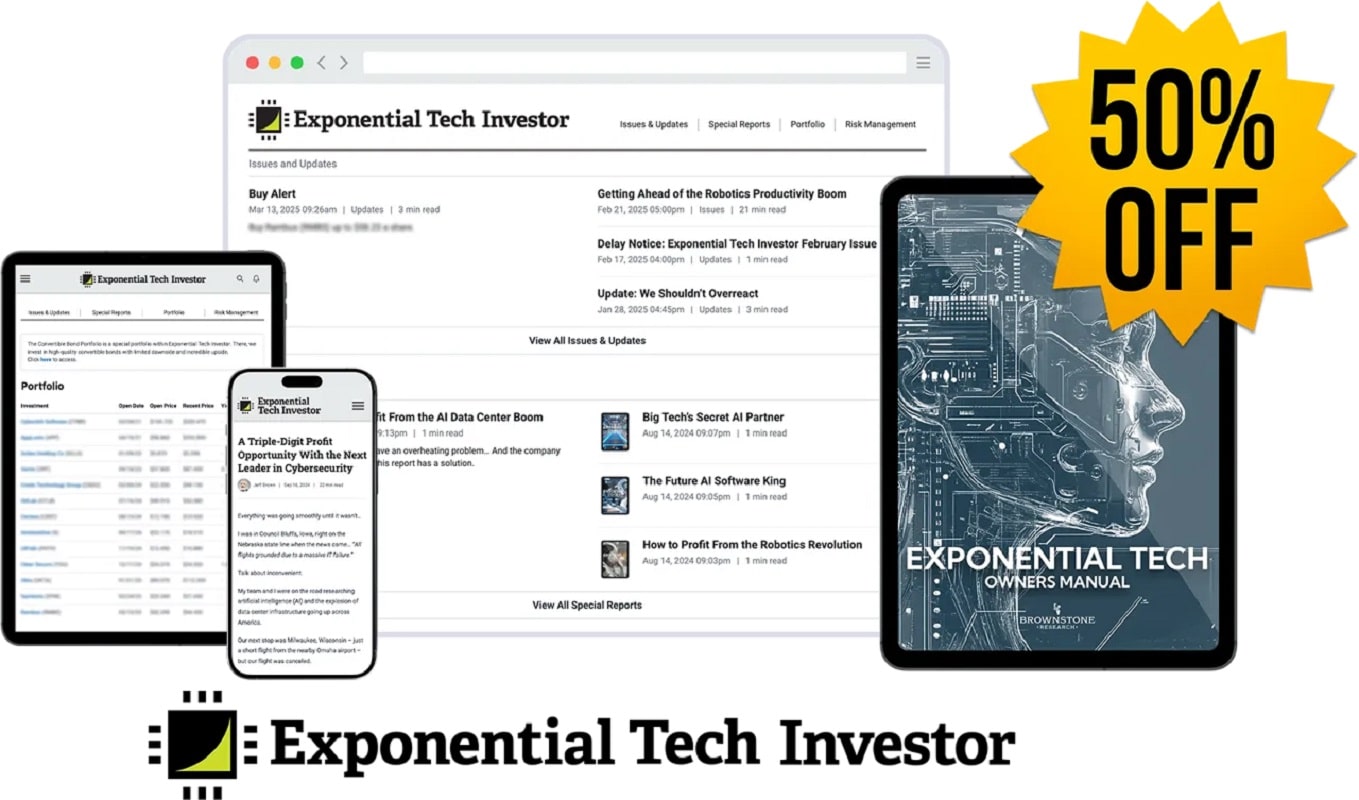
Brown’s track record includes early calls on Nvidia, Tesla and bitcoin, and the current version of Exponential Tech Investor bundles thematic reports on AI super‑chips, AGI, data‑center plays and a dedicated quantum computing opportunity he frames as the “next frontier in AI.” One bonus report specifically highlights a small‑cap quantum‑computing stock that he believes could benefit disproportionately as quantum hardware advances, alongside other AI‑linked recommendations.
The service is not cheap—launch pricing around 2,500 dollars per year, usually marketed against a notional 5,000‑dollar list price—and it targets investors comfortable with high volatility and small‑cap risk. Subscribers receive detailed write‑ups, risk‑management guidance and a model portfolio.
If you are serious about building a concentrated basket of speculative quantum and AI stocks and want a curated research pipeline, Exponential Tech Investor can be a useful idea source, as long as you treat its picks as one input into your own due diligence rather than a blind “buy” list.
FAQ: 7 Great Quantum Computing Stocks to Buy
What is quantum computing in simple terms?
Quantum computing uses quantum bits (qubits) that can represent multiple states at once, allowing certain complex calculations to be solved far faster than with traditional binary computers.
Are quantum computing stocks too risky for beginners?
Quantum stocks are early‑stage, volatile and often unprofitable, so they carry higher risk than blue‑chip tech names. Beginners should keep position sizes small and consider ETFs for diversification.
How long will it take for quantum computers to become mainstream?
Most roadmaps suggest practical, commercially relevant systems will scale through the late 2020s, while fully fault‑tolerant, broadly useful machines are more likely a 2030s story.
What is the difference between quantum stocks and quantum ETFs?
Individual quantum stocks give targeted exposure to one company’s success or failure, while quantum‑themed ETFs spread your risk across a basket of hardware, software and enabling‑tech names.
How much of my portfolio should I allocate to quantum computing?
Many investors treat quantum as a speculative theme and limit it to a small slice—often 1–5 percent of an equity portfolio—depending on risk tolerance, time horizon and overall diversification.