
XGPT 1‑Day Profit Windows is being unveiled as Tim Sykes’ first patent‑pending AI trading engine, built to forecast short, explosive intraday moves in volatile stocks so traders can see high‑conviction opportunities before they appear on most people’s screens.
XGPT: Tim Sykes’ 1‑Day Profit Window AI Goes Public
XGPT is Tim Sykes’ first patent‑pending AI trading system, developed with his StocksToTrade fintech team to scan the market for short‑term setups that fit his day‑trading framework.
Instead of acting as a generic chatbot, XGPT is described as a specialized engine built to identify “1‑Day Profit Windows” – brief, high‑velocity moves in thinly traded stocks that most traders only notice after the fact. The December 19 briefing is billed as the first time Sykes fully opens XGPT’s playbook to the public, including a free, brand‑new forecast attendees can evaluate in real time.
According to the promo copy, every example highlighted for this event was generated in real time by XGPT before November 1, 2025, and not reconstructed after the fact. The emails stress that these are “verified forecasts, no backtests, no reconstruction,” and repeatedly warn readers not to trade off the raw entries or confidence scores until they’ve watched the full presentation. This framing is designed to differentiate XGPT from hypothetical backtests and to underline that the AI has already been live in the market before its official unveiling.
What Are “1‑Day Profit Windows”?
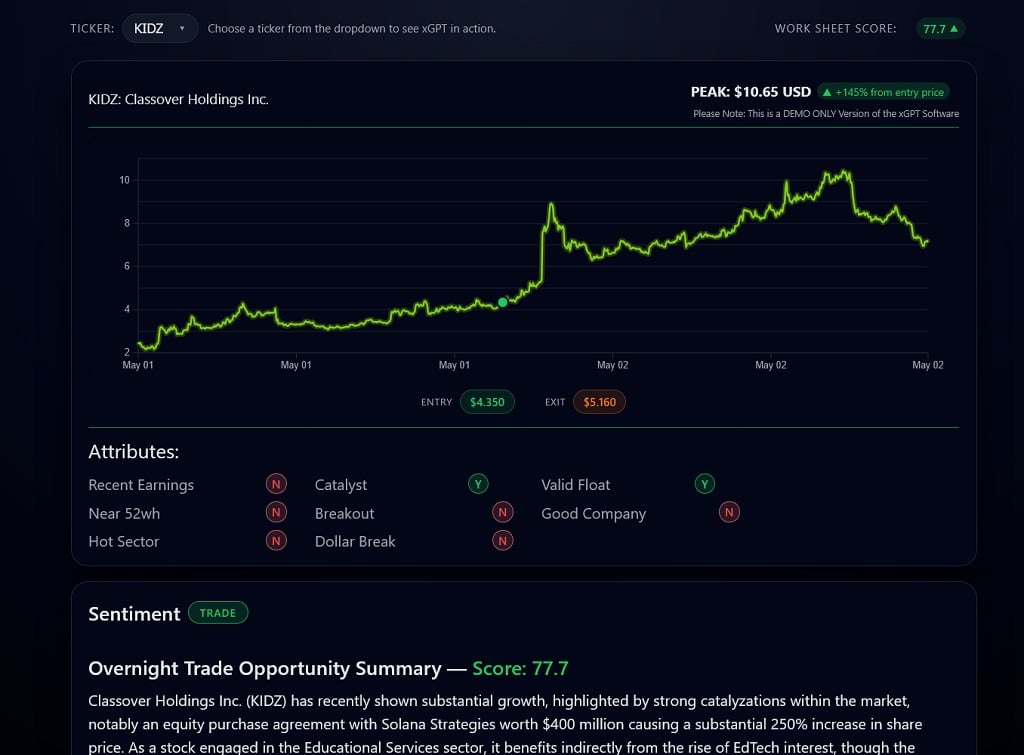
At the heart of the campaign is the promise that XGPT can forecast “1‑Day Profit Windows” – very short‑lived trading opportunities where a stock spikes dramatically within a single session. The marketing cites prior 1‑day moves of 256%, 340%, and 432% in micro‑cap names where XGPT allegedly flagged a window the day before, along with a confidence score for the expected move. The examples include tickers like RNAZ, LTRY, GV, NVNI, SYTA, KLTO, CLDI, ATCH, and DFLI, each tied to a specific calendar date when XGPT highlighted a tradeable window.
The copy repeatedly emphasizes that these “1‑Day Profit Windows” are “practically invisible to most people,” pointing to the speed and obscurity of many low‑float spikes. In Sykes’ recent public content, he describes XGPT as an assistant that pulls together news, float, sector, volume, and technical context in minutes – then converts that into a structured trade plan, complete with suggested entries, exits, and risk levels for potential overnight or next‑day plays.
How XGPT Fits Into Tim Sykes’ Trading Framework
Tim Sykes has spent roughly 25 years trading volatile penny stocks through booms, busts, and multiple market crises, documenting his strategies publicly and building an education business around them. He has reported more than $7 million in trading profits and has become known for teaching momentum and “supernova spike” setups to students who focus on small, fast‑moving names.
XGPT is presented as a codification of that playbook rather than a replacement for it. The tool is trained to look for the same conditions Sykes watches manually – early spikes, short squeezes, strong catalysts, and low floats – and then produce detailed, rules‑based trade plans.
In a recent tutorial, Sykes explained that he “would not take an afternoon or overnight trade without using XGPT,” noting that the AI provides a checklist of indicators and levels that many traders overlook when they chase headlines or a single chart pattern.
The promotional emails for the December 19 event position XGPT as a way to scale that framework to a broader audience. Instead of manually scanning hundreds of tickers, users can “click, prompt, forecast” and receive a structured outlook on potential 1‑day moves, including projected price ranges and confidence scores, before deciding whether to act.
Real‑Time Forecasts vs. Backtests
A key claim is that XGPT’s highlighted trades are “verified forecasts” made in advance, not cherry‑picked backtests. For instance, one of the emails that I receive describe XGPT projecting a move in GXAI from $2.75 to $3.19 with an 80% confidence score, only for the stock to spike as much as 101% the following day. Another example references ENSC, where XGPT allegedly forecast a move from $3.00 to $3.75 at 75% confidence, followed by an intraday surge of 305%.
Outside the promo copy, reviews and related content corroborate that XGPT has been sending out intraday or pre‑close alerts on highly volatile stocks since at least 2024, often around 3:15 p.m. Eastern time for potential overnight and next‑day plays. In one blog post, Sykes walks readers through a real alert on Bright Minds Biosciences (ticker DRUG), where XGPT’s trade plan preceded a sharp short‑squeeze move, complete with specific share sizes and target exits.
The December 19 presentation is framed as an opportunity to see how those forecasts are structured and to receive one new XGPT forecast in real time, free of charge, so attendees can judge the process for themselves.
Risk Warnings and Why Sykes Says “Don’t Just Buy the Examples”
Despite the eye‑catching gains in the examples, the promo email repeatedly warns readers not to buy GXAI, ENSC, or any of the highlighted tickers based solely on the email copy. Sykes stresses that these are illustrations of what XGPT has done in the past, not formal recommendations, and that past performance does not guarantee future results.
This caution is echoed in third‑party reviews of his services. Analysts who have examined XGPT and Sykes’ broader offerings emphasize that the AI is a tool for generating trade ideas and structured plans, not an autopilot system. They note that successful use still requires risk management, conservative position sizing in thin names, and an understanding of how quickly these setups can reverse.
The official event messaging reinforces this point by instructing traders to “write down your questions” and bring them to the December 19 briefing, where Sykes plans to explain how to interpret confidence scores, entry zones, and risk levels before anyone tries to trade based on XGPT’s output.
Why December 19 Is Positioned as a “Critical” Date
The December 19 event is marketed as a one‑time “big reveal” where several threads come together: the public unveiling of XGPT, a fresh free forecast, and what the copy hints is a looming catalyst for volatility. Sykes and Banyan Hill frame it as a critical briefing because they claim XGPT is “flashing wildly” ahead of something big, and they want attendees to understand how to use the AI before that break.
The invite copy also notes that access to the free preview and an exclusive report titled The Hidden Intelligence Behind XGPT will be pulled once the event goes live. That bonus report is said to walk readers through multiple historical forecasts that preceded major 1‑day spikes, reinforcing the “hidden profit window” concept and setting expectations for the live session.
Three other market veterans – Ian King, Adam O’Dell, and Addison Wiggin – are referenced as encouraging traders to attend, underscoring that this is a broader Banyan Hill campaign tapping multiple personalities to legitimize the launch.
Who XGPT and the Event Are Aimed At
The XGPT 1‑Day Profit Windows concept is clearly targeted at highly active traders rather than long‑term investors. Sykes talks about “slashing the average investor’s holding time by 99.99%,” focusing on overnight and single‑session setups rather than multi‑month positions.
Ideal attendees and users are portrayed as:
-
Traders interested in volatile micro‑caps, short squeezes, and “supernova spikes.”
-
People who feel overwhelmed scanning for setups manually and want AI to narrow a daily watchlist.
-
Existing Sykes followers who want a more systematic way to apply his patterns in today’s AI‑driven market.
For that audience, the promise is not market‑wide timing but a tool that surfaces a handful of specific, high‑conviction intraday windows each week, wrapped in a structured plan instead of a vague “hot list.”
The “Big Secret” Bonus: The Hidden Intelligence Behind XGPT
Ahead of the event, registrants are offered a free bonus called The Hidden Intelligence Behind XGPT, which Sykes urges readers not to skim.
The report reportedly compiles multiple historical XGPT forecasts that lined up with large intraday moves, illustrating how the AI’s logic tracks volatility, catalysts, and technical levels in real markets.
This “Big Secret” positioning aligns with Banyan Hill’s broader style of using pre‑event reports to build curiosity and demonstrate value before making an offer. Sykes hints that the report will make it clear why experienced traders with seven‑ and eight‑figure track records see XGPT as “the biggest teaching breakthrough” of his career, especially for students who struggle with discipline and pattern recognition under pressure.
Access to this report and the preview feed is scheduled to end when the December 19 broadcast begins, adding a scarcity element to the registration push.
To watch the XGPT’s 1 Day Profit Windows event click here.
FAQ: XGPT and the December 19 1‑Day Profit Windows Event
What is XGPT?
XGPT is Tim Sykes’ AI‑powered trading model, built with his StocksToTrade fintech team to analyze small‑cap and momentum stocks based on his established penny‑stock framework. It generates structured trade plans and “1‑Day Profit Window” forecasts rather than generic chat responses.
What are 1‑Day Profit Windows?
“1‑Day Profit Windows” are short, high‑volatility opportunities where a stock may spike significantly within a single session, often driven by news, short squeezes, or speculative flows. XGPT’s goal is to identify those windows in advance, providing projected moves and confidence scores before the next day’s trading.
Who should consider attending the December 19 event?
The briefing is aimed at active traders who focus on short‑term moves, especially in small‑cap or momentum names, and who are open to using AI as a screening and planning tool. Long‑term investors and those uncomfortable with rapid, high‑risk trades may find the style less suitable.
Will XGPT make trades automatically?
No. XGPT is described as an “analyst at your fingertips” that produces reports, forecasts, and trade plans, but users must still decide if and how to act. Sykes emphasizes that AI is not “better than humans” yet and that traders must apply their own risk management and judgment on every setup.
What do you get for free on December 19?
Attendees are promised a live walkthrough of how XGPT works, a brand‑new 1‑Day Profit Window forecast to evaluate, and access to the Hidden Intelligence Behind XGPT bonus report if they join the VIP list in time. Any full subscription or paid offer associated with XGPT will be detailed during or after the presentation.