
Jim Rickards is making some of his boldest calls yet about where America’s economy, markets and national wealth are headed in 2026, from a hidden $150 trillion “birthright” to a new wave of government‑backed resource and AI investments. To understand how he expects all of this to unfold – and what it could mean for everyday investors – we need to start with his background and the big ideas behind his latest forecasts.
Why Jim Rickards’ 2026 Forecasts Matter
Jim Rickards has spent more than 50 years in some of the most important rooms in finance, intelligence and government. He helped craft the petrodollar deal in the 1970s, advised during the Iranian hostage crisis, consulted the Fed during a $1.9 trillion banking scare, and warned Washington about the 2008 crash before it hit.
Today, he is using that background to make bold predictions about what could happen to the U.S. economy and markets between now and 2026. His latest thesis centers on a largely ignored part of U.S. law, a “hidden national endowment” as he calls it, that he estimates at roughly $150 trillion, and a series of policy moves he believes will unlock a new era of American wealth, led by Donald Trump’s second term.
This article breaks down Rickards’ 2026 outlook in simple, clear language. You’ll see what he expects for natural resources, the dollar, inflation, U.S. politics, stocks, AI and defense — and how he believes everyday investors can position themselves.
The $150 Trillion “American Birthright”
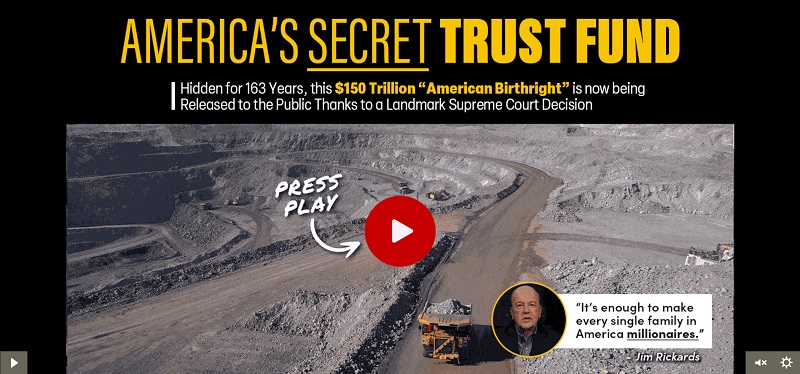
Rickards’ most striking claim is that America is sitting on a $150 trillion “national inheritance” that most people have never heard about.
He traces it back to changes Congress made to Title 30 of the U.S. Code in the 19th century, under President Ulysses S. Grant. According to Rickards, Sections 22–42 effectively created a kind of “national trust fund” tied to mineral rights on federal lands.
Over time, he says, this endowment has:
-
Grown to an estimated $150 trillion in raw value.
-
Become large enough, on paper, to pay off the U.S. national debt four times over.
-
Equal the value of buying every home in America and taking a 100% stake in all Nasdaq‑listed companies.
He stresses this is not a literal cash pool or a simple trust account, and it was never designed as a program that cuts million‑dollar checks to every household. Instead, he uses “trust” and “endowment” as plain‑English labels for a giant store of mineral wealth on public lands that has been locked up for decades.
Why This Wealth Stayed Hidden for Over a Century
If the United States has so much mineral wealth, why hasn’t it been fully used already? Rickards blames decades of regulation and environmental policy.
He argues that for roughly 50 years, federal agencies and courts made it extremely difficult to develop new mines and large energy projects on federal lands. He points to:
-
Large areas of land placed off‑limits to mining and drilling.
-
High‑profile projects like Alaska’s Pebble Mine and Arizona’s Resolution copper deposit that have been stuck in legal or regulatory limbo for decades.
-
Environmental decisions that prioritized the protection of certain habitats and species over resource access.
Rickards highlights data suggesting:
-
An area larger than 25 of the 27 states east of the Mississippi is currently blocked from mineral exploration.
-
The U.S. ranks near the bottom of major mining nations when it comes to the time it takes to bring a major deposit into production, just one notch above Zambia in one S&P Global study.
He also notes that we have become heavily dependent on China for many critical minerals. By his count, the U.S. relies on China for nearly 100% of 20 key materials used in everything from AI chips and EV batteries to advanced weapons. When China started limiting exports of some of these inputs, Rickards saw it as a wake‑up call.
In his view, the combination of regulations and foreign dependence effectively buried America’s birthright — until now.
The Chevron Doctrine and the 2024 Turning Point
A major legal pillar in Rickards’ story is something called the Chevron Doctrine.
For decades, Chevron gave federal agencies broad power to interpret laws and issue rules. Rickards claims this allowed regulators, especially at the EPA and similar bodies, to kill or delay projects with “kill shot” authority. In practice, that meant:
-
Long delays for large mines and energy projects.
-
Frequent litigation and appeals.
-
Uncertainty that discouraged investment in U.S. resource development.
In 2024, the Supreme Court overturned the Chevron Doctrine. Rickards sees this as an historic turning point, because:
-
Agencies no longer enjoy the same automatic deference.
-
Courts, appointed judges, and the current administration now have more say in how laws are applied.
-
The legal obstacle that blocked many U.S. resource projects has been removed.
He believes the end of Chevron unlocks the legal pathway to tap that $150 trillion mineral endowment, starting in the mid‑2020s and accelerating into 2026 and beyond.
Trump’s Second Term and the “New Homestead Act”
Rickards connects this legal shift to a broader political and economic plan under Donald Trump’s second term.
He compares the new phase to a modern Homestead Act:
-
In the 1800s, the Homestead Act let settlers claim 160 acres of land for $18. Adjusted for today, that small investment could turn into land worth nearly $900,000.
-
The result was a wave of “rags to riches” stories, the birth of new cities, and rapid western expansion driven by gold, silver, oil and other minerals.
Today, he sees echoes of that earlier era:
-
Trump has talked about building new “Freedom Cities” and reopening the “frontier” of American opportunity.
-
Federal lands — roughly 28% of total U.S. land area, heavily concentrated in the West — contain major deposits of copper, lithium, rare earths, uranium, oil, gas and more.
-
The administration has signaled support for opening up these lands and fast‑tracking energy and mining projects, especially if they reduce dependence on foreign supply chains.
In Rickards’ view, we are at the very start of a 21st‑century resource rush that could rival, or even exceed, the gold and oil booms that built cities like San Francisco, Denver, Houston and Birmingham.
Executive Orders, Sovereign Wealth, and “Monetizing the Balance Sheet”
Another key part of Rickards’ 2026 forecast is the creation of what he calls America’s first sovereign wealth fund.
He notes that many countries — such as Norway, Saudi Arabia and some Gulf states — have long used national resource wealth to build sovereign funds that support citizens through benefits, low taxes or direct payouts.
According to Rickards, Trump has taken similar steps:
-
At the start of his second term, Trump created a U.S. Sovereign Wealth Fund framework, with the goal of “monetizing the asset side of the U.S. balance sheet.”
-
On March 20, Trump signed Executive Order 14241, allowing government agencies to invest through a “dedicated mineral and mineral production fund.”
-
The administration has already begun taking equity stakes in select mining and resource companies, which Rickards tracks as examples of this new approach.
He does not claim to know exactly how the fund will be used — whether it will pay down debt, backstop Social Security, or provide direct benefits. But he argues that the combination of:
-
A formal sovereign‑wealth structure,
-
Aggressive deregulation, and
-
Direct government co‑investment in strategic companies
…points toward a massive monetization of America’s physical resource wealth between now and 2026.
GPOs: A New Type of Government‑Driven Stock Catalyst
To describe the new investment landscape, Rickards coins the term GPOs, or Government Participation Offerings.
He compares GPOs to IPOs:
-
An IPO is when a private company goes public, often creating big windfalls for early backers. But IPO allocations usually go to institutions and wealthy insiders, not regular investors.
-
A GPO, in his definition, is when the U.S. government takes a significant stake in a publicly traded company as part of its resource and strategic‑industry push.
The government’s involvement can:
-
Signal strong political and structural support.
-
Unlock funding, permits, and long‑term contracts.
-
Trigger large price jumps as other investors rush in.
Rickards cites several recent examples:
-
MP Materials jumped over 100% in a month after the Pentagon reportedly bought a 15% stake.
-
Lithium Americas gained nearly 100% in days on rumors of a major deal, then surged another third in after-hours trading after the government moved forward.
-
Trilogy Metals spiked around 200% in a single day when the White House announced it was buying into the company.
He believes there could be dozens more GPOs before 2026, especially targeting companies tied to rare earths, copper, lithium, uranium and other critical inputs.
His core prediction: investors who identify these companies before the government files and buys in could see substantial gains, sometimes in a very short period.
2026: 50 Years of Resource Wealth in One Term?
Rickards summarizes his macro view this way:
“We will see 50 years of trapped mineral wealth unleashed in a single presidential term.”
From an investment standpoint, that means:
-
A multi‑year boom in U.S. mining and energy stocks.
-
Renewed focus on domestic supply chains for AI chips, EVs, batteries, and advanced weapons.
-
Large flows of capital into mid‑cap and small‑cap resource companies, where the leverage to new projects is greatest.
He acknowledges these are “best case” scenarios, and not every project or stock will succeed. But he points to past historical examples where government green‑lights turned sleepy miners into multi‑baggers:
-
First Quantum in Zambia, which soared more than 2,500% over five years after a major project approval.
-
Northern Dynasty in Alaska, tied to the Pebble project, which briefly delivered nearly 3,000% gains in the 2000s.
-
Paladin Energy in Namibia, which climbed over 60,000% in four years as its uranium project advanced.
His argument is not that 60,000% gains are normal, but that trapped resources plus political change plus capital can create extraordinary outliers, and 2024–2026 is shaping up like one of those rare periods.
The “American System” and a New Revenue Model
Looking beyond resources, Rickards also forecasts a broader shift back toward what he calls the “American System.”
Historically, he notes, the U.S. federal government relied heavily on tariffs rather than income taxes. Income tax is a relatively recent creation, and for much of early U.S. history there was no federal income tax at all.
He connects this to several Trump proposals:
-
Replacing or reducing the IRS and creating an External Revenue Service focused on collecting tariffs from foreign trade instead of taxing American workers’ income.
-
Using tariffs not only to raise revenue, but also to encourage re‑shoring of manufacturing, energy and advanced technology.
In this scenario, 2026 and the years around it could see:
-
Strong tailwinds for domestic producers in industries like energy, refining, heavy manufacturing, and advanced materials.
-
Headwinds for companies that rely heavily on overseas production and resist re‑shoring.
Rickards’ team has put together a report titled “Inside Trump’s Secret Plan to ‘Reset’ America” that outlines energy and infrastructure plays he believes stand to benefit most from this shift.
He also built a companion report called “Trump’s Takedown Trade: 3 Stocks to Sell Immediately”, focusing on popular companies he thinks could fall 30–50% or worse if they land on the wrong side of this reset.
Strategic Intelligence: How Rickards Packages His 2026 Ideas
To share his forecasts and specific investment ideas, Rickards runs a research service called Strategic Intelligence.
The service is marketed as a way to:
-
Understand “the vast and often unseen forces” shaping the economy and markets during Trump’s second term and beyond.
-
See major policy shifts, court decisions and geopolitical moves weeks or months before they are widely discussed.
-
Access model‑portfolio recommendations based on those insights.
A typical offer around this 2026 theme includes:
-
Six months of Strategic Intelligence for $49, discounted from a stated rate of $299 per six months.
-
Monthly 20‑page issues covering topics like AI, the military, court decisions, and elections.
-
Access to a model portfolio with all of Rickards’ current recommendations.
The package also includes four special reports tied to his 2026 predictions:
-
The American Birthright: How to Claim Your Share of America’s $150 Trillion Mineral Endowment
-
Five resource and mineral‑rights stocks Rickards believes will benefit as federal lands are opened and the sovereign wealth fund grows.
-
-
Inside Trump’s Secret Plan to “Reset” America
-
A deeper look at the American System, tariffs, and three U.S. energy and infrastructure plays he expects to thrive.
-
-
Trump’s Takedown Trade: 3 Stocks to Sell, Immediately
-
Three widely held stocks he sees as “ticking time bombs” that could suffer as production is forced back onshore and global supply chains are reworked.
-
-
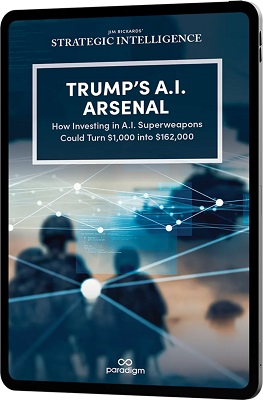
Trump’s A.I. Arsenal: How Investing in A.I. Superweapons Could Turn $1,000 into $162,000
-
Defense and technology companies at the intersection of AI and military modernization, including projects like Iron Dome‑style systems and AI‑driven drones.
-
The trial comes with a 30‑day money‑back guarantee: if a new subscriber is not satisfied, they can request a full refund within the first month and keep all the reports and materials they’ve received.
AI, Superweapons and the 2026 Defense Build‑Out
One of Rickards’ most specific sector forecasts for 2026 is in AI‑driven defense.
He argues that:
-
Large parts of the U.S. military are still using platforms designed decades ago — from bombers to ships to tank fleets.
-
Trump’s defense strategy is less about upgrading old equipment and more about leapfrogging to AI‑enabled systems.
Examples he highlights include:
-
An “Iron Dome” for America, based on the missile shield concept used in Israel but scaled up dramatically for U.S. territory.
-
A partnership between a major defense contractor and SpaceX on “Star Shield,” a Starlink‑based early warning and communications layer.
-
A smaller company developing a long‑range AI drone that can:
-
Hit targets up to 3,000 miles away.
-
Fly at around Mach 0.85 at up to 45,000 feet.
-
Operate from carriers or small airfields.
-
Cost roughly one‑tenth as much as an F‑16.
-
He believes this company, and a handful of similar players, could see enormous upside as the Pentagon shifts spending from legacy hardware to AI‑enabled systems in the mid‑2020s.
His “Trump’s A.I. Arsenal” report is built around this thesis, with a long‑term target that some of these names could rise 10,000% or more over multiple decades in the most optimistic scenarios.
For 2026 specifically, Rickards expects:
-
A clear ramp in defense budgets targeting AI, drones, space‑based systems and autonomous platforms.
-
Big winners among defense contractors and specialized tech firms that capture key roles in these programs.
He contrasts this with many high‑profile civilian AI projects, noting that some have yet to show real profits, while defense AI is funded by large, long‑term government contracts.
Will Tapping the Endowment Cause Inflation or Dollar Collapse?
One natural concern is whether “unlocking” a $150 trillion resource endowment could trigger hyperinflation or collapse the dollar.
Rickards addresses this directly.
He notes:
-
In the past, when countries were on a gold standard, large new gold discoveries could expand the money supply and push up prices.
-
Today, no major currency is backed by gold or a fixed commodity. Central banks create money through policy decisions, not direct conversion of metal.
From that standpoint, he does not expect simply developing more minerals to cause runaway inflation. In fact, he suggests that increased supply of key materials might even reduce price pressure over time, especially if demand normalization meets higher output.
He does acknowledge that:
-
A big jump in resource and infrastructure spending can be inflationary in the short run.
-
The dollar’s long‑term value also depends on fiscal policy, debt, and global capital flows, not just resource reserves.
But his core view is that unlocking domestic resources strengthens America’s real wealth base, which is ultimately positive for the currency and the economy if managed well.
How Institutional and Billionaire Money Fits In
Rickards is clear that major players are already moving into this theme. He points to:
-
Berkshire Hathaway increasing its stake in energy producer Occidental Petroleum.
-
PIMCO buying hundreds of millions of shares in a major natural‑gas exporter.
-
Elliott Management taking a billion‑dollar position in Anglo American, a big mining company with past ties to U.S. projects.
-
Venture funding and private capital flowing into U.S. mining startups backed by billionaires like Bill Gates and Jeff Bezos.
At the same time, he argues that smaller investors have an edge because:
-
Many of the best‑positioned resource companies have market caps in the hundreds of millions, not hundreds of billions.
-
A mega‑billionaire can’t put a meaningful percentage of his wealth into a $400 million stock without effectively taking it over, which caps their upside.
A small investor, by contrast, can allocate a few hundred or a few thousand dollars to a tiny miner or infrastructure company and still benefit if it doubles, triples or more.
His advice: pay attention to where the big money is looking (and which themes they’re betting on), but use your smaller size to invest in earlier‑stage and more leveraged names they cannot easily accumulate.
Putting It Together: Rickards’ Big Picture for 2026
Summing up Jim Rickards’ predictions for 2026, his framework looks like this:
-
America is not broke. Beneath federal lands lies a vast, long‑ignored mineral endowment he values at roughly $150 trillion.
-
Past policy blocked access. Environmental rules, agency power under the Chevron Doctrine, and political choices kept this wealth bottled up.
-
Law and leadership have shifted. The end of Chevron, Trump’s deregulation push, and new executive orders are opening the door to large‑scale development and co‑investment.
-
A new sovereign wealth model is emerging. Trump’s sovereign wealth framework and mineral‑fund authority mark the start of “monetizing the asset side of the U.S. balance sheet.”
-
GPOs will be powerful catalysts. Government stakes in strategic companies can send select stocks soaring if investors buy in first.
-
The “American System” returns. More revenue from tariffs and less from income taxes, plus pressure to re‑shore production, could reshape winners and losers across the market.
-
AI and defense are major growth engines. AI‑powered weapons systems, missile shields and military platforms are likely to attract large, durable funding streams.
-
The biggest wins may come in resources and strategic industries. Copper, lithium, rare earths, uranium, energy, refining, logistics, and defense tech all sit at the intersection of these trends.
For individual investors, Rickards’ main message is that the next few years could compress decades of wealth creation into one political term, especially for those who understand the policy shifts and position themselves early in the right stocks.
He repeatedly warns that nothing is guaranteed and that no one should risk money they can’t afford to lose. But he is clear: in his view, 2026 is not just another year — it’s the start of a once‑in‑a‑lifetime reset of how America uses its natural wealth, runs its economy, and funds its future