
Dividend investing has always been a cornerstone of wealth creation for long-term investors seeking both income and stability. Heading into 2026, the appeal of dividend-paying stocks is stronger than ever. With global markets navigating elevated interest rates, geopolitical uncertainties, and persistent inflation, investors are increasingly drawn to companies that generate consistent cash flow, return capital to shareholders, and offer predictability in a volatile world.
For many years, investors chased high-growth companies, often prioritizing future potential over current profitability. But the current environment demands a more disciplined approach. Cash-rich companies with strong fundamentals now shine, as they can maintain and even grow dividends regardless of market turbulence. In this context, dividend-paying stocks are not only a source of passive income but also a strategic hedge against volatility.
High yields are enticing, but a yield alone does not guarantee safety. A truly secure dividend comes from a combination of strong cash flow, manageable debt, resilient business models, and a proven history of payout consistency. In the sections that follow, this article will provide a detailed guide to the best high-yield dividend stocks for 2026, while also equipping investors with the knowledge to distinguish safe income plays from risky “yield traps.”
What Makes a Dividend “Safe”?
A high dividend yield can be either a blessing or a warning sign. Many investors have learned the hard way that a seemingly generous payout can disappear quickly if the underlying business is unstable. The difference between a safe dividend and a dangerous one lies in the quality of the company’s cash flow, its balance sheet strength, and the resilience of its business model.
Free cash flow is central to dividend safety. A company can report strong earnings but still struggle to pay dividends if it lacks sufficient cash. Free cash flow, which accounts for operating cash minus capital expenditures, is the true measure of a company’s ability to sustain distributions. Investors should focus on companies with consistent, robust free cash flow that comfortably exceeds dividend payouts, ensuring stability even during economic downturns.
Payout ratios provide additional insight into sustainability. While sector norms vary, excessively high payout ratios can signal risk, particularly if earnings are volatile or debt is rising. Companies with reasonable ratios relative to their cash flow are better positioned to maintain and increase dividends over time.
Balance sheet health is another critical factor. Rising interest rates in recent years have made leverage more costly, exposing companies with weak financial structures. Those with manageable debt, predictable refinancing schedules, and strong interest coverage are more likely to preserve dividends through market turbulence.
The durability of a company’s business model is equally important. Dividend safety is reinforced when a company operates in sectors with recession-resistant demand, such as consumer staples, healthcare, regulated utilities, and midstream energy. Companies with strong competitive advantages, pricing power, and predictable cash flows can navigate cycles without compromising shareholder distributions.
Finally, a proven track record of dividend payments across multiple market cycles demonstrates management discipline and commitment to shareholders. Companies that consistently raise dividends, even during recessions, are reliable sources of income for long-term investors.
How Dividend Safety Is Changing in the Post-Rate-Hike Era
Dividend investing in 2026 must be viewed through a different lens than in prior decades. Low interest rates once allowed even moderately leveraged companies to maintain dividends with little risk, but rising rates have changed that dynamic. Companies now face higher borrowing costs, shrinking cash flow flexibility, and the potential for dividend cuts if fundamentals deteriorate.
This evolution has created a polarized market. Companies with strong cash flows, disciplined leverage, and durable competitive advantages stand out as exceptionally safe. Meanwhile, firms with high debt or cyclical earnings are exposed to financial pressure, making their dividends far riskier. Investors must now consider not only traditional financial metrics but also the impact of higher rates on long-term stability. Evaluating a company’s ability to maintain dividends under stress has become an essential part of income investing in 2026.
The Role of Defensive Sectors in High-Yield Income Portfolios
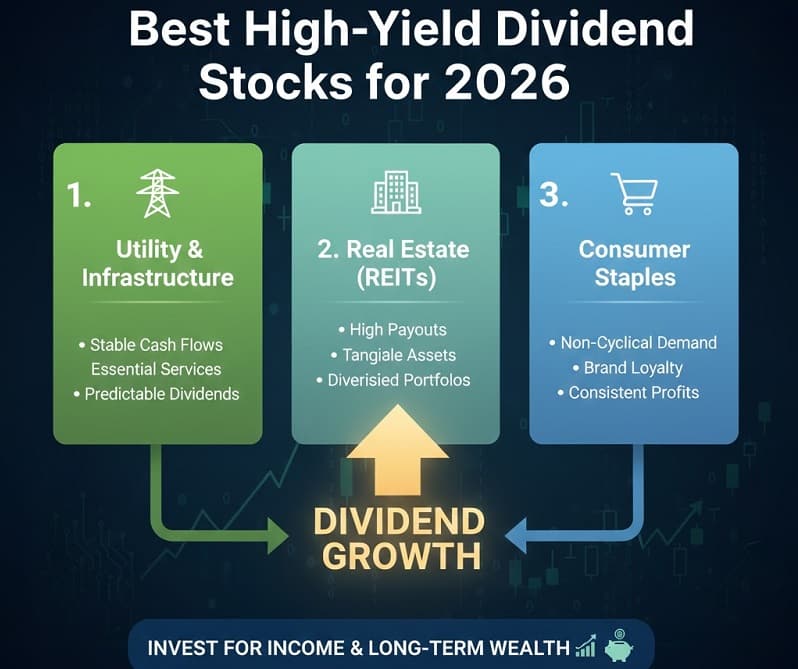
Defensive sectors have taken on a new level of importance for dividend investors. Industries such as consumer staples, healthcare, telecom, and energy infrastructure offer stability, resilience, and predictable cash flows—attributes that are highly prized in a high-rate, uncertain environment.
Consumer staples, for example, provide consistent demand even during recessions. Healthcare benefits from long-term demographic trends and steady demand for essential products and services. Telecom companies generate subscription-based revenue streams that are largely insulated from economic cycles, while midstream energy infrastructure collects stable fees regardless of commodity price swings. These defensive sectors form the foundation of a modern dividend portfolio, offering both high yields and a degree of protection against market volatility.
The Best High-Yield Dividend Stocks for 2026
In selecting the top dividend stocks, the focus is on sustainability, cash flow strength, and resilience. Each company highlighted below has been analyzed for free cash flow coverage, payout ratio, sector stability, and growth potential.
AT&T (T)
AT&T remains one of the most prominent high-yield telecoms. The company’s transition to a more streamlined media and telecom model has improved operational efficiency and stabilized cash flow. Its subscription-based revenue provides a predictable earnings stream, supporting a generous dividend. Despite legacy debt from past acquisitions, management has demonstrated commitment to dividend sustainability, making it a strong candidate for income-focused portfolios.
Verizon (VZ)
Verizon’s high yield is supported by a robust, subscription-driven business. The company benefits from scale, strong brand recognition, and consistent demand for connectivity. Verizon has maintained manageable leverage and a disciplined payout ratio, ensuring that its dividend remains reliable, even in a higher-rate environment.
Enterprise Products Partners (EPD)
As a midstream energy infrastructure company, EPD generates revenue from transportation and storage fees rather than direct commodity exposure. This model creates remarkably stable cash flows, allowing for high and consistent dividends. Long-term contracts underpin revenue visibility, while a history of conservative financial management enhances dividend reliability.
Realty Income (O)
Known as “The Monthly Dividend Company,” Realty Income operates in the REIT sector but stands out due to its diversified portfolio of commercial properties with long-term leases. This creates predictable cash flows, and the company has a strong track record of monthly dividend payments. The focus on quality tenants and conservative financing adds to its appeal as a defensive income stock.
AbbVie (ABBV)
AbbVie is a healthcare powerhouse with a strong pipeline of drugs and global reach. Its dividend is well-covered by cash flow, and the company has a long history of payout growth. Even amid healthcare sector pressures, AbbVie demonstrates resilience through diversified revenue streams and strong R&D capabilities.
Altria (MO)
Altria offers high yield supported by stable cash flows from its tobacco and nicotine product portfolio. Its consistent market share, disciplined capital allocation, and shareholder-friendly dividend policy make it a reliable income option, although investors should remain mindful of regulatory and consumption trends.
Blackstone Secured Lending (BXSL)
As a business development company focused on secured lending, BXSL provides high yield underpinned by structured credit. While higher-risk than traditional corporates, the company maintains a disciplined underwriting process and generates cash flow sufficient to support consistent dividends. Its unique structure offers both attractive yield and defensive characteristics through secured lending.
JPMorgan Equity Premium Income ETF (JEPI)
JEPI is an ETF that provides exposure to equity premium strategies combined with high dividend yield. It generates income through option premiums and carefully selected equity positions. This fund offers a unique approach to income generation with lower volatility compared to traditional equity portfolios, making it appealing for conservative dividend investors.
Conclusion
High-yield dividend stocks offer investors an attractive combination of income and stability, but not all yields are created equal. In 2026, safe income plays are defined by strong free cash flow, manageable leverage, resilient business models, and a long history of payout reliability. Defensive sectors such as consumer staples, healthcare, telecom, and midstream energy infrastructure are central to building portfolios that endure economic uncertainty while delivering consistent dividends.
By carefully selecting companies that meet these criteria, investors can generate meaningful income, reduce portfolio risk, and position themselves for long-term growth. The opportunities for disciplined, income-focused investors in 2026 are substantial, and with a strategic approach, dividend stocks can serve as the foundation for a secure and rewarding investment strategy.
FAQ: Best High-Yield Dividend Stocks for 2026
What is considered a safe dividend yield in 2026?
A safe dividend yield varies by sector but generally ranges from 3% to 7%, provided it is supported by strong cash flow and sustainable payout ratios.
How do rising interest rates affect dividend stocks?
Higher rates increase borrowing costs, reduce valuation multiples, and pressure companies with high debt. Companies with stable, predictable cash flows are less impacted.
Are high-yield REITs safe investments?
REITs can be safe if they have quality tenants, long-term leases, and conservative financing. Avoid REITs with high leverage and declining occupancy.
Should I prioritize dividend growth or high yield?
Both are important, but safety should come first. Dividend growth indicates financial health, while yield measures current income. Combining both creates a balanced income strategy.
Can telecom and utility stocks withstand economic downturns?
Yes, these sectors are considered defensive because they provide essential services with predictable demand.
How important is free cash flow coverage?
Free cash flow coverage is critical. Dividends must be supported by real cash, not accounting profits, to be sustainable.
Are ETFs like JEPI a good alternative to individual dividend stocks?
Yes, they provide diversified exposure, potentially lower volatility, and consistent income through managed strategies.
How do I avoid dividend traps?
Check for excessive payout ratios, declining cash flow, rising debt, and industry headwinds. Sustainable high yields always have strong fundamentals behind them.
What role does sector diversification play in dividend portfolios?
Diversification reduces risk by spreading exposure across defensive sectors and income streams, ensuring consistent cash flow even if one industry faces challenges.
Can dividend investing outperform growth investing in 2026?
For risk-adjusted returns and income generation, dividend investing can outperform, particularly in volatile or high-rate environments where growth stocks face higher risk.