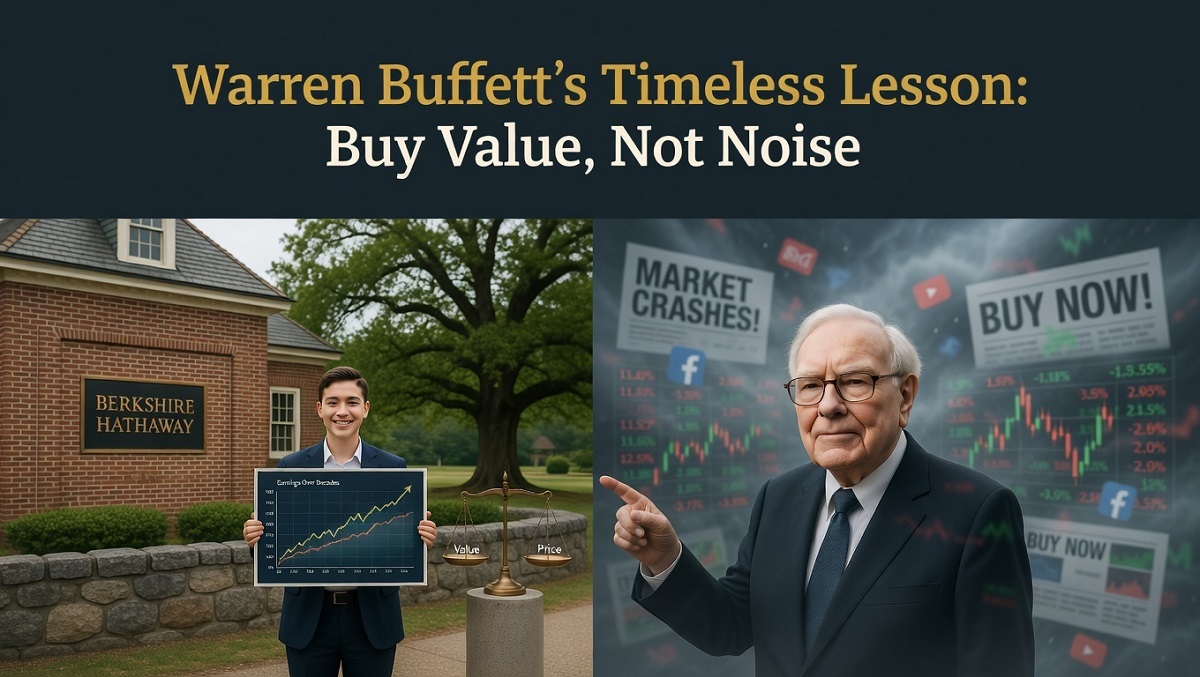
If you consume financial news the way most investors do today, the stock market feels like a nonstop crisis machine. Interest rates, elections, wars, inflation, AI bubbles, banking scares—every headline is sold as the one that “changes everything.” Yet the quiet truth is that markets have always lived with uncertainty, and most of what feels urgent in real time is forgettable in hindsight.
Warren Buffett understood this earlier than almost anybody. He built one of the greatest investing track records in history not by predicting recessions or gaming elections, but by ignoring almost all of it. He focused relentlessly on what he could know: the quality of a business, its intrinsic value, and the price he paid. In a world where investors now refresh feeds every few seconds, that approach feels almost radical. That’s exactly why it still works.
Below, I’ll explore how Buffett’s “ignore the noise, buy value” philosophy translates directly to today’s markets—and how you can apply it in 2026, including five real-world value stocks that fit the spirit of his playbook.
The Modern Noise Machine
Fifty or sixty years ago, investors might have read a newspaper, glanced at a ticker, and caught an evening news segment. Today, they live inside a 24/7 financial information stream: real-time news alerts, social media hot takes, algorithm-driven “breaking” headlines, and bite-sized video commentary from self-proclaimed experts. The volume is unprecedented; the value is debatable.
This always-on environment creates structural problems for investors:
-
It pushes attention toward what just happened, not what matters over years.
-
It rewards confident narratives, not accurate probabilities.
-
It makes investors feel like constant reaction is a form of control.
Buffett’s view on this is blunt. He has repeatedly said that macroeconomic forecasts and headline commentary are “an expensive distraction” for most investors. He does not shape his strategy around the next election, the next Fed move, or the next geopolitical shock. He buys understandable businesses at sensible prices and lets the business results—not the news cycle—drive his returns.
For investors in 2026, that is not outdated advice. It’s a competitive edge, precisely because so few people follow it.
Buffett’s Core Philosophy, Updated for 2026
Buffett’s partnership letters from the late 1950s and 1960s are striking for what they leave out. There is essentially no macro commentary, no hand‑wringing over elections, no attempt to position around war scares or central bank policy. That omission is not a gap in the record; it is the strategy itself. He knew he had no edge in forecasting the global economy, and he consciously declined to play that game.
Instead, he focused on three categories of investments:
-
Generals: statistically cheap, often boring securities bought below intrinsic value.
-
Workouts: special situations like mergers, liquidations, and reorganizations where return drivers were specific events, not the broad market.
-
Control situations: cases where he purchased enough of a company to influence management and unlock value directly.
The common thread was simple: each type of investment depended far more on business fundamentals and corporate actions than on macroeconomic forecasts. He concentrated on what he could reasonably understand, estimate, and act on.
In 2026, the architecture of markets has changed—algorithmic trading, passive flows, AI‑driven signals—but the underlying principle still holds. You can’t reliably predict:
-
Election outcomes.
-
Central bank timing.
-
The exact path of inflation and growth over the next 12–18 months.
You can, however, still estimate:
-
A company’s normalized earnings power.
-
The strength and durability of its competitive position.
-
Whether today’s market price embeds overly pessimistic or optimistic assumptions.
That is the essence of value investing in any decade.
How Fear and Headlines Create Mispricing
Every major worry—war, inflation, interest rate spikes, recessions—can be translated into one of two stories in markets:
-
“This changes everything; nothing will ever be the same.”
-
“This will pass, but the damage to prices is permanent.”
Both often appear plausible in real time, especially when supported by vivid anecdotes, scary charts, or authoritative voices. But much of the time, markets eventually revert to being driven by business results: revenue growth, margins, capital allocation, and industry structure.
Behavioral finance research, and decades of market history, suggest several recurring patterns:
-
Investors overweight recent news and underweight long-run fundamentals.
-
They overreact to bad headlines in cyclical sectors (banks, homebuilders, industrials, consumer brands), creating pockets of deep pessimism.
-
They crowd into whatever is working now—sometimes high‑growth tech, sometimes “safe” bond proxies—and drive valuations to extremes.
Buffett’s approach converts this human tendency into an opportunity. If enough people fixate on macro narratives, entire sectors or individual companies can become mispriced relative to their long-term earnings power and asset value. That gap is where patient value investors get paid.
The Three Buckets, Reimagined for Today
To translate Buffett’s old buckets (generals, workouts, control) into the 2026 market, think in terms of how your returns are generated.
1. Modern “Generals”: Boring, Cheap, Cash-Heavy
These are companies with:
-
Understandable business models.
-
Decent to strong return on equity.
-
Solid balance sheets and cash flows.
-
Market prices that bake in low expectations or exaggerated fear.
They are rarely on “Top 10 Stocks to Buy Now” lists because they lack a compelling story. They often reside in sectors currently out of favor—regional banks, traditional asset managers, old‑line consumer brands, cyclical homebuilders, even timber REITs.
2. Modern “Workouts”: Event‑Driven in an M&A and Spin‑Off World
Special situations today often involve:
-
Mergers and acquisitions with defined deal terms.
-
Spin‑offs and break‑ups where a hidden asset becomes visible.
-
Liquidations and asset sales, especially in real estate and old industrial conglomerates.
These opportunities still hinge on specific corporate events, not on where the S&P 500 goes next quarter. You are betting on probability and timing of a deal closing, regulatory approval, or value realization from a corporate restructuring—not on the next inflation print.
3. Modern “Control” and Activist Situations
In public markets, few individual investors can buy control stakes the way Buffett did in small caps decades ago. But you can still benefit from similar dynamics by:
-
Investing alongside high‑quality activists or owner‑managers.
-
Focusing on companies where insider ownership is high and capital allocation historically rational.
These setups often share Buffett’s preferred traits: management thinking like owners, willingness to repurchase shares when cheap, and discipline in acquisitions and dividends.
With that framework, we can examine five specific stocks in 2026 that look like modern “generals”: boring, mispriced, and built for patient investors.
Buffett’s Playbook: 5 Value Stocks for 2026
#1: U.S. Bancorp (USB)
If Buffett needed a living case study of a high‑quality bank temporarily unloved by the market, U.S. Bancorp would be near the top of the list. It is one of the largest regional banks in the United States, with roughly 26‑state coverage and a broad range of services including retail and commercial banking, payment services, mortgages, and wealth management. It has long held a reputation for conservative underwriting and disciplined risk culture—traits Buffett has historically prized in financial institutions.
Why the Market Is Worried
Recent years have been uncomfortable for banks:
-
Rising interest rates compressed some net interest margin dynamics.
-
Investors worried about commercial real estate exposure and potential credit losses.
-
The regional banking stress episodes made markets suspicious of balance sheet quality and deposit stability, especially for mid‑sized and regional institutions.
U.S. Bancorp has not been immune to those concerns. But that is exactly what can turn a solid franchise into a value opportunity when prices disconnect from long‑term earning power.
Valuation and Fundamentals
Recent analysis suggests that U.S. Bancorp’s market price implies a meaningful discount to its estimated fair value. In early March 2026, one widely followed narrative pegged fair value around 63.95 dollars per share versus a market price around 53.91 dollars, implying roughly 15–16 percent undervaluation. Another estimate placed fair value near 58.09 dollars with a market price around 52.23 dollars, again indicating an apparent discount.
The bank:
-
Holds assets approaching 700 billion dollars, giving it sizable scale.
-
Posts valuation metrics such as a price‑to‑earnings ratio around the low‑ to mid‑teens and a price‑to‑sales ratio near its three‑year highs, reflecting modest optimism but still below some fair‑value estimates.
-
Continues to invest in digital banking and AI‑driven efficiency to reduce costs and improve customer experience.
For a value investor, the thesis is straightforward:
-
You get a proven banking franchise with diversified revenues.
-
You buy at a price that assumes persistent headwinds, particularly in commercial real estate and competitive pressure from fintechs.
-
If those risks are manageable rather than catastrophic, and if the bank executes on its operating leverage and cost initiatives, the gap between market price and intrinsic value can close over time through earnings growth, dividends, and potential multiple expansion.
Buffett has repeatedly demonstrated a preference for well‑run banks bought when the market is anxious. U.S. Bancorp fits that mold in 2026.
Hennessy Advisors (HNNA)
Hennessy Advisors is the kind of under‑the‑radar asset manager that rarely trends on social media and almost never makes headlines. It runs a range of mutual funds and invests across equity and fixed income markets, earning steady management fees on assets under management. The business is simple: gather assets, manage them efficiently, keep costs low, return capital to shareholders.
In 2026, Hennessy looks like a classic value play: small, overlooked, and cash‑generative.
The Business and Balance Sheet
Hennessy Advisors:
-
Manages mutual funds and related investment products, earning fee income rather than taking large balance sheet risk.
-
Operates with exceptionally strong liquidity metrics, with a quick ratio above 12 and a current ratio above 12, indicating ample near‑term financial flexibility.
-
Generates decent profitability, including normalized return on equity in the low‑double‑digit range and solid return on assets.
From a shareholder perspective, the company also pays dividends. As of early 2026, its shares around 9–10 dollars implied a dividend yield of approximately 5.5 percent, while the price‑to‑earnings ratio sat under 8. That combination—high single‑digit P/E, mid‑single‑digit yield, strong liquidity—has all the hallmarks of a classic value stock.
Why It’s Mispriced
There are several reasons the market might overlook Hennessy Advisors:
-
It is small, with a market capitalization under 100 million dollars, placing it off the radar of most large institutions.
-
The narrative excitement is elsewhere—ETFs, private credit, alternatives—not in traditional mutual fund platforms.
-
Analysts and the financial media devote little airtime to micro‑cap asset managers, creating an information vacuum.
Buffett has often gravitated toward smaller, simpler companies where the lack of coverage creates opportunity rather than risk. An owner‑like management, a clean balance sheet, and consistent cash returns to shareholders are exactly the sort of traits he has historically paid attention to.
Hennessy, in that sense, is not a “story stock” at all. It’s a quiet compounding machine that the market appears to undervalue.
#3: KB Home (KBH)
Homebuilding is one of those sectors that always seems to sit near the center of macro anxiety. When interest rates climb, investors worry that mortgage costs will crush demand. When the economy slows, they worry about job losses and foreclosures. When home prices rise quickly, they worry about bubbles and affordability crises. The result is chronic pessimism whenever the macro picture looks cloudy.
KB Home is a large U.S. homebuilder that has learned to operate through multiple cycles. Its model emphasizes “Built‑to‑Order” homes, where buyers have significant say in design and features, and where the company has leveraged this customization into higher margins and customer satisfaction.
Operating and Financial Profile
Recent analysis of KB Home in 2025–2026 paints a picture of a company that has quietly strengthened itself while the market fixates on macro risk:
-
Business model: KB’s Built‑to‑Order approach differentiates it from peers who primarily sell spec homes. Customers can personalize their homes, often spending more on design studio upgrades that carry attractive margins.
-
Scale and performance: For the 2025 fiscal year, KB Home generated housing revenues of roughly 6.4 billion dollars.
-
Margins: Housing gross margins have stabilized around 21–23 percent—below pandemic peaks, but above pre‑pandemic norms thanks to better cost control and higher‑margin product mix.
-
Earnings: Trailing twelve‑month diluted EPS has been around 8.15 dollars.
-
Balance sheet: The company carries over 1.1 billion dollars in liquidity and has deployed more than 500 million dollars in share repurchases through late 2025 and early 2026, signaling management’s confidence in intrinsic value.
Valuation remains compelling:
-
KB Home has often traded near a price‑to‑book ratio around 1.1x and forward P/E around 8x.
-
These multiples reflect the market’s assumption that the “good times” for housing are over, or that higher‑for‑longer interest rates will permanently pressure demand.
Why It Fits the Value Mold
Buffett has historically profited from buying decent cyclical businesses when the market assumes the worst. Homebuilders are cyclical by nature, but well‑managed ones can survive downturns and thrive in recoveries. KB Home’s improvements in balance sheet discipline, margin structure, and product differentiation give it a strong base from which to navigate volatility.
For a value investor:
-
You’re not buying perfection; you’re buying a business priced for very modest expectations.
-
If demand proves more resilient than feared—helped by structural housing shortages in many U.S. markets and creative financing tools like mortgage rate buy‑downs—the upside from an 8x earnings multiple can be meaningful.
-
Even if growth slows, share repurchases and disciplined capital allocation can deliver acceptable returns from today’s valuation.
In other words, KB Home looks like a classic cyclical value play: unloved when rates are high, attractive when you look past the immediate macro headlines.
#4: Rayonier (RYN)
Timberland is one of the most quietly resilient asset classes in public markets. Trees grow regardless of headlines, and timberland owners can choose when to harvest, adjusting supply to market conditions. That biological growth and harvest optionality make timber a long‑term real asset with inflation‑hedging characteristics, even though short‑term earnings can fluctuate.
Rayonier is a leading timberland real estate investment trust (REIT) with roughly four million acres of timberlands focused on some of the most productive softwood regions in the United States, along with additional assets overseas.
Business Model and Competitive Position
Rayonier’s operations are segmented into:
-
Southern Timber: selling wood products in the U.S. South.
-
Pacific Northwest Timber: selling logs, including exports.
-
Real Estate: converting select land to higher‑value uses such as residential, industrial, solar, or conservation.
In recent years:
-
Trailing twelve‑month revenue as of late 2025 reached around 1.29 billion dollars, a roughly 60 percent year‑over‑year increase driven significantly by real estate activities.
-
Adjusted EBITDA roughly doubled to about 114 million dollars in a recent quarter, indicating strong relative performance despite sector headwinds.
-
The company maintained a conservative balance sheet, with a debt‑to‑equity ratio around 0.45, better than the timber REIT industry average near 0.54.
The core thesis: Rayonier owns scarce, productive land assets and can monetize them through timber harvests, real estate sales, and emerging opportunities such as carbon markets and renewable energy projects.
Why Markets Misunderstand Timber REITs
Timber REITs like Rayonier often get priced as if their futures are tightly linked to short‑term housing cycles and lumber prices. That can cause volatility when housing slows or commodity prices swing, even though the underlying land keeps growing trees and accumulating intrinsic value.
In 2025–2026, the broader timber sector has faced:
-
Slower housing markets in some regions.
-
Tariff and trade uncertainties affecting exports.
-
Investor rotation toward flashier real estate segments or pure‑play infrastructure REITs.
Rayonier’s strategy—managing timber sustainably, optimizing land for its highest and best use, and maintaining a solid balance sheet—aligns closely with how a long‑term value investor thinks about asset‑backed businesses.
A patient investor in Rayonier is buying:
-
Real assets with embedded inflation protection.
-
A management team positioned to benefit from improving lumber markets and new land use opportunities.
-
A conservative financial structure that reduces the risk of permanent capital loss.
That constellation—hard assets, misunderstood cyclicality, conservative leverage—is exactly the kind of profile Buffett has repeatedly endorsed when priced right.
#5: Harley‑Davidson (HOG)
Harley‑Davidson is an iconic brand that evokes strong reactions. To optimists, it is a symbol of freedom and American manufacturing with a loyal customer base. To pessimists, it is a fading legacy brand struggling to attract younger riders in a world of changing preferences and stricter regulations. That tension is what makes it a candidate for value investors.
Recent Challenges and Reset
Harley’s recent performance has been messy:
-
In the fourth quarter of 2025, the company generated revenue that modestly beat analyst expectations but suffered from severe profitability pressure, including a large adjusted EPS loss and sharply negative operating margins.
-
Management intentionally reduced dealer inventory, especially in key touring segments, and used promotions to clear stock and rebalance the channel—moves that hurt short‑term margins but aimed to restore dealer health.
-
The company acknowledged macro headwinds and internal strategy missteps, calling 2026 a “transition year” focused on resetting the business and aligning its product and pricing more closely with demand.
The 2026 outlook from Harley‑Davidson envisions:
-
Global retail and wholesale motorcycle volumes around 130,000–135,000 units.
-
Operating income for the core motorcycle segment ranging from a modest loss to a modest profit, reflecting ongoing pressure.
-
Continued operating losses at its electric motorcycle subsidiary and modest profitability at its financial services arm.
-
Capital investment in the 175–200 million dollar range to support product development and strategic realignment.
In other words, the next year is not about record profits. It is about cleaning up the balance between production and demand, resetting pricing, and refining the model lineup.
Why a Value Investor Cares
Harley’s situation embodies a pattern Buffett knows well: a strong brand facing real but potentially solvable challenges, priced by the market as if failure is the most likely outcome.
Key elements of the value case:
-
Brand equity: Harley‑Davidson still commands one of the most recognizable motorcycle brands globally, with deep emotional resonance among its existing base and strong heritage.
-
Financial flexibility: The company maintains substantial liquidity—around 3.1 billion dollars in cash—and has repaid over 1 billion dollars in old debt, giving it room to navigate a transition period.
-
Strategic pivots: Management is working to expand more accessible price points, adjust the product portfolio, and reinvigorate parts and accessories, which support customization and customer loyalty.
The risks are real—demographics, competition, electric transition, and tariffs—but the market often extrapolates short‑term pain too far into the future. If Harley can stabilize volumes, improve dealer profitability, and demonstrate a path to sustainable margins, today’s low expectations could prove too pessimistic.
Value investors don’t need Harley to become a high‑growth story. They need it to be “good enough” relative to a price that already reflects a lot of bad news.
How These Five Fit Buffett’s Playbook
While no one can say definitively what Buffett would buy today, these five names share characteristics that rhyme with his historic preferences:
-
U.S. Bancorp (USB): A high‑quality bank, temporarily out of favor, with a durable franchise and apparent undervaluation based on intrinsic value estimates.
-
Hennessy Advisors (HNNA): A small, underfollowed asset manager with strong liquidity, respectable profitability, a low P/E, and a high dividend yield.
-
KB Home (KBH): A cyclical homebuilder trading near book value and low earnings multiples despite healthy margins, strong liquidity, and a disciplined capital return program.
-
Rayonier (RYN): A timber REIT with valuable land assets, conservative leverage, and growth opportunities in real estate and emerging land uses, mispriced by short‑term housing and commodity worries.
-
Harley‑Davidson (HOG): A heavily scrutinized but iconic consumer brand in transition, with strong liquidity and a strategy to reset volumes and product mix while the market prices in extended weakness.
What ties them together is not sector or style, but structure:
-
They are asset‑backed or cash‑generative businesses with identifiable economic engines.
-
They trade at valuations that assume muted or troubled futures, creating room for upside if reality proves less dire.
-
Their outcomes depend far more on company‑specific execution than on perfect macro forecasting.
This is precisely the kind of setup Buffett has historically sought: invest where your edge is in understanding businesses and human behavior, not in predicting the next economic headline.
Investor Behavior: The Great Distraction Dividend
The gap between what investors know they should do (think long term, focus on fundamentals) and what they actually do (react to headlines, trade frequently) is where a lot of underperformance is born. Buffett has called macro forecasts and market predictions an “expensive distraction” for a reason: time spent consuming and reacting to them rarely translates into better decisions.
In 2026, that distraction is turbocharged:
-
Passive index flows and momentum strategies can amplify short‑term reactions to news, causing abrupt price swings.
-
Retail investors can trade instantly on phones, turning temporary emotions into executed orders.
-
Social media algorithms reward extreme narratives—doom or euphoria—more than nuanced analysis.
The irony is that all of this increases the opportunity for the minority willing to behave differently. If everyone tried to be Buffett, his edge would shrink. But most people are not willing to be:
-
Bored when others are excited.
-
Patient when others demand instant feedback.
-
Quietly contrarian when others are loudly certain.
The “distraction dividend” accrues to investors who decline to rent their attention to the news cycle and instead own businesses at sensible prices for long periods.
The Patience Premium: Time as an Edge
Buffett’s real edge is not stock‑picking genius in the way people imagine. It is his willingness to align his time horizon with the underlying economics of the businesses he owns. When he buys a company, his default assumption is that he might own it for 10 years or more, not 10 days.
Time becomes an edge when:
-
You allow compounding to work in your favor.
-
You ignore short‑term volatility that scares away less patient investors.
-
You give management teams time to execute strategies instead of demanding instant perfection.
In practice, that means:
-
Owning companies like U.S. Bancorp through credit cycles, not just when spreads look perfect.
-
Sticking with a timber REIT like Rayonier through housing and lumber price fluctuations, recognizing that trees grow regardless.
-
Watching a homebuilder like KB Home navigate rate scares while continuing to improve margins and return capital.
-
Allowing a brand like Harley‑Davidson a genuine transition period without assuming every stumble is fatal.
Patience is not just a virtue; it is a source of return. Many bargains exist only because most market participants refuse to measure outcomes in years rather than quarters.
Building a Buffett‑Style Process in 2026
Translating all of this into your own investing decisions requires more than copying tickers. It means adopting a process that mirrors the underlying philosophy. Here is a simple framework:
1. Filter Out Macro Noise by Default
Create explicit rules for yourself:
-
No trading decisions based solely on elections, Fed meetings, or geopolitical headlines.
-
No portfolio overhauls driven by a single macro data point.
-
No “emergency” reactions to intraday price moves without revisiting business fundamentals.
If you are tempted to act on macro fear, force yourself to reread your original investment thesis: did the intrinsic economics of the business change, or did the news just get louder?
2. Focus on Business Quality and Price
For each prospective investment, ask:
-
Do I understand how this business makes money?
-
What does normalized earnings power look like—through a cycle, not just last year?
-
How strong is the balance sheet? Can it survive a rough patch without permanent damage?
-
Is management rational in capital allocation—investing for growth, paying sustainable dividends, and repurchasing shares only when cheap?
Then compare that to price:
-
Is the P/E, price‑to‑book, or cash flow multiple pricing in overly pessimistic assumptions?
-
What would have to go right for the stock to be fairly valued or slightly undervalued instead?
-
Are you paid for the risks you’re taking via margin of safety?
3. Accept That Not Every Thesis Will Work—But the Process Can
Even Buffett has made mistakes. What matters is that:
-
Your losers don’t permanently destroy your capital base.
-
Your winners compound over long periods.
-
Your process avoids concentrating risk in what you cannot know (macro) and instead concentrates it in what you can reasonably understand (business economics).
If you apply that lens consistently—whether into U.S. Bancorp, Hennessy Advisors, KB Home, Rayonier, Harley‑Davidson, or any other target—you are practicing genuine value investing, not just buying low P/E stocks.
Final Thought: The Courage to Be Bored
The investing world celebrates the dramatic—the perfect market call, the hot IPO, the meme stock that triples in a week. None of that built Berkshire Hathaway. Buffett’s fortune was compounded in businesses most people considered boring, purchased at sensible prices, held through ugly headlines, and allowed to do what good businesses do over time: grow earnings and increase intrinsic value.
Today’s environment is louder and faster, but the underlying game is the same. There will always be war scares, inflation fears, interest rate debates, and political drama. You can spend your energy trying to anticipate how each will affect markets—or you can do what Buffett has done for decades: largely ignore them, and focus instead on what you own and what you pay for it.
U.S. Bancorp, Hennessy Advisors, KB Home, Rayonier, and Harley‑Davidson are not guarantees, and they are not recommendations tailored to your specific situation. They are illustrations of a mindset: buy understandable, cash‑generative businesses at prices that assume too much bad news, then give them time.
That approach worked in the 1950s and 1960s, when Buffett was quietly compounding his partnerships far faster than the Dow while the world worried about nuclear standoffs and political upheaval. It still works today for those willing to resist the noise, embrace value, and have the courage to be a little bit bored.
FAQ: Ignoring Noise and Buying Value Stocks
Why should I ignore financial news when investing?
Most financial news focuses on short‑term events that rarely change a company’s long‑term earning power. Acting on every headline often leads to overtrading, higher costs, and emotional decisions, while a focus on business fundamentals and valuation tends to produce better long‑term results.
Are value stocks still relevant in 2026?
Yes. Even with AI, algorithmic trading, and faster information flow, markets still misprice companies when fear or hype dominates. Value stocks—solid businesses trading below their estimated intrinsic value—remain a proven way to compound wealth over time.
How do I know if a stock is a true value opportunity and not a value trap?
Look for durable cash flows, a sound balance sheet, competent and shareholder‑aligned management, and a clear reason why the market is pessimistic. If the business is deteriorating structurally (shrinking market, obsolete product, unsustainable debt), it may be a value trap rather than a bargain.
How long should I plan to hold value stocks like the ones discussed?
A realistic horizon is measured in years, not months. Value investing relies on the gap between price and intrinsic value closing over time as fundamentals play out, which can involve full cycles in earnings, sentiment, and macro conditions.
Is it risky to concentrate on a few value stocks instead of owning the whole market?
Concentration can increase both upside and downside. If you choose a focused value approach, you should thoroughly understand each business, diversify across industries and risk drivers, and be comfortable with volatility. Many investors pair a core index allocation with a satellite of carefully chosen value positions.