
Gold has quietly moved from “dead money” to one of the market’s most powerful trends, and 2026 could be the year this new bull market goes mainstream. Stansberry Research believes the biggest winners in this cycle will not be bullion, ETFs, or traditional miners, but a tiny gold royalty company trading under $50 that uses Pierre Lassonde’s proven royalty model to turn rising gold prices into high‑margin, diversified cash flows. In this guide to Stansberry Research #1 Gold Stock to Buy in 2026, you’ll see why they expect gold to surge far beyond prior highs—and how this under‑the‑radar royalty play could offer one of the most asymmetric risk‑reward setups in the entire precious‑metals sector.

Why Stansberry Research Is So Bullish on Gold in 2026
Stansberry Research argues that gold is entering what could be the most powerful bull market of the past 100 years, after a decade of disappointing returns and underperformance. Over the last several years, gold has quietly outpaced major stock indexes, and 2025’s surge to new all‑time highs has sparked a new wave of institutional and retail interest. In their view, the move has only just begun, which is why they’ve highlighted a #1 gold stock to buy in 2026 that they believe offers far more upside than bullion, ETFs, or traditional miners.
Their thesis rests on three pillars:
-
Macro pressure: Soaring government and consumer debt, persistent inflation, and rate‑cut cycles that undermine fiat currencies.
-
Safe‑haven demand: Renewed geopolitical tension in regions like Russia, the Middle East, and Venezuela pushing investors toward hard assets.
-
Institutional and central‑bank buying: Billionaire hedge‑fund managers and central banks collectively adding more than 1,000 metric tons of gold per year, creating a powerful demand floor.
Against this backdrop, Stansberry Research believes that owning the right royalty company under $50 per share could be the single best way to profit from rising gold prices in 2026 and beyond.
The Case for Gold: Debt, Inflation, and Central Bank Buying
Stansberry’s argument starts with the macro picture. They point to a series of data points that, taken together, describe a global financial system under strain:
-
U.S. national debt above $38 trillion, accelerated by post‑pandemic deficits and higher interest costs.
-
Record consumer debt, including more than $1.8 trillion in student loans and around $1.2 trillion in credit‑card balances, leaving households more vulnerable to economic shocks.
-
Pressure on the Federal Reserve to cut rates as growth slows, which tends to weaken the dollar and strengthen gold.
Layered on top of this is a steady deterioration in currency credibility worldwide as governments engage in aggressive monetary stimulus and debt monetization. Stansberry frames this as a “race to the bottom,” with multiple fiat currencies losing purchasing power at the same time—historically a favorable backdrop for precious metals.
Perhaps the most compelling data point is central‑bank demand. According to the World Gold Council, official‑sector buyers added roughly 1,045 metric tons of gold in 2024, marking the third straight year of 1,000+ ton net purchases. Stansberry emphasizes that these entities—the world’s central banks—are “worth more than all the world’s billionaires combined,” and yet they are steadily swapping paper reserves for physical bullion.
When large pools of capital and policy‑level actors simultaneously move toward gold, they argue, long‑term investors should pay attention.
How High Could Gold Go in This Cycle?
Stansberry Research believes that the current cycle could see gold climb far beyond most mainstream forecasts. Some large investment banks have floated targets around $5,000 per ounce by 2026, but Stansberry suggests that, in a full‑blown mania, gold could eventually reach $10,000 per ounce or even higher.
They bolster this with historical examples:
-
In the 1970s, after President Nixon closed the gold window, gold rose roughly 2,300%, from $35 to about $850 an ounce.
-
In the early 2000s, gold advanced from under $300 to about $1,000 by 2008, more than tripling in less than a decade.
Stansberry also cites prominent investors like David Einhorn, John Paulson, Naguib Sawiris, Ray Dalio, and Seth Klarman, all of whom have endorsed gold as a portfolio component or actively increased their exposure. While each has a different strategy, their common theme is that gold can serve as both a hedge and a source of upside when currencies and risk assets are under pressure.
Crucially, Stansberry’s internal research on past gold bull markets (eight distinct upcycles since the mid‑1970s) suggests that only one cycle produced less than a 100% overall gain. In other words, when gold runs, it tends to move in large, sustained waves—another reason they consider 2026 a pivotal year to position in their #1 gold stock.
Why Stansberry Research Favors Gold Royalty Companies
Although gold bullion, ETFs, and mining stocks are the most common ways to gain exposure, Stansberry Research argues that gold royalty companies offer a more attractive blend of upside and risk management. Their reasoning centers on how royalty and streaming businesses are structured:
-
A royalty company does not operate mines or manage day‑to‑day production. Instead, it provides capital to miners in exchange for a contractual right to receive a percentage of future production or revenue.
-
Once the deal is signed, the royalty firm avoids most of the operating costs, labor, regulatory risk, and capital‑expenditure overruns that plague traditional mining companies.
-
Because royalties are often spread across dozens or even hundreds of projects, these firms enjoy broad diversification—if one mine underperforms, others can help offset the hit.
In Stansberry’s words, royalties are “the perfect business” for gaining leverage to rising gold prices with lower operational risk and higher margins than miners. They highlight three core benefits:
-
Low overhead: A large royalty portfolio can be managed by a relatively small team because the operating companies do the heavy lifting.
-
Scalable cash flows: Once a royalty is in place, incremental ounces produced generate high‑margin revenue to the royalty holder.
-
Embedded growth: Royalty companies often benefit from exploration success on their partner’s properties over time, without spending their own capital on drilling.
For investors, this means exposure to gold price upside and exploration optionality, but with less exposure to per‑mine cost inflation and operational blowups.
Lessons From Franco‑Nevada and Royal Gold
To illustrate the power of the royalty model, Stansberry Research draws on the histories of Franco‑Nevada (FNV) and Royal Gold (RGLD)—two of the most successful precious‑metals royalty firms in the world.
Franco‑Nevada: A Pioneer of Gold Royalties

Franco‑Nevada was co‑founded in the early 1980s by Pierre Lassonde, who saw an opportunity to apply the royalty model—long used in oil and gas—to gold mining. A signature early deal involved paying $2 million for a 4% interest in future production from what became the Goldstrike mine in Nevada, one of North America’s largest gold deposits.
According to Stansberry’s materials, early Franco‑Nevada investors could have turned $100 into more than $32,000, and $5,000 into about $1.6 million, as the company’s royalty income grew with the mine’s output. Over roughly 18 years, they highlight that Franco‑Nevada generated average annual returns of about 38%, vastly outperforming:
-
Physical gold, which actually declined during part of that period.
-
Oil, which lost around 45%.
-
Long‑term Treasury bonds, whose yields roughly halved.
Today, Franco‑Nevada is a multi‑billion‑dollar company with more than 400 royalty and streaming interests spanning multiple commodities and geographies. Its long‑term track record has made it a benchmark for the royalty model and a favored “go‑to” gold stock for many generalist investors.
Royal Gold: A 10,000% Winner

Stansberry also points to Royal Gold, a Denver‑based royalty firm founded in the mid‑1980s, which shifted its focus to gold royalties around 1987. Over the ensuing decades, Royal Gold built a portfolio of nearly 400 royalties across five continents and, by some estimates, delivered 10,000%+ total returns over 25 years—far outpacing the broader stock market’s roughly 400% gain over the same period.
For Stansberry, these histories serve as proof of concept:
-
The royalty model, when executed well, can generate outsized long‑term returns relative to both gold and traditional equities.
-
Investors did not need to pick individual mines or handle bullion logistics; owning a royalty company captured the upside via diversified, high‑margin streams.
However, they also stress a key point: both Franco‑Nevada and Royal Gold are now large, mature companies with market caps in the tens of billions, which may limit their future “home run” potential compared with earlier phases.
Stansberry’s #1 Gold Stock to Buy in 2026: A Tiny Royalty Firm Under $50
The centerpiece of Stansberry Research’s 2026 gold thesis is not Franco‑Nevada or Royal Gold, but a smaller royalty company trading for under $50 per share that they profile in a special report titled The No. 1 Gold Stock to Buy in 2026.
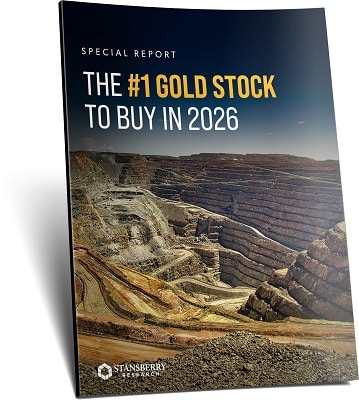
While the teaser does not explicitly name the company, it describes several characteristics:
-
It is a gold‑focused royalty and streaming firm, built on the same business model pioneered by Franco‑Nevada and Royal Gold.
-
The leadership team includes an executive who previously helped grow the world’s largest silver royalty company into a multibillion‑dollar enterprise, suggesting deep sector experience.
-
The firm holds royalty interests in multiple jurisdictions—Brazil, Turkey, Ghana, Argentina, Canada, and the United States—providing geographic diversification.
-
With fewer than 30 employees, it maintains very low overhead while managing a growing portfolio of deals.
The key attraction, according to Stansberry, is size and agility. Because the company is still relatively small, it can pursue:
-
Sub‑billion‑dollar deals that are too small to “move the needle” for giants like Franco‑Nevada or Royal Gold.
-
Highly favorable terms on smaller transactions that larger players may ignore, but which can have an outsized impact on a firm with a modest market cap.
In Stansberry’s words, a single $1 billion project may barely register for a $40 billion company, but could send a smaller royalty stock “soaring.” Similarly, a cluster of $100 million–scale deals—insignificant to the giants—could materially reshape the earnings power and valuation of a nimble royalty firm under $50.
They position this unnamed stock as the #1 gold stock to buy in 2026 because it combines:
-
The proven economics of the royalty model.
-
Early‑stage growth potential akin to Franco‑Nevada or Royal Gold in their formative years.
-
Leverage to a gold price they believe could be on its way to $5,000–$10,000 over the coming cycle.
Why Stansberry Thinks This Royalty Stock Could Outperform
Stansberry Research outlines several reasons why this under‑$50 royalty firm might outperform both miners and larger royalty peers if their gold supercycle thesis plays out.
1. “Feedstock” from the Giants
Because Franco‑Nevada and Royal Gold have grown so large, Stansberry believes they increasingly focus only on mega‑projects, leaving smaller but potentially lucrative opportunities for hungry, smaller royalty players. In practice, this can mean:
-
Smaller development‑stage mines that need financing but don’t meet the size threshold of the big royalty firms.
-
Attractive royalty packages that giants pass on, allowing the smaller firm to negotiate more favorable terms.
2. Operating Leverage to Gold Prices
Royalty revenue is directly tied to production volumes and commodity prices. If gold moves from today’s levels toward the $5,000–$10,000 range envisioned by Stansberry, each incremental dollar in gold price can drop almost straight to the royalty company’s bottom line.
3. Diversification and De‑Risking Over Time
As the firm signs more deals, its portfolio becomes more diversified across properties and jurisdictions, which reduces single‑asset risk while preserving upside. A string of successful deals can also validate management’s capital‑allocation discipline, potentially warranting higher market multiples.
4. M&A Optionality
In a strong gold market, smaller royalty firms sometimes become acquisition targets for larger players seeking to bulk up portfolios quickly. If Stansberry’s pick executes well, it could benefit not only from organic growth but also from the possibility of a takeover premium.
Put simply, Stansberry sees this stock as a leveraged play on both gold’s price and capital rotation into royalty models, with better growth prospects than the larger incumbents.
How to Access Stansberry’s Full Research on the #1 Gold Stock
To access Stansberry’s Full Research on the #1 Gold Stock readers have to subscribe to Stansberry Research’s Commodity Supercycles newsletter.

Here’s what the offer includes:
-
Report #1: “The No. 1 Gold Stock to Buy in 2026”
-
Details the small royalty company Stansberry considers its top gold pick for the current bull market, including the name, ticker, and full investment thesis.
-
-
Report #2: “The Silver Trade”
-
Explains a strategy to profit from an unusually high gold‑to‑silver price ratio (around 72‑to‑1), highlighting a silver‑focused opportunity that has historically rallied sharply when the ratio normalized.
-
-
Report #3: “The Secret Currency: How to Make 500% From the U.S. Government’s Second, Secret Currency”
-
Describes a niche precious‑metals‑related investment favored by historic wealthy families, pitched as an alternative to conventional bullion with higher upside potential.
-
Alongside these reports, a Commodity Supercycles subscription includes:
-
A monthly newsletter focusing on gold, silver, energy, and other natural‑resource opportunities.
-
A model portfolio with 40+ open “buy” recommendations.
-
Access to back issues and archives covering prior cycles and picks.
-
Stansberry Digest daily commentary and a bonus daily e‑letter from Whitney Tilson.
Pricing in the current promotion is framed as an 84% discount, with a one‑year subscription advertised at $79 instead of the nominal $499 list price, backed by a 30‑day money‑back guarantee.
What Kind of Investor Is This #1 Gold Stock For?
While Stansberry Research presents its #1 gold stock to buy in 2026 as a standout opportunity, it is important to match the strategy with the right type of investor profile.
This sort of royalty‑driven gold idea may be most appropriate if you:
-
Believe gold is entering a multi‑year bull market driven by debt, inflation, and geopolitical risk.
-
Prefer business models with lower operating risk and diversified cash‑flow streams relative to single‑asset miners.
-
Are comfortable with equity volatility, since even royalty firms can see share prices swing with commodity markets.
-
Have a multi‑year time horizon to let a cycle play out rather than expecting instant gains.
Conversely, it may be less suitable if you:
-
Are seeking capital preservation only and cannot tolerate significant drawdowns.
-
Prefer simple, fully transparent exposure like physical bullion or broad ETFs.
-
Do not want to subscribe to a research service to obtain the name and analysis of the specific stock.
Key Takeaways on Stansberry Research’s #1 Gold Stock for 2026
Stansberry Research’s pitch for its #1 gold stock to buy in 2026 can be distilled into a few core ideas:
-
The firm believes we are in the early stages of a powerful gold bull market, underpinned by debt, inflation, monetary debasement, and sustained central‑bank buying.
-
Rather than buying bullion, ETFs, or traditional miners, they advocate for gold royalty companies as a more efficient way to capture upside with lower operational risk.
-
Historic royalty leaders like Franco‑Nevada and Royal Gold demonstrate the model’s potential, but Stansberry now favors a smaller, under‑$50 royalty firm with greater room for growth.
-
The full details—name, ticker, and complete analysis—are bundled into their special report The No. 1 Gold Stock to Buy in 2026, available with a trial to Commodity Supercycles.
For investors who share Stansberry Research’s outlook on gold and are willing to allocate a portion of their portfolio to a focused royalty play, this under‑$50 stock is presented as a compelling candidate to anchor that exposure in 2026.
FAQ: Stansberry Research #1 Gold Stock to Buy in 2026
What is Stansberry Research’s #1 gold stock to buy in 2026?
Stansberry Research’s #1 gold stock for 2026 is a small gold royalty company trading under $50 per share, built on the same royalty model pioneered by Franco‑Nevada and Royal Gold, but with more room to grow. The exact name and ticker are revealed in their special report, The No. 1 Gold Stock to Buy in 2026.
Why does Stansberry favor a royalty company over gold miners or bullion?
They argue that royalty companies avoid the heavy capital costs, operational risks, and permitting headaches of running mines, while still capturing upside from rising gold prices through high‑margin royalty streams. Because royalties are spread over many projects, these firms can offer more diversification and lower downside than single‑asset miners.
How can a stock under $50 benefit from a gold bull market?
If gold rises toward the $5,000–$10,000 range that Stansberry believes is possible, each additional dollar in gold price can flow directly into the royalty company’s revenue, potentially driving outsized earnings and share‑price gains from a relatively low starting market cap.
What is the track record of the royalty model in gold?
Stansberry highlights that early investors in Franco‑Nevada and Royal Gold saw life‑changing returns: Franco‑Nevada’s early years generated about 38% average annual returns over 18 years, while Royal Gold delivered more than 10,000% over roughly 25 years, far outpacing the broad stock market.
Why does Stansberry think gold is entering a historic bull market?
Their thesis is based on record government and consumer debt, renewed rate cuts, persistent inflation pressures, geopolitical conflict, and aggressive central‑bank gold buying (over 1,000 metric tons in 2024), all of which historically support sustained strength in gold.
How much upside does Stansberry see for gold prices?
Some banks project gold could hit $5,000 by 2026, but Stansberry suggests a full bull‑market “mania” could eventually drive prices to $10,000 per ounce or higher over several years, similar to prior secular moves in the 1970s and 2000s.
How do I find out the name and ticker of the #1 gold stock?
The name, ticker symbol, and full analysis are contained in Stansberry’s special report The No. 1 Gold Stock to Buy in 2026, which is provided with a trial subscription to their Commodity Supercycles newsletter.
What else is included with a Commodity Supercycles subscription?
Subscribers receive monthly research on gold, silver, energy, and other resources, access to a model portfolio with 40+ open “buy” ideas, archive access, and three bonus reports: The No. 1 Gold Stock to Buy in 2026, The Silver Trade, and The Secret Currency: How to Make 500% From the U.S. Government’s Second, Secret Currency.
Is this #1 gold stock a low‑risk investment?
Stansberry positions royalties as lower risk than miners, but they clearly state that all investments carry risk, past performance does not guarantee future results, and no one should invest money they are unwilling to lose. The stock remains an equity tied to commodity cycles, so volatility is to be expected.
Who is this type of gold royalty stock best suited for?
It is aimed at investors who are bullish on gold, comfortable with cyclical resource stocks, and willing to hold through volatility for potential multi‑year upside, rather than those seeking short‑term trades or ultra‑conservative capital preservation.