
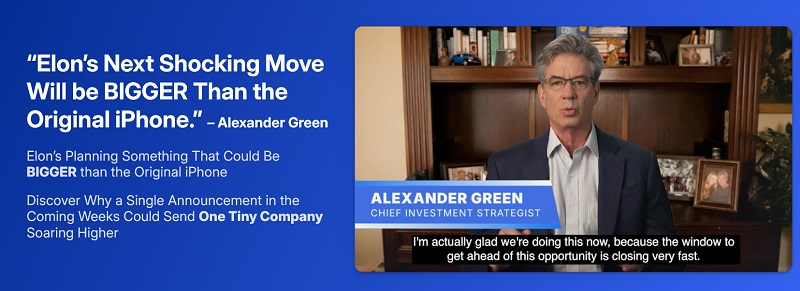
The way 8 billion people connect to the internet may be on the verge of a once‑in‑a‑generation disruption. Alexander Green, Chief Investment Strategist of The Oxford Club, believes Elon Musk’s SpaceX is preparing to launch a new phase of its satellite‑internet vision—something he calls “Project 53.”
At the center of this thesis is not SpaceX itself, but a much smaller satellite company that controls spectrum rights Musk “can’t get anywhere else.” According to Green, this little‑known business could be the linchpin of a multi‑trillion‑dollar space‑to‑Earth communications network—and an exceptional opportunity for investors willing to move before the crowd. His Oxford Microcap Trader service is built to find exactly this kind of asymmetric, early‑stage play.
Below, we’ll break down the story using a simple structure: the problem, the solution, the vehicle, the proof, and the offer behind Project 53 and Oxford Microcap Trader.
The Problem: Old Internet Infrastructure and Limited Access
For all the talk about 5G, AI and the cloud, the backbone of today’s internet is still based on old infrastructure:
-
Cell towers that leave rural areas and remote regions with dead zones
-
Underground fiber and coaxial cables that are expensive and slow to deploy
-
Legacy networks that struggle to deliver affordable, high‑speed access to billions
Roughly 5 billion people are online, but nearly 3 billion still have no reliable internet access at all. Many others pay high monthly bills for connections that are slow, unreliable, or both. Traditional telecom giants have little economic incentive to build out into low‑density or hard‑to‑reach regions, and in many countries, regulation and capital intensity slow progress even further.
For investors, this creates a paradox. The global digital economy continues to expand, but the infrastructure that underpins it has structural limitations. Most large‑cap telecom stocks are mature, heavily regulated, and priced as if they will simply grind forward, not reinvent the world’s networking layer. The market’s biggest upside, Green argues, lies at the point where old infrastructure gives way to a new model of connectivity.
The Solution: Space‑Based Connectivity and “Project 53”
In Green’s Project 53 thesis, the solution is not another incremental improvement to cell towers or ground cables—it’s a radical shift to direct‑from‑space connectivity. Musk’s SpaceX has already demonstrated what’s possible with Starlink: constellations of low‑Earth‑orbit satellites delivering broadband internet to user terminals almost anywhere on the planet.
But Project 53 goes a step further. It envisions:
-
Broad, seamless coverage that treats the globe as a single serviceable footprint.
-
Lower dependence on terrestrial infrastructure, especially in rural and under‑served regions.
-
The potential to disrupt the economics of traditional telecom, reducing the need for dense networks of towers and expensive backhaul.
Critically, this kind of system doesn’t work without access to very specific spectrum—radio frequencies that are both scarce and highly regulated. In satellite communications, these spectrum rights are the “lanes” on the highway. Without the right lanes, even the best rockets and satellites cannot legally deliver service.
Green’s central claim is that there is one small satellite company that holds a crucial bundle of exclusive spectrum rights that SpaceX and other major players need to fully execute on a project of this magnitude. If Musk moves ahead with what Green calls Project 53, this company’s assets could become exponentially more valuable.
The Vehicle: A Tiny Spectrum‑Rights Company at the Heart of Project 53
The “vehicle” in this story is not SpaceX stock (which remains private) and not another mega‑cap telecom name. It’s a publicly traded satellite company with an approximate $8 billion market cap that Green refers to in his report as “The Next Great Space Company.”

Green’s research asserts that:
-
The company owns irreplaceable spectrum rights that are uniquely suited to space‑to‑Earth communications.
-
These rights are exclusive and finite, meaning SpaceX cannot simply replicate them by filing paperwork or launching more satellites.
-
The broader market has not fully priced in the potential of these assets in the context of a large‑scale SpaceX partnership.
If Project 53 is announced and the market recognizes this company as a critical partner or “gatekeeper,” Green believes the stock could soar 3,000% or more over the next five years—or less. That’s the kind of asymmetric upside he looks for with Oxford Microcap Trader: defined downside (as with any stock), but multi‑bagger potential if his thesis is correct.
Because this is a micro‑ to small‑cap idea, liquidity is limited and institutional coverage is still light. That’s precisely why Green considers it an opportunity:
-
Fewer Wall Street analysts = less “crowded trade” risk.
-
Smaller float = more powerful impact from incremental institutional buying.
-
Early‑mover retail investors can establish positions before potential re‑rating and multiple expansion events.
The ticker symbol, full company name, and buy‑up‑to price are reserved for subscribers in his special report, “The Next Great Space Company: Your Gateway to Project 53.”
The Proof: Why Alexander Green and Microcaps?
For any bold thesis—especially one projecting potential 30X gains—it’s reasonable to ask: why this analyst, and why this strategy? Alexander Green’s pitch leans on two main pillars: his background and the track record of The Oxford Club’s microcap and small‑cap research.
Alexander Green’s Background
Green has built his reputation over decades as an investment strategist, author, and long‑time Chief Investment Strategist for The Oxford Club. His work has focused heavily on undervalued growth stocks and early‑stage opportunities that often sit outside mainstream coverage.
In the Project 53 presentation and offer, he frames his role as:
-
Identifying breakthrough themes (like space‑based internet and spectrum plays).
-
Distilling them into actionable stock ideas for private investors.
-
Providing ongoing portfolio management guidance via alerts and updates.
He is not claiming to control the outcome of SpaceX decisions or regulatory approvals, but to recognize structural inflection points before they become obvious to the broad market.
The Microcap Edge
The Oxford Microcap Trader service is built on a simple idea: smaller, under‑followed companies can move farther, faster when catalysts hit. While large‑cap tech names can still double or triple over time, it is often in the microcap space where 10X–30X opportunities emerge, particularly when:
-
A microcap controls a critical technology, asset or license that a much larger player needs.
-
A big strategic partnership, buyout, or regulatory green light suddenly re‑prices the business.
-
Wall Street coverage shifts from minimal to intense as funds “discover” the story.
Green cites past microcap wins where early investors captured 1,000%‑plus returns, sometimes within a few years. He doesn’t present these as typical, and the materials clearly remind readers that investing in microcaps is risky—volatility is higher, liquidity can be thin, and individual positions can decline sharply.
However, when they work, they can significantly impact a portfolio. Project 53 is framed as exactly that kind of high‑impact, high‑conviction setup, with the spectrum‑rights company sitting at the center.
The Offer: Inside Oxford Microcap Trader’s Project 53 Package
To give investors a way to act on Project 53 and similar ideas, The Oxford Club packages the research into a premium membership: Oxford Microcap Trader. For those who join through the Project 53 campaign, the membership is described as follows.
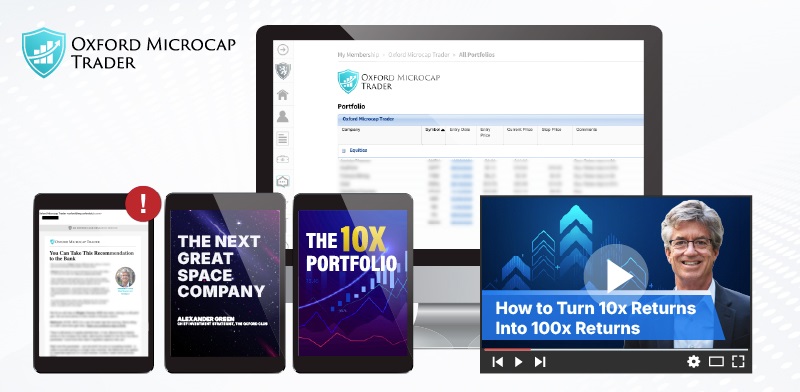
1. One Full Year of Oxford Microcap Trader Research
Members receive:
-
20–25 microcap recommendations per year, each delivered via concise email alerts.
-
Clear “Buy” and “Sell” trade alerts , including ticker, buy‑up‑to price, and risk considerations.
-
Immediate access to the current model portfolio, showing all open positions, initial entry prices, and current status (Buy/Hold).
This ongoing stream of ideas is designed to complement, not replace, a reader’s broader portfolio. The focus is on targeted high‑upside positions, not core index exposure.
2. Special Report #1: “The Next Great Space Company”
This is the flagship Project 53 report. Inside, members find:
-
The full analysis behind Green’s Project 53 thesis.
-
The name and ticker symbol of the spectrum‑rights space company.
-
The specific spectrum assets that make it essential to Musk’s plans, as Green sees them.
-
The valuation case supporting his 3,000% upside projection, including scenario analysis.
-
Step‑by‑step guidance on how to buy the stock and where to consider trimming or exiting if the story changes.
This report acts as the roadmap for the Project 53 trade.
3. Special Report #2: “The 10X Portfolio”
To avoid concentrating everything into a single pick, Oxford Microcap Trader also includes a report featuring three additional microcap stocks Green believes could each return 1,000% or more over roughly 12 months.
These companies are positioned as:
-
“Hidden champions” attacking critical pain points in sectors ripe for disruption.
-
Businesses with large addressable markets but modest current valuations.
-
Under‑the‑radar names where positive catalysts may not yet be fully priced in.
Together with the Project 53 pick, they form a mini‑portfolio of high‑conviction growth ideas.
4. Special Training: “How to Turn 10X Returns into 100X Returns”
For more advanced or aggressive members, Green includes a video training series on using low‑cost options to amplify stock gains. The emphasis is on:
-
Using “penny options” selectively, as a satellite strategy around core microcap positions.
-
Structuring trades so that limited premium controls a larger notional exposure.
-
Providing “paint‑by‑numbers” guidance suitable for those who may be new to options.
The goal is not to turn members into full‑time options traders, but to introduce a leveraged overlay that can convert a 10X move in a stock into a potential 100X effect on a smaller options allocation, while keeping defined risk.
5. Ongoing Updates and Member Support
Members also receive:
-
Weekly email updates on all open recommendations and key macro developments.
-
Alerts if SpaceX makes a Project 53‑style announcement, if the satellite partner launches new satellites, or if insider buying accelerates.
-
24/7 access to a members‑only website with the full archive of reports, open picks, and educational content.
-
Access to a VIP Member Services Team via phone, offering concierge‑style support for service‑related questions.
The standard retail price for Oxford Microcap Trader is positioned at $5,000 per year, but the Project 53 campaign offers a limited‑time discount to $1,995 for the first 100 members.
The Performance Guarantee: “A Triple Every Month… or Alex Works Free”

One of the boldest elements of the offer is Green’s guarantee. He pledges that, over a 12‑month period, the Microcap Trader model portfolio will deliver at least 12 opportunities to see triple‑digit gains—an average of one potential 100%+ winner per month.
Key points of the guarantee:
-
It is based on “chances” to capture triple‑digit moves in recommended stocks, not a promise of realized gains in every member’s account.
-
Past performance is no guarantee of future results, and all sales are final on the subscription itself.
-
If the portfolio does not present at least 12 triple‑digit opportunities within a year, members can call in, and Green commits to extend their access for another full year at no additional cost.
This structure is meant to show confidence in the research pipeline and signal that Green’s interests are aligned with his subscribers—he only earns full value if he continues to deliver high‑upside ideas.
Who Project 53 and Microcap Trader Are (and Aren’t) For
Given the focus on microcaps and asymmetric upside, this approach is best suited for:
-
Investors who understand that volatility and drawdowns are normal in small‑cap and microcap stocks.
-
People comfortable allocating a portion of their portfolio to speculative, high‑reward ideas.
-
Readers looking for research‑driven guidance rather than meme stocks or pure momentum plays.
It is not aimed at:
-
Investors seeking guaranteed income or capital preservation.
-
Anyone uncomfortable with the possibility of large individual stock losses.
-
Traders looking for intraday systems or automated signals.
Green repeatedly emphasizes risk management and the importance of never investing more than you can afford to lose in any single microcap idea, even one he believes could rise 3,000% or more.
The Bottom Line: A Structured Way to Bet on a Massive Shift
Alexander Green’s Project 53 thesis combines three powerful elements:
-
A massive structural problem: outdated internet infrastructure that leaves billions under‑served.
-
A credible technological solution: space‑based connectivity that can bypass many terrestrial bottlenecks.
-
A targeted investment vehicle: a small satellite company with unique spectrum rights that may be indispensable to SpaceX’s vision.
Oxford Microcap Trader is his mechanism for turning that thesis into specific, actionable trades. Whether or not Project 53 plays out exactly as he describes, the framework he uses—identifying critical “choke points” in big themes and then finding small companies that control those choke points—is a powerful way to think about microcap investing.
For investors who believe the next decade will be defined by space, spectrum and global connectivity, Project 53 and Oxford Microcap Trader offer a structured, research‑driven way to participate—before any official announcement from Musk turns this story into front‑page news.
FAQ – Alexander Green’s Project 53 and Oxford Microcap Trader
What exactly is “Project 53” according to Alexander Green?
Project 53 is Alexander Green’s term for a potential next phase of SpaceX’s satellite‑internet rollout, where space‑based connectivity could start to replace traditional cell towers, cables, and dead zones worldwide by using critical spectrum rights held by a smaller satellite company.
Who is the “Next Great Space Company” in the Project 53 thesis?
Green refers to a publicly traded satellite company with roughly an $8 billion market cap that owns exclusive spectrum rights SpaceX “can’t get anywhere else.” He believes these assets make it a key partner for Project 53, but the actual name and ticker are only revealed in his special report for Oxford Microcap Trader members.
What do I get if I join Oxford Microcap Trader through the Project 53 offer?
Members receive a year of Alexander Green’s microcap research (around 20–25 recommendations), email buy/sell alerts, access to the model portfolio, the Next Great Space Company Project 53 report, a “10X Portfolio” report with three more microcaps, a training series on using options for leverage, weekly updates, and full access to the members‑only website.
How big are the gains Alexander Green is targeting with Project 53?
For the Project 53 pick, Green says the satellite company could rise as much as 3,000% over the next five years or less if the market recognizes its role in enabling SpaceX’s ambitions. Across Microcap Trader, he targets multiple 10X‑type opportunities, while emphasizing that microcap stocks are risky and individual results can vary widely.
What is the performance guarantee on Oxford Microcap Trader?
Green pledges that, over 12 months, the Microcap Trader model portfolio will present at least 12 chances to see triple‑digit gains (100%+). If that doesn’t happen, members can call Oxford’s VIP Member Services, and he will extend their subscription for another full year at no additional cost.