
In an era of persistent inflation, rising U.S. debt, and shifting global monetary dynamics, gold has re-emerged as a key asset for wealth preservation and growth. Porter Stansberry, founder of Stansberry Research and Porter & Co., has long advocated for gold as a hedge against currency debasement. In his Royalty Riches report, he argues that gold royalty companies represent the superior way to gain exposure to a potential historic gold bull market — far outperforming physical gold, mining stocks, or traditional investments.
This article explores Stansberry’s thesis, the “Royalty Riches” report, why gold royalty companies stand out, the macroeconomic drivers he highlights (including Basel III implications), and whether these are truly the best gold investment for investors in 2026 and beyond.
Porter Stansberry’s Gold Investing Philosophy
 Porter Stansberry has built his reputation on contrarian, macro-driven insights. He famously predicted economic challenges in his 2010 documentary The End of America, which reached nearly 100 million views. Over three decades, he has identified “all-in” moments for gold — in the early 2000s (around $300/oz), during the 2008 financial crisis (below $800/oz), and more recently.
Stansberry attributes his timing to a proprietary algorithm taught to him by economist Kurt Richebächer. The formula incorporates credit growth, true inflation rates, interest rates, and dollar exchange value. It has reportedly predicted gold’s price range accurately, forecasting $5,500/oz by end of next year and up to $6,000/oz by 2028.
His core view: In a debt-fueled system, endless money printing devalues fiat currencies, driving capital to hard assets like gold. Recent trends — central banks (China, Russia, India) accumulating gold, record U.S. bank gold imports ($75 billion in Q1 2025), and institutions like Morgan Stanley allocating 20% to gold — support this.
The Macro Case: Why Gold Could See a Massive Run
Stansberry points to converging forces:
- U.S. Debt Crisis — Total liabilities (debt + entitlements) approach $100 trillion. Interest payments exceed the defense budget. Social Security faces insolvency by ~2029.
- Dollar Debasement — M2 money supply surged to $26.7 trillion in 2025. Foreign creditors are shifting from U.S. Treasuries to gold.
- Basel III Regulations — The “endgame” phase (phased in, full by 2028) reclassifies physical gold as a Tier 1 high-quality liquid asset (HQLA), equivalent to cash or Treasuries for bank reserves. Previously, gold was discounted (e.g., 50% risk weight). This change eliminates duration and counterparty risk, encouraging banks to hold gold over bonds.
- Global Demand Surge — Central banks hold more gold than Treasuries for the first time since 1996. Physical inflows and re-monetization could drive explosive demand.
These factors position gold for a generational bull market, but Stansberry argues direct bullion or miners aren’t optimal.
Why Gold Royalty Companies? The Capital Efficiency Edge
Traditional gold mining is capital-intensive: high costs, overruns, permitting delays, and operational risks. Miners often dilute shareholders or face volatility.
Gold royalty (and streaming) companies flip this model. They provide upfront financing to miners in exchange for a percentage of future production (royalties) or a fixed-price stream of metal. Key advantages:
- Low Overhead — Minimal staff (e.g., geologist, accountant, lawyer) generates hundreds of millions in revenue.
- No Operational Risk — No mining costs, labor, or environmental issues.
- Revenue in Ounces — Paid in physical gold, not depreciating dollars — perfect hedge against inflation (real rate 10-14% per Chapwood Index).
- Capital Efficiency — High returns on invested capital; back-tested baskets show ~1,800-2,000% cumulative returns over 18 years vs. gold’s 476% and S&P 500’s 556%.
- Compounding Power — Dividends and growth without dilution.
Stansberry highlights royalty companies as “world-class compounders,” outperforming gold bullion and miners in past cycles.
Top Gold Royalty Companies in Focus
The Royalty Riches report spotlights a basket of six royalty companies (two focused on gold/precious metals, two on energy, others diversified). While specific tickers are subscriber-exclusive, industry leaders include:
- Franco-Nevada (FNV) — Often called Stansberry’s #1. Pioneer in royalties/streaming; partnerships with top miners (Newmont, Barrick). Outperformed gold by ~1,000% since 2007; low costs, diversified portfolio.
- Wheaton Precious Metals (WPM) — Leader in streaming; strong cash flows, consistent dividends. Frequently cited for superior returns in bull markets.
- Royal Gold (RGLD) — Disciplined acquisitions, North American focus. Recent deals enhance growth; 24+ years of dividend increases.
- Others — Mid-tier names like Triple Flag Precious Metals (TFPM), Osisko Gold Royalties, Sandstorm Gold (now part of larger entities).
These firms benefit from rising gold prices without proportional cost increases, amplifying upside.
The Royalty Riches Report: What’s Inside?
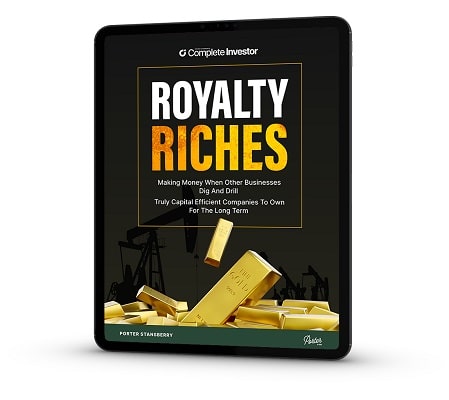
Royalty Riches consolidates Stansberry’s research on these companies — usually reserved for his flagship Porter Stansberry’s Complete Investor advisory ($2,000+/year). It includes:
- Names, tickers, and due diligence on six royalty picks.
- Analysis of capital efficiency and compounding potential.
- Exposure to gold/silver and energy royalties amid AI/data center demand.
- Long-term hold strategy for monetary shifts.
Offered standalone for $199 (no subscription required), it’s positioned as accessible research for the “once-in-a-generation” gold opportunity.
Is This the Best Gold Investment?
Pros:
- Royalty companies offer leveraged upside to gold prices with lower risk than miners.
- Capital efficiency and ounce-based revenue provide inflation protection.
- Historical outperformance during bull markets.
- Alignment with macro trends (Basel III, central bank buying).
Cons/Risks:
- Dependent on gold prices; corrections possible.
- Counterparty risk (though diversified).
- Not guaranteed; past performance ≠ future results.
- Volatility in commodity cycles.
For long-term, risk-adjusted exposure to gold’s potential re-monetization, gold royalty companies — as outlined in Royalty Riches — stand out as a compelling choice over bullion or miners. Stansberry’s track record and focus on efficiency make this a strategy worth considering for diversified portfolios.
If you’re bullish on gold amid debt and currency challenges, exploring royalty stocks could position you ahead of the curve. Always conduct personal due diligence and consult professionals before investing.
FAQ: Porter Stansberry Royalty Riches Report – Best Gold Investment?
What is the Royalty Riches report by Porter Stansberry?
Royalty Riches is a standalone research report from Porter Stansberry that identifies what he considers the best way to invest in gold during a potential historic bull market. It focuses on gold royalty companies (and select energy royalty names) as superior vehicles compared to physical gold, gold ETFs, or mining stocks. The report details six specific royalty companies, including ticker symbols, due diligence, and analysis of their capital efficiency and compounding potential.
Why does Porter Stansberry say gold royalty companies are the best gold investment?
Stansberry argues that gold royalty and streaming companies are among the most capital-efficient businesses in the world. They provide upfront financing to miners and collect a percentage of future production (royalties) or a fixed stream of metal without bearing operational costs, labor, permitting delays, or environmental risks. This structure delivers higher returns on capital, revenue paid in physical gold ounces (inflation-protected), and strong compounding over time. Back-tested baskets reportedly returned ~1,800–2,000% over 18 years vs. gold’s ~476% and the S&P 500’s ~556%.
What macro factors does Stansberry say are driving the next gold bull market?
Key drivers include:
- Record gold inflows to U.S. banks and institutions like Morgan Stanley allocating 20% to gold. He forecasts gold reaching ~$5,500/oz by end of next year and up to $6,000/oz by 2028.
- Exploding U.S. debt and entitlements (~$100 trillion total liabilities) requiring massive money printing.
- Dollar debasement and loss of reserve currency status, with foreign central banks (China, Russia, India) buying record gold.
- Basel III regulations reclassifying physical gold as a Tier 1 high-quality liquid asset (HQLA) by 2028, allowing banks to hold gold as reserves instead of Treasuries.
What is Basel III and why does it matter for gold?
Basel III is a set of international banking regulations developed by the Basel Committee on Banking Supervision. The final “endgame” phase (phased implementation, full effect by 2028) will treat physical gold as a Tier 1 high-quality liquid asset — equal to cash or U.S. Treasuries for bank reserve requirements. Previously, gold was discounted (e.g., 50% risk weight). This change removes duration and counterparty risk, encouraging global banks to shift reserves from Treasuries to gold, potentially creating massive new demand.
Which gold royalty companies are highlighted in the Royalty Riches report?
The report covers six royalty companies — two focused primarily on gold and precious metals, two on energy, and others diversified. Specific names and tickers are provided in the full report (available for $199). Industry leaders often associated with Stansberry’s thesis include Franco-Nevada (FNV), Wheaton Precious Metals (WPM), Royal Gold (RGLD), and others like Triple Flag Precious Metals and Osisko Gold Royalties.
How much does the Royalty Riches report cost?
The Royalty Riches report is offered as a standalone purchase for $199 — no subscription required. This is significantly less than Stansberry’s flagship advisory (Porter Stansberry’s Complete Investor, normally $2,000+ per year), where similar research is usually reserved for paying members.
Is the Royalty Riches report part of a subscription?
No. It is a one-time purchase with no recurring fees or automatic renewal. You receive the full report (including company names, tickers, and analysis) without needing to join any ongoing advisory service. However, Stansberry invites readers to consider his premium Complete Investor advisory for continued recommendations and model portfolios.
What are the risks of investing in gold royalty companies?
While royalty companies have lower operational risk than miners, they are still exposed to:
- Broader market or economic downturns. Past performance (e.g., 1,800%+ returns in back-tests) is not a guarantee of future results. These are equity investments and can lose value.
- Declines in gold (or silver/energy) prices.
- Counterparty risk (if partner miners fail to produce).
- Commodity cycle volatility.
Should I buy physical gold instead of royalty stocks?
Stansberry recommends physical gold or Bitcoin as core hedges (he personally allocated ~50% of liquid net worth to gold/Bitcoin recently), but argues royalty companies offer leveraged upside and compounding potential with less direct exposure to storage/security issues. Physical gold is simpler and has no counterparty risk, while royalty stocks provide income (dividends) and growth tied to rising metal prices.
How can I get the Royalty Riches report?
The report is available through a special offer here. It costs $199 and provides immediate access to the research on his six favorite royalty companies. No subscription is required for this standalone report.
Has Porter Stansberry been accurate about gold before?
Stansberry has advocated gold during three major “all-in” periods: early 2000s (~$300/oz), 2008 crisis (below $800/oz), and recently. His calls aligned with multi-fold gains in gold prices during those cycles. However, no investment or forecasting method guarantees future success.