

Louis Navellier — who manages nearly $1 billion in client assets and has a long history of identifying major market turning points — is warning of a significant event he calls a “brutal AI dislocation.” In a special InvestorPlace presentation hosted by Chris Hurt, Navellier explains that this anticipated shakeout, triggered by Nvidia’s quarterly earnings release on that date, will mark the end of Stage 1 of the AI boom — the easy-money phase where almost any company associated with AI could deliver strong gains simply by riding the rising tide of hype and speculation.
Navellier has spent decades studying technology cycles and has repeatedly demonstrated an uncanny ability to spot inflection points well before most investors. He was aggressively bullish on the personal computer revolution in the 1980s and early 1990s, correctly identified the dot-com bubble peak in January 2000, flagged the risks of the 2008 financial crisis as early as January 2008, and nailed the Covid market bottom within two days in 2020. His quantitative system has turned $10,000 into as much as $410,000 over 15 years in certain periods, more than doubled the S&P 500’s return from 1998 to 2024, and produced dozens of stocks that delivered 1,000% to 5,000% or more gains.
Today, he is stepping forward not to scare investors, but to prepare them. He believes the February 25 Nvidia earnings report — even if the company beats estimates — is likely to disappoint relative to the extraordinarily high expectations already priced into the stock and the broader AI sector. This “expectations bubble” has reached a point where anything less than perfection could trigger a violent rotation out of first-wave AI leaders, similar to the psychological shifts that ended the easy-gain phases of past technology booms.

Understanding the Historical Pattern of Technology Booms
Navellier emphasizes that every major technological revolution follows a predictable three-phase cycle.
Stage 1 is characterized by widespread excitement and speculation. Capital floods into almost any company tied to the new technology, creating broad-based gains even among mediocre businesses. This phase rewards investors who simply participate, regardless of selectivity.
Stage 1 eventually ends with a dislocation — a seemingly small event that exposes the gap between sky-high expectations and reality. This catalyst triggers panic selling, heavy losses for late entrants or over-leveraged players, and a sharp correction in the most speculative names. Historically, these dislocations have been triggered by earnings disappointments, failed product launches, regulatory setbacks, or external shocks that reveal the sector’s overextension.
Stage 2 is the phase of consolidation and genuine value creation. A handful of true winners emerge with strong fundamentals, dominant market positions, or unique advantages. Capital rotates toward these survivors, often producing the largest and most sustainable gains of the entire cycle. The majority of Stage 1 participants — including many that appeared promising — fade or disappear entirely, while the right vehicles deliver life-changing returns.
Navellier illustrates this pattern with several historical examples. During the railroad boom of the late 1800s, railroads dominated more than 60% of the U.S. stock market. In 1873, the failure of the banking firm Jay Cooke & Co. triggered a nationwide panic, forced the NYSE to close for 10 days, and bankrupted a quarter of all railroad companies. Yet investors positioned in the strongest survivors made over 1,000% in the years that followed.
The automobile boom followed the same trajectory. By the early 20th century, 253 active U.S. automakers existed. The 1920 recession acted as the dislocation event, wiping out most of them. Only a few dozen survived, and 80% of the market eventually consolidated into Ford, General Motors, and Chrysler — the Stage 2 winners that delivered massive long-term gains.
The dot-com/internet boom is the most familiar modern example. In late 1999 and early 2000, companies with “.com” in their name soared regardless of fundamentals. The catalyst came when MicroStrategy issued an earnings correction — a seemingly minor event that shattered the illusion of endless growth. The Nasdaq collapsed 77%, Cisco lost 88% (taking 25 years to recover), and many hyped names went to zero. But the true Stage 2 winners — Amazon, Google, Netflix, and others — went on to deliver gains of 8,151%, 1,037%, and 7,749% respectively.
The biotech boom of the early 1990s followed the same arc. A 1992 wave of FDA rejections collapsed the biotech index by more than 55%, but Amgen — one of the few genuine innovators — soared as much as 30,243% in the subsequent Stage 2 phase.
Navellier’s conclusion is clear: technology booms do not end — they transition. The dislocation marks the boundary between hype-driven speculation and real business building. The largest, most durable gains almost always occur in Stage 2, after the shakeout separates the survivors from the casualties.
The February 25, 2026 Catalyst: Nvidia’s Earnings & the Expectations Bubble
Navellier identifies February 25, 2026 — the date of Nvidia’s next quarterly earnings release — as the most likely trigger for the AI market’s shift from Stage 1 to Stage 2. He explains that Nvidia has conditioned Wall Street to expect not just beats, but repeated blowout quarters with upward guidance revisions. This has created an “expectations bubble” where the stock price already embeds near-perfect performance indefinitely.
In November 2025, Nvidia beat consensus estimates and delivered record results, yet the stock barely moved because the forward guidance, while strong, did not exceed the already astronomical bar. Navellier believes the market has reached a point where no company — not even Nvidia — can consistently deliver results that satisfy these extreme expectations. Even a solid but “only good” report could be perceived as a disappointment, triggering a rapid rotation out of first-wave AI leaders.
He stresses that the company does not need to miss earnings or issue negative guidance. A simple failure to exceed already sky-high consensus forecasts would be enough to pop the bubble psychologically. Because Nvidia’s earnings are a bellwether for the entire AI sector, the ripple effect could be swift and severe — similar to MicroStrategy’s correction in 2000 or Jay Cooke’s collapse in 1873.
Navellier is not predicting the end of AI or a prolonged bear market. He remains extremely bullish on the long-term potential of artificial intelligence, comparing its transformative power to fire or electricity. What he is forecasting is the end of the easy phase — the period where broad participation in AI-related stocks was rewarded regardless of fundamentals. After February 25, selectivity will matter more than ever.
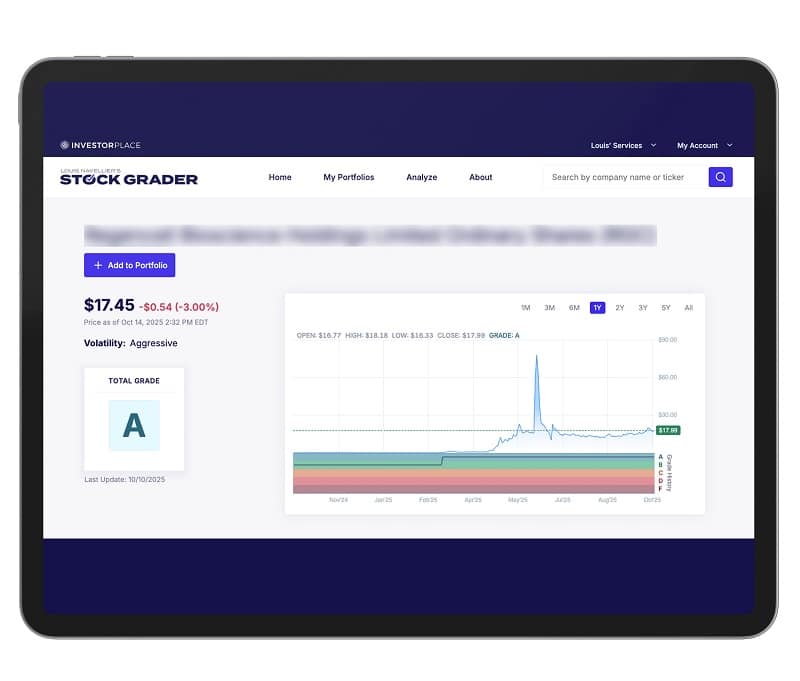
At the heart of Navellier’s approach is his proprietary Stock Grader — a quantitative model that evaluates over 6,000 publicly traded companies daily and assigns each an A-to-F grade based on dozens of fundamental, momentum, and risk-adjusted factors. The system measures revenue growth, earnings momentum, cash flow strength, valuation discipline, and other metrics that historically distinguish breakout winners from average performers.
The grader is designed to identify stocks offering unusually high reward potential relative to downside risk — the rare combination that produces multi-thousand-percent returns with limited drawdowns. Navellier built the core of this model in the late 1970s using mainframe computers at Wells Fargo, and he has refined it continuously ever since. He uses it to manage private client money, institutional portfolios, and his own research services.
The grader has flagged many of Navellier’s most successful calls before they became widely recognized. It identified Moderna, Novavax, and Vaxart months before Covid vaccines were approved (subsequent gains of 1,523%, 2,562%, and 1,723%). It highlighted Permian Basin Royalty Trust, YPF, and PBF before the Russia-Ukraine conflict (gains of 162%, 113%, and 192%). During the EV boom, it flagged Blink Charging (up to 3,350%) while avoiding weaker names like Rivian (down 88% from IPO).
Navellier emphasizes that the grader is not perfect — no system is — but it has proven exceptionally effective at separating future winners from future losers, especially during boom-bust transitions.
The Six Stage 2 AI Picks: Positioning for the Next Wave
In his special report The AI Boom Stage 2: Six Stocks for the Next Wave of Artificial Intelligence, Navellier reveals six specific stocks his Stock Grader has flagged as prime beneficiaries of the post-dislocation environment. These are not the obvious first-wave leaders — Nvidia, Microsoft, or the other Magnificent 7 names — but smaller, under-the-radar companies with strong fundamentals, limited downside risk, and clear positioning to gain market share as the AI sector consolidates.

Navellier explains that Stage 2 winners are rarely the most hyped companies during Stage 1. They are often overlooked businesses that possess durable competitive advantages, solid cash flows, and the ability to execute when broader speculation fades. He believes these six picks are designed to:
- Weather the February 25 shakeout with limited damage.
- Capitalize on capital rotation away from overvalued first-wave names.
- Deliver potentially explosive returns as corporations begin deploying AI at enterprise scale throughout 2026 and beyond.
He compares the current moment to the post-dot-com survivors (Amazon, Google, Netflix), the post-1920 auto consolidators (Ford, GM, Chrysler), and the post-1992 biotech standouts (Amgen). In each case, the largest gains came after the dislocation, when the market rewarded real business value rather than narrative hype.
The six picks are detailed in the report, which is available as part of the current Breakthrough Stocks membership offer. Navellier stresses that these are the same quality of ideas he provides to his high-net-worth private clients — the same process, the same system, but at a fraction of the cost.
Breakthrough Stocks Membership: Current Limited-Time Offer
To access the six Stage 2 AI picks, run any stock through the Stock Grader, receive monthly recommendations, and stay positioned ahead of the February 25 dislocation, Navellier is offering a special discounted one-year membership to Breakthrough Stocks — his monthly research service focused on high-reward, limited-risk opportunities.
Exclusive Offer Pricing:
- 1 Year of Breakthrough Stocks for $1,799 Regular price: $4,000 Discount: 55% off This limited-time offer is available only through the current promotional page.

Included Benefits & Bonuses:
- One new high-conviction stock recommendation each month (minimum 12 per year), with full analysis, buy range, and risk assessment.
- Direct access to the Stock Grader tool — grade any of 6,000+ stocks A-to-F instantly.
- The AI Boom Stage 2: Six Stocks for the Next Wave of Artificial Intelligence — the complete list of six Stage 2 picks.
- The Stocks to Sell Before the AI Dislocation — a warning list of vulnerable names that could be hit hard on or after February 25.
- 100% satisfaction guarantee — full refund if not satisfied within the trial period.
Navellier stresses urgency: the February 25 Nvidia earnings report is fast approaching. Positioning before the dislocation is critical to avoid chasing winners higher or holding losers through a prolonged recovery period.
Risks & Important Considerations
All investments involve risk, including the potential loss of principal. Past performance — whether historical boom patterns, Navellier’s prior recommendations, or reader testimonials — does not guarantee future results. The February 25 dislocation is a prediction based on current market dynamics, not a certainty. Stage 2 winners are never obvious in real time; many seemingly promising companies fail to survive the transition. Investors should conduct their own due diligence, consider their risk tolerance, and consult a qualified financial advisor before making any investment decisions.
Louis Navellier’s message is straightforward: Stage 1 of the AI boom rewarded broad participation. Stage 2 will reward selectivity, fundamentals, and preparation. The dislocation he forecasts could be painful for many — but it also represents one of the clearest second-chance opportunities in decades for those who position themselves correctly.
To access the six Stage 2 AI picks, Stock Grader tool, monthly recommendations, bonus reports, and the 55% discounted $1,799 one-year membership, complete the secure order form on the promotional page here while the special offer remains active.
What is Breakthrough Stocks and what do I get as a member?
Breakthrough Stocks is Louis Navellier’s monthly research service focused on high-reward, limited-risk opportunities identified by his Stock Grader system. Members receive one new stock recommendation per month (minimum 12 per year), full analysis, buy ranges, risk assessments, and timely alerts for entries and exits. Additional benefits include 24/7 access to the Stock Grader tool (grade any stock A–F), weekly updates, and a complete digital archive of past recommendations and reports.
What is the current limited-time offer for Breakthrough Stocks?
For a limited time, new members can join Breakthrough Stocks for $1,799 for one full year — a 55% discount off the regular $4,000 price. This offer includes immediate access to:
- All monthly recommendations, alerts, and historical research archive
- The AI Boom Stage 2: Six Stocks for the Next Wave of Artificial Intelligence
- The Stocks to Sell Before the AI Dislocation (warning list of vulnerable names)
- Direct use of the Stock Grader tool
Is there a money-back guarantee for Breakthrough Stocks?
Yes — Navellier offers a 100% satisfaction guarantee. If you are not satisfied for any reason, contact support within the trial period for a full refund. All reports and access materials remain yours to keep even if you cancel.
Are there risks to investing in Stage 2 AI stocks?
Yes — all stock investments carry risk, including the potential for loss of principal. The February 25 dislocation is a prediction, not a certainty. Stage 2 winners are never obvious in real time; many seemingly promising companies fail to survive transitions. Past performance (historical booms, Navellier’s prior recommendations, reader testimonials) does not guarantee future results. Investors should conduct their own due diligence, consider their risk tolerance, and consult a financial advisor.
How do I get the six Stage 2 AI picks and join Breakthrough Stocks?
Complete the secure order form on the current promotional page to lock in the $1,799 one-year membership (55% off regular price) while the limited-time offer is active. You’ll receive instant access to the six Stage 2 picks, Stock Grader tool, monthly recommendations, bonus reports, and all membership benefits.