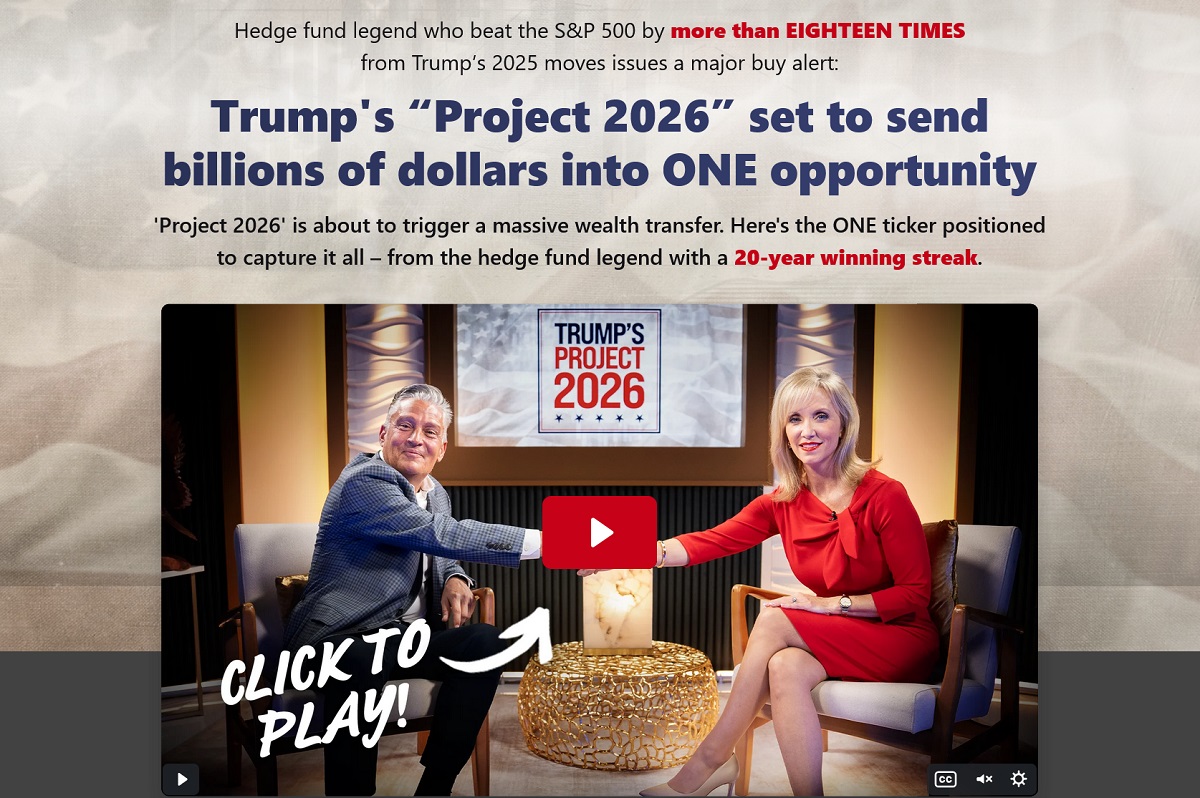
Larry Benedict’s “Project 2026” centers on a simple but aggressive idea: a massive wealth transfer inside the S&P 500, away from the “Magnificent Seven” and toward the other 493 stocks – with one ETF, RSP, sitting right in the middle of that potential shift. In this article, you’ll see how Trump’s new trade powers, Larry’s “One Ticker” strategy, and the Invesco S&P 500 Equal Weight ETF (RSP) all come together in what he believes could be one of the biggest trading setups of the decade.
What Is Larry Benedict’s Project 2026?
Project 2026 is Larry Benedict’s name for a sweeping market shift he believes will be driven by Trump’s new use of national‑security trade powers under Section 232 and Section 301. After the Supreme Court ruled against Trump’s earlier emergency tariff framework, the administration pivoted toward these older but powerful laws that sit outside the current tariff system and allow targeted pressure on specific industries.
Under Section 232, the president can label heavy foreign dependence in a sector – like steel, semiconductors, or pharmaceuticals – a national security risk, then hit that sector with tariffs or restrictions. Section 301 lets the United States respond to “unfair” trade practices with broad, potentially long‑lasting trade actions that can be renewed and expanded.
Larry’s view is straightforward: these tools won’t just move headlines – they can shove hundreds of billions of dollars around the stock market, sometimes in a matter of weeks or even days. Instead of slow, negotiated tariff battles, Project 2026 could bring sudden, sector‑by‑sector disruptions that create big winners and big losers across the S&P 500.
Why Larry Thinks a Wealth Transfer Is Coming
 For years, market gains have been dominated by the “Magnificent Seven”: Apple, Microsoft, NVIDIA, Amazon, Meta, Tesla, and Google. Together, these seven names now represent over 30% of the S&P 500’s total value, meaning a small group of mega‑cap tech stocks exerts outsized influence over the entire index.
Larry points out three key problems with this concentration:
-
The Magnificent Seven already soared on themes like AI, cloud computing, and digital advertising, making them very large and, in his view, harder to grow at the same pace.
-
When policy shifts begin targeting other sectors – like domestic manufacturing, critical materials, supply chains, or traditional industries – money may rotate out of these giants into the rest of the market.
-
A shock from new tariffs, national‑security reviews, or sector restrictions can hit market darlings faster than most 401(k) investors can react.
Project 2026, as Larry frames it, is built on that rotation story. If Trump uses Section 232 and 301 to push aggressive “America‑first” policies, companies tied to domestic production, reshoring, and diversified supply chains could start drawing in capital. The key question then becomes: how do you position for a broad move into the “forgotten 493” stocks without trying to guess individual winners one by one?
Meet RSP: The ETF at the Center of the Strategy
RSP is the Invesco S&P 500 Equal Weight ETF, built to track the S&P 500 Equal Weight Index. Instead of giving the biggest tech names massive weight like the traditional S&P 500 does, RSP assigns each of the 500 stocks roughly equal weight and rebalances quarterly.
That equal‑weight structure is crucial to Larry’s Project 2026 thesis:
-
In a cap‑weighted index, huge companies like Apple or Microsoft dominate index performance and attract most of the passive money flow.
-
In an equal‑weight index, mid‑sized and smaller S&P names get a bigger share of the pie, so they can benefit more when money rotates away from mega‑cap leaders and into the rest of the index.
-
If hundreds of billions start leaving the Magnificent Seven and flowing toward the other 493, a vehicle like RSP is designed to capture that broader move instead of relying on just a few giants.
RSP normally holds over 500 stocks and keeps its expense ratio around 0.20%, which is competitive for a more specialized ETF. Because it rebalances quarterly, it tends to “trim” names that have run too far and “add” to names that lag, which has historically made it more volatile and more active than a standard index tracker.
How Project 2026 Could Affect RSP
To see how Project 2026 might play out for RSP, you have to link policy risk and index construction. When Trump targets a sector using Section 232 or 301 – say steel, autos, chips, or pharmaceuticals – the following can happen:
-
Uncertainty spikes. Companies relying heavily on foreign suppliers suddenly face questions about costs, access to materials, and future regulation.
-
Investors move money. Capital often leaves sectors or names in the policy “crosshairs” and looks for more resilient or more favored areas, sometimes inside the same broad index.
-
Rotation accelerates. In a market already top‑heavy in a few mega‑caps, political risk can become the spark that sends funds toward smaller, more domestic, or more diversified names.
Because RSP spreads its weight more evenly across all S&P 500 names, a sustained rotation into the forgotten 493 would naturally show up more strongly in its returns than in a cap‑weighted S&P 500 fund. The more capital moves away from the Magnificent Seven, the more the equal‑weight approach could shine compared with traditional index trackers that still lean heavily on those giants.
In practical terms, Larry sees RSP as a single ticker that can ride the broader wealth transfer he expects Project 2026 to unleash. Rather than trying to pick dozens of individual stocks that might benefit from reshoring, tariffs, and sector‑specific policies, this ETF is meant to give you diversified exposure to the “new winners” he believes will emerge inside the S&P.
Larry Benedict: The Market Wizard Behind the Plan
Larry Benedict isn’t just another newsletter editor; he’s a professional trader whose name appears in Jack Schwager’s book “Hedge Fund Market Wizards” alongside big names like Ray Dalio and Joel Greenblatt. During the 2008 meltdown, when the S&P 500 fell 37%, Larry posted a 23% gain for his clients, making $95 million in that year alone.
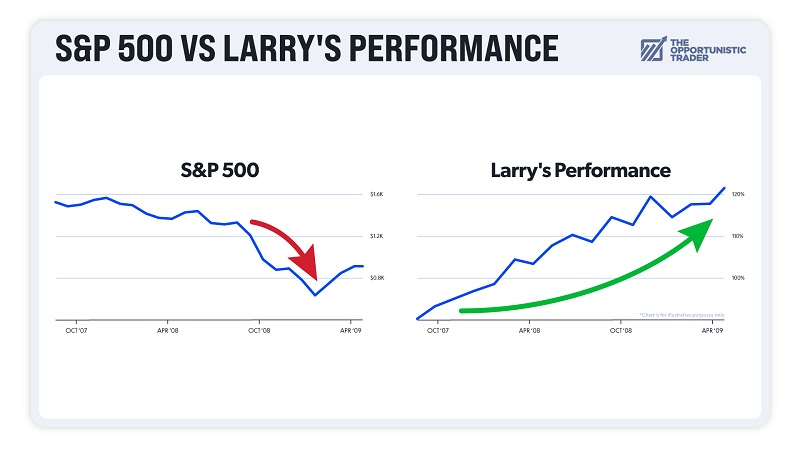
Over a 20‑year stretch as a hedge fund manager and professional money manager, Larry achieved consecutive winning years through four different presidential administrations. In 2025, he delivered a 279% return on cash using his “One Ticker Trading” approach while the S&P 500 returned 15%, an 18× difference in percentage returns.
He also has a history of navigating Trump‑driven volatility:
-
On “Liberation Day,” when tariffs triggered a rapid 10% drawdown and wiped more than $2 trillion in market value, Larry used a single ticker (QQQ) to guide his readers to a series of wins – gains of roughly 30%, 59%, 18%, and 29% in just over two weeks.
-
Right after Trump’s 2024 reelection, Larry went 13‑for‑13 on his first trade recommendations of 2025, with no losing trades in that initial run.
-
He has used Trump’s moves in tariffs, subsidies, and approvals – from clean energy to AI – as recurring catalysts in his trading.
His “secret,” as he describes it, is staying focused on the one ticker that sits at the center of each major market move, then trading it multiple times as conditions unfold. That focus is exactly what he is now applying to RSP in Project 2026.
The One Ticker Trader Approach
One Ticker Trader is Larry’s trading advisory where he applies that single‑ticker philosophy month after month. Instead of juggling dozens of positions, he hunts for the one stock, ETF, or theme that best captures a major macro trend, then uses options to target it with leverage and defined risk.
Here’s what subscribers to One Ticker Trader receive when they join through the Project 2026 offer:
-
Monthly deep‑dive research. Each month, Larry breaks down what’s happening in the markets, how Trump’s policies are shifting capital, and which sectors or themes are setting up for big moves.
-
Timely trade alerts. When he sees a setup, subscribers get the ticker, suggested entry price, when to buy, when to sell, and how he’s structuring the trade (often with options).
-
Focused trading plan. Instead of scattering attention across 15–20 positions, Larry zeroes in on one main ticker and trades it multiple times as the story develops.
His track record inside this framework includes:
-
Nearly 60% gains in a single day during Liberation Day chaos using QQQ, followed by additional trades netting around 29% and 30% on the same ticker.
-
A 41% gain in nine days tied to Trump’s spending bill rattling bond markets.
-
An 87% gain when Trump pushed through new drilling permits.
The goal isn’t to win every trade or to avoid volatility; it’s to translate big macro shifts into focused, repeatable opportunities on a single core ticker at a time.
What You Get in Larry’s Project 2026 Package
Through the current Project 2026 promotion, new members can access One Ticker Trader and Larry’s RSP playbook at a steep discount.
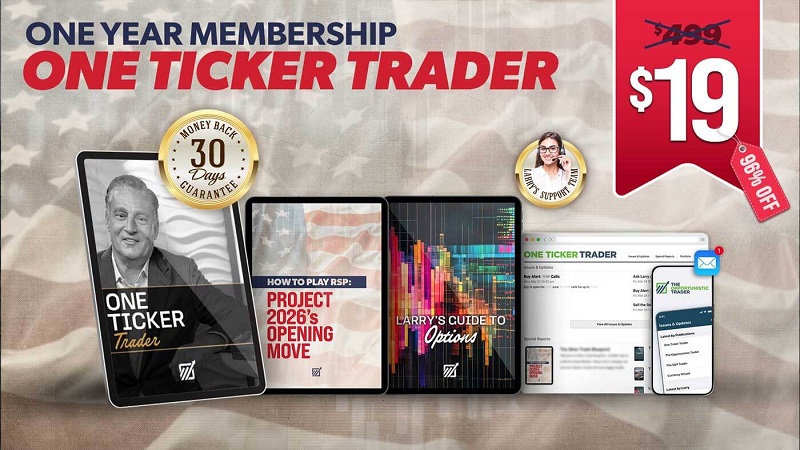
Here’s the full package:
One Year of One Ticker Trader
You receive 12 months of research, trade ideas, and ongoing guidance as Project 2026 unfolds.
-
Monthly issues explaining the most important market moves tied to Trump’s policies.
-
Trade alerts with exact ticker, entry zone, and exit strategy.
-
A model portfolio and email updates as positions are opened, managed, and closed.
Special Report #1 – “How to Play RSP: Project 2026’s Opening Move” (Value: $199)
This report is Larry’s step‑by‑step blueprint for using RSP as the main vehicle for the first big wealth transfer he expects from Project 2026. Inside, he covers:
-
The full Project 2026 thesis: why the Magnificent Seven are vulnerable, why the other 493 S&P stocks could be poised to surge, and why an equal‑weight ETF like RSP can capture that move in one trade.
-
The exact entry strategy, including signals he watches to determine when the wealth transfer is actually starting, so you’re not buying too early or late.
-
Step‑by‑step instructions on how to buy RSP, position size guidelines, and when to consider taking profits.
-
Timing triggers that hint when capital is rotating from Big Tech into domestic and overlooked sectors, helping you line up your trades with those flows.
Instead of guessing which individual industrial, energy, or supply‑chain stocks might benefit, the report focuses on using one diversified ETF to play the broader shift.
Special Report #2 – “Larry’s Guide to Options” (Value: $99)
Because One Ticker Trader relies heavily on options, this second report serves as a beginner‑friendly options primer. It is designed for regular investors who may never have placed an options trade before. You’ll learn:
-
A plain‑English explanation of what an option is, without heavy jargon.
-
The two basic types of options – calls and puts – and when Larry typically uses each.
-
How to place your first options trade step by step, with screenshots showing where to click on common brokerage platforms.
-
How to open an options account and how to answer the basic questions most brokers ask.
-
Risk management basics, including how much to allocate per trade, when to take profits, and when to cut losses.
One of the report’s key points is that options can limit risk compared with buying shares outright. For example, instead of spending $18,000 on 100 shares of a $180 stock and risking a $1,800 loss on a 10% drop, you might spend $500 on an option with similar upside potential and a maximum risk capped at that $500 premium.
Larry’s Trading Course
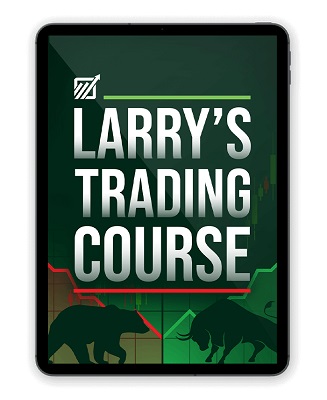
Alongside the written reports, Larry includes a trading course designed to simulate “looking over his shoulder” as he trades. In it, he walks through:
-
Basic terminology and tools he uses every day.
-
How he reads indicators, news, and price action to build a trading thesis.
-
How he organizes his screens, watchlists, and alerts to catch opportunities as they develop.
The idea is to give you the kind of hands‑on education that used to be available only on professional trading floors, but in a format you can follow from home and at your own pace.
Pricing, Guarantee, and Renewal Details
The retail price of this full package – One Ticker Trader plus both Project 2026 reports and the trading course – is listed at $499. Through the current promotion, you can access everything for $19 for the first year, which works out to less than $2 per month.
Larry backs this with a 30‑day “keep‑everything” money‑back guarantee:
-
You have 30 days to explore the member area, read the reports, and follow a trade or two (or paper trade them if you prefer).
-
If you decide the service isn’t right for you at any time within those 30 days, you can contact support for a full refund of your membership fee.
-
Even if you cancel, you keep both special reports – the RSP playbook and the options guide – as a thank‑you for trying the service.
The subscription is set to automatically renew each year at a higher rate – currently $199 plus applicable taxes – unless you cancel at least one day before the renewal date. Annual subscribers receive a reminder before renewal, and customer service is available by phone or through the company’s account page.
Who Project 2026 and RSP Could Be Right For
While only you can decide what fits your financial situation, Larry’s Project 2026 plan is clearly targeted at a specific type of investor:
-
People who hold significant S&P 500 exposure (through 401(k)s or IRAs) and worry about being over‑reliant on a few mega‑cap tech names.
-
Investors who want a simple, focused way to try to benefit from potential rotation into domestic, diversified, or overlooked S&P 500 names.
-
Traders interested in learning to use options with clearly defined risk and a rules‑based approach.
-
Individuals willing to follow email alerts and make trades through a standard online brokerage account.
It may be less appropriate for investors who prefer fully passive buy‑and‑hold strategies, who are uncomfortable with options or short‑term volatility, or who cannot afford to lose the money they might commit to trading. Any use of RSP or similar ETFs should still be evaluated in the context of your broader asset allocation, risk tolerance, and time horizon.
How to Get Started With Larry Benedict’s Project 2026 and RSP
If you decide you want to explore Larry Benedict’s Project 2026 plan in more detail, the process laid out in the presentation is straightforward:
-
Activate the One Ticker Trader subscription.
You use the secure order form, enter your contact and payment information, and lock in the current $19 promotion before it reverts toward the $499 retail price. -
Download the RSP Playbook and Options Guide.
Once your membership is live, you immediately gain access to “How to Play RSP: Project 2026’s Opening Move” and “Larry’s Guide to Options,” which you can read at your own pace. -
Review the latest research and alerts.
You can scan the member portal, model portfolio, and archived alerts to see how Larry has been positioning around Trump‑related shocks and other macro events. -
Decide how to participate.
Some members start by paper trading his recommendations, while others commit a small portion of their capital and scale up only if they’re comfortable with the process. -
Use the 30‑day window wisely.
Within the first month, you can judge whether Larry’s approach, communication style, and strategy around RSP and Project 2026 fit your goals – and request a refund if they don’t.
Final Thoughts: Playing the RSP Opportunity With Eyes Wide Open
Larry Benedict’s Project 2026 thesis is bold: that Trump’s use of Section 232 and 301 will drive one of the biggest capital rotations inside the S&P 500 in recent memory, and that an equal‑weight ETF like RSP is uniquely positioned to benefit as money moves from the Magnificent Seven into the other 493 stocks. Backing that thesis is his decades‑long trading record, his 279% return on cash in 2025, and a highly focused “One Ticker” approach he’s now aiming squarely at RSP as the opening move of Project 2026.
At the same time, RSP remains an equity ETF subject to market risk, and options trading adds leverage and complexity that can amplify both gains and losses. Any investor considering this path should treat Larry’s materials as research and education, not as a promise of results, and should size positions so that even a string of losing trades would be survivable.
If you want a structured way to follow this story – with a single, clearly defined ticker at its core, a step‑by‑step options guide, and a trading course from a recognized Market Wizard – Larry Benedict’s Project 2026 package around RSP is designed to be that roadmap.
FAQ: Larry Benedict’s Project 2026 and RSP
What is Larry Benedict’s Project 2026 and why does he focus on RSP?
Project 2026 is Larry Benedict’s name for the wealth transfer he expects as Trump uses Section 232 and 301 trade powers to redirect money across the S&P 500. He believes capital will rotate away from the “Magnificent Seven” mega‑caps into the other 493 stocks, and he targets the Invesco S&P 500 Equal Weight ETF (RSP) because it spreads weight more evenly across all S&P 500 names and can potentially benefit more from that rotation.
How does Larry’s One Ticker Trader service help me trade Project 2026?
One Ticker Trader is Larry’s options trading advisory where he picks a single core ticker at a time – like RSP for Project 2026 – and sends members deep‑dive research plus buy and sell alerts. You get monthly market analysis, specific options or ETF trade setups, and real‑time alerts that include ticker, entry zone, exit strategy, and risk guidelines so you don’t have to build the plan from scratch.
What exactly do I get for the $19 Project 2026 offer?
The special offer includes one full year of One Ticker Trader, Larry’s special report “How to Play RSP: Project 2026’s Opening Move,” his “Guide to Options,” and access to his trading course. The standard retail value is $499, but this promotion discounts it to $19 for the first year, which comes with a 30‑day money‑back, keep‑everything guarantee.
Is trading RSP and options with Larry’s strategy safe?
All investing involves risk, and Larry and the publisher emphasize that past gains – including his 279% return on cash in 2025 and big wins during “Liberation Day” – are not typical. RSP is still an equity ETF subject to market volatility, and options can lose 100% of the premium paid, which is why Larry teaches position sizing, risk limits, and exit rules in his reports and trading course.
What happens after the first year – will my subscription renew automatically?
Yes. When you join, you agree that One Ticker Trader will automatically renew each year at the then‑current renewal price – currently listed as $199 plus applicable taxes – unless you cancel. You’ll receive a renewal reminder, and as long as you cancel at least one day before the renewal date, you won’t be charged for another year.