What if you could trade inflation, elections, the next Fed rate cut—or whether AI-powered robots will beat humans at chess again this year?
That’s not science fiction anymore. It’s what the fast-growing world of prediction markets allows traders, investors, and even casual speculators to do: trade on real-world events as easily as they would stocks or commodities.
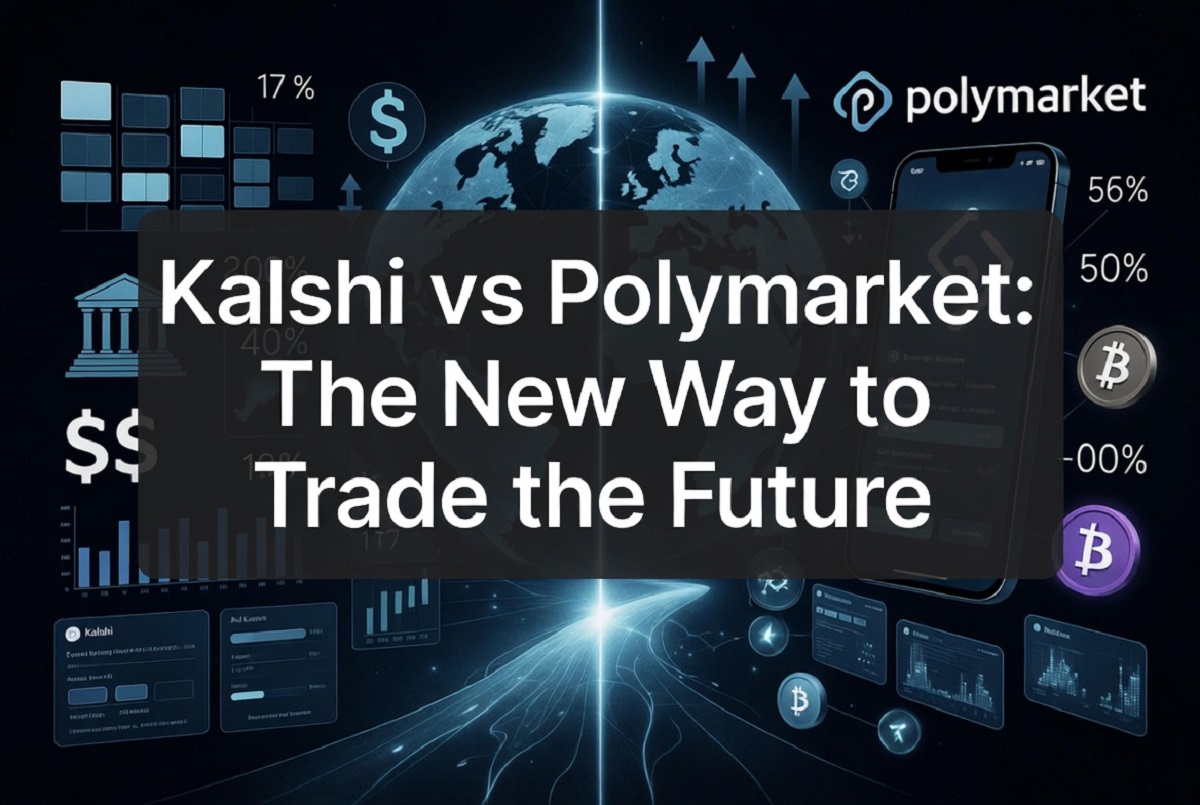
Prediction markets like Kalshi and Polymarket are reshaping how people think about forecasting, investing, and risk. They offer a brand-new asset class: event contracts, whose prices reflect the crowd’s belief about what will happen in the future.
In this deep dive, we’ll unpack the differences between Kalshi and Polymarket, how each operates, their potential rewards and risks, and whether these new tools represent smart trading—or just sophisticated gambling.
What Are Prediction Markets?
At their core, prediction markets work on a simple premise: people bet on outcomes, and market prices represent the probability of those outcomes occurring.
Let’s start with an example:
Market: “Will the Federal Reserve cut interest rates by June 2026?”
If the “YES” contract is trading at $0.70, that implies the market believes there’s a 70% chance the rate cut will happen.
If you buy one “YES” share for $0.70 and the cut happens—you get $1. If it doesn’t, your $0.70 goes to zero.
Essentially, each event market is a binary option, but framed in an accessible, intuitive way. It’s the financialization of probability.
Even better, because these contracts aggregate real money and opinions from thousands of participants, prediction markets often outperform expert forecasts and opinion polls in accuracy. Platforms like Kalshi and Polymarket make it possible for anyone to express and profit from their view of the future.
How Prediction Markets Work (A Quick Primer)
Prediction markets use yes/no contracts (also called “event contracts”) priced between $0.01 and $0.99.
-
Each contract settles at $1 if the event occurs (“YES”) or $0 if it does not (“NO”).
-
The market price of a contract represents the collective probability of that outcome.
-
Example: A contract priced at $0.35 suggests a 35% chance of the event occurring.
Just like in traditional markets:
-
Liquidity improves price efficiency.
-
Traders can buy or sell at any time before settlement.
-
Profits come from price movement or prediction accuracy.
The difference?
Instead of speculating on corporate earnings or ETFs, you’re trading the likelihood of real-world events—economic data releases, political outcomes, even cultural moments.
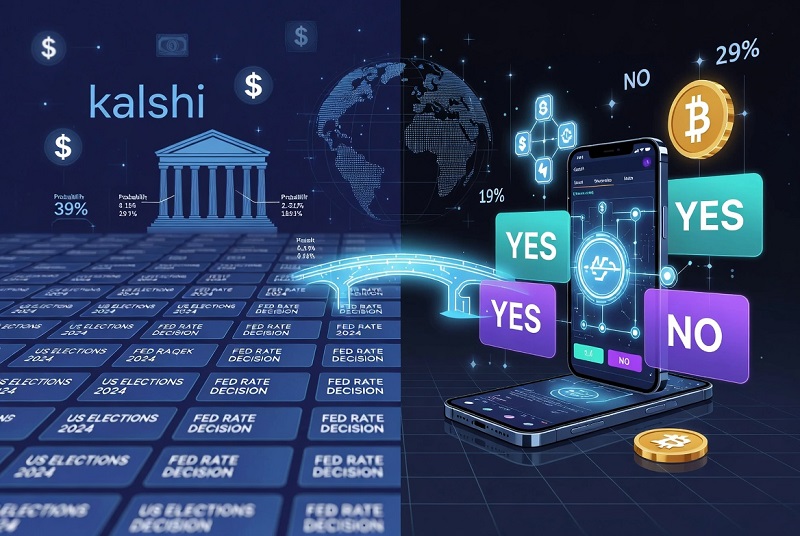
What Is Kalshi? The Regulated Prediction Exchange
Kalshi is the Wall Street version of a prediction market. Founded by Tarek Mansour and Luana Lopes Lara, it became the first U.S.-regulated event exchange, approved by the Commodity Futures Trading Commission (CFTC) in 2021.
Think of it as the NYSE for events.
Key Features of Kalshi
-
Regulated exchange: Operates fully under the CFTC, giving it legal status and legitimacy.
-
Dollar-denominated contracts: Uses USD for deposits and settlements.
-
U.S. user access: Available to U.S. residents, unlike most crypto-based markets.
-
Professional-grade design: Appeals to traders seeking data-driven event exposure.
Kalshi’s Market Focus
Kalshi focuses mainly on economic and policy events, such as:
-
Inflation rate reports (CPI, PCE)
-
Federal Reserve interest rate decisions
-
Unemployment figures
-
GDP growth
-
Stock market benchmarks (e.g., S&P 500 performance contracts)
Example
“Will U.S. inflation exceed 3.0% in September 2026?”
YES contract trades at $0.62 → market implies 62% chance.
Kalshi has become popular among hedge fund managers, quantitative traders, and analysts seeking a regulated way to hedge or express macroeconomic views.
Because it’s legally recognized and built for compliance, Kalshi sits at the crossroads of Wall Street discipline and retail innovation.
What Is Polymarket? The Decentralized Alternative
If Kalshi is Wall Street, Polymarket is the crypto frontier—a decentralized, blockchain-powered prediction market that lets users trade almost any topic imaginable.
Built on the Polygon blockchain, Polymarket lets users buy YES or NO shares using USDC (a stablecoin pegged to the U.S. dollar). It’s technically restricted for U.S. users (due to lack of CFTC regulation), but remains open to global participants.
Key Features of Polymarket
-
Decentralized platform: Operates via smart contracts with transparent, on-chain data.
-
Wider range of topics: Politics, entertainment, technological events, sports, and global current affairs.
-
Crypto-based transactions: Trades and settlements are in USDC.
-
Community-driven markets: Users or affiliates propose new markets quickly, often reacting to trends faster than regulated platforms can.
Example
“Will Donald Trump win the 2028 U.S. Presidential Election?”
YES shares at $0.48 suggest a 48% chance.
Polymarket has gained traction among crypto traders, data enthusiasts, and political analysts, famous for its accurate forecasts of major elections.
Its flexibility makes it exciting—but lack of formal regulation also introduces risk.
Kalshi vs Polymarket (Key Differences)
Here’s how the two platforms compare side by side:
| Feature | Kalshi | Polymarket |
|---|---|---|
| Regulation | Fully regulated (CFTC-approved) | Not U.S.-regulated |
| Currency | U.S. dollars (USD) | USDC (stablecoin) |
| Risk Level | Lower (legally compliant) | Higher (crypto volatility, grey legal area) |
| Market Topics | Economics, Fed policy, finance | Politics, global events, culture |
| Accessibility | Open to U.S. residents | Limited U.S. access |
| Settlement | Fiat payouts through bank transfers | Crypto settlements via blockchain |
| User Base | Traders, analysts, investors | Speculators, crypto-native users |
| Reputation | “Wall Street-style exchange” | “Decentralized forecast market” |
In short, Kalshi = regulated precision, while Polymarket = unregulated freedom.
Why Prediction Markets Are Gaining Popularity
Prediction markets are booming thanks to three converging trends: financial gamification, data democratization, and public distrust in traditional experts.
Major Drivers
-
Rise of retail traders: After COVID-era meme stocks, individuals crave more hands-on, expressive financial tools.
-
Failing poll accuracy: After several high-profile polling misses, prediction markets proved more reliable for political forecasting.
-
Streaming attention: Social media amplifies real-time sentiment—perfect fuel for event trading.
-
AI and big data integration: Algorithmic trading is improving market efficiency and real-time pricing.
Why traders love them: prediction markets offer a fun, efficient way to quantify beliefs. They turn opinions into tradable assets.
Studies from institutions like the University of Iowa, which ran early “Iowa Electronic Markets,” confirm these markets’ uncanny ability to aggregate dispersed knowledge more accurately than most experts or polls.
Are Prediction Markets Better Than Traditional Investing?
The key difference is what you’re buying.
-
Stock investors buy ownership in companies, banking on value appreciation over years or decades.
-
Event traders buy probabilities that resolve in days or weeks.
Prediction markets operate on short-term information asymmetry, not intrinsic value. That makes them faster, tighter, and more emotional than most financial markets.
Comparison
| Aspect | Stocks | Prediction Markets |
|---|---|---|
| Time Horizon | Long-term (years) | Short-term (days/weeks) |
| Asset Type | Equity ownership | Binary event contracts |
| Risk | Market volatility | All-or-nothing event outcome |
| Data Reliance | Corporate, macro factors | News, polling, sentiment |
| Purpose | Build wealth | Trade probabilities |
So, investing in prediction markets feels closer to sports betting meets quant trading. Done well, it’s strategic. Done poorly, it’s impulsive gambling.
The Risks You MUST Understand
Prediction markets can be informative and profitable, but they come with specific risks worth acknowledging:
Regulatory Uncertainty
-
Kalshi operates legally under the CFTC, but its permission framework is narrow. Political event contracts remain controversial.
-
Polymarket has faced enforcement actions from the CFTC, and U.S. residents are currently blocked from using the main platform.
Liquidity Fluctuations
Some markets attract thousands of participants, while others may have limited volume—making it harder to exit positions profitably.
Emotional Trading
Binary outcomes trigger strong behavioral biases: confirmation bias, loss aversion, overconfidence. It’s easy to “bet your beliefs,” not analyze data logically.
Binary Risk Profile
Events don’t settle gradually. You either win 100% or lose it all. That “all-or-nothing” design amplifies volatility.
Crypto & Custody Risks (Polymarket)
Using USDC on-chain introduces smart contract and wallet vulnerabilities.
Information Manipulation
Because outcomes rely on defined data sources, ambiguous event definitions can sometimes create disputes on settlement terms.
Investing or Gambling?
Here lies the philosophical question: Are prediction markets a new investment frontier—or legalized gambling?
The answer depends on intent and strategy.
If you approach it like a trader:
-
Research sources.
-
Manage risk.
-
Diversify across many contracts.
-
Use hedging or arbitrage.
Then, you’re investing in data-driven forecasts.
But if you:
-
Bet impulsively on favored candidates or teams.
-
Double down out of FOMO.
-
Treat trades like a thrill ride.
Then, you’re gambling, not investing.
As Jonathan Rose from Earnings Advantage often emphasizes in traditional trading education, data discipline separates professionals from speculators. The same applies here: use frameworks, not feelings.
The Future of Prediction Markets
Both Kalshi and Polymarket are paving the way for a broader transformation of financial forecasting.
Possible Future Trends
-
Institutional adoption: Hedge funds may use event markets to hedge election or policy exposure.
-
Expansion of legalized contracts: As regulatory frameworks mature, markets on politics, sports, or social issues may become legally tradable.
-
AI integration: Predictive models combined with crowd probability signals can yield hybrid “AI + human” forecasting systems.
-
Education and mainstreaming: Platforms will emphasize responsible speculation, analytics dashboards, and integrations with portfolio tools.
In many ways, prediction markets are the next iteration of crowdsourced intelligence—aggregating human and machine insight into a single probabilistic signal.
Strategy: How to Approach Trading Prediction Markets
Want to test prediction trading responsibly? Here’s a structured approach.
Start Small:
Trade events with clear data definitions (e.g., “Will CPI exceed 3%?” vs “Will AI take over jobs?”).
Research-Driven Entries:
Use consensus economic forecasts, polling data, and sentiment data (via Polymarket dashboards or Kalshi insights).
Consider Arbitrage:
If two markets differ on the same event (e.g., Kalshi implies 65%, Polymarket implies 75%), arbitrage traders can buy/sell accordingly to lock in risk-free profits—though execution can be complex.
Diversify Outcome Types:
Don’t go all in on one theme (e.g., politics). Mix economics, geopolitical, and macro events for balance.
Manage Expectations:
Aim for steady compounding, not all-or-nothing bets.
Example Trade: “The Next Fed Rate Cut”
Let’s walk through a real-world market example.
Scenario:
Kalshi lists “Will the Fed cut rates by June 2026?”
YES = $0.68, NO = $0.32.
Market probability = 68% chance of a rate cut.
You believe inflation will stay sticky, making rate cuts unlikely.
You buy 100 “NO” contracts at $0.32 ($32 total).
If the Fed holds rates steady, YES = 0, NO = 1, and your contracts pay out $100—yielding a profit of $68 (over 200%).
If the cut happens, you lose your $32 stake.
That’s how event-driven conviction meets trading discipline.
Recommended Service: Earnings Advantage (by Jonathan Rose)
If you’re serious about leveraging ideas like these in predictive, data-rich trading—Earnings Advantage, a service reviewed on Steady Income Investments, offers a strong foundation.
This service focuses on earnings-based event strategies, helping traders develop data-driven systems for short-term trades—much like applying discipline to Kalshi-style markets.
While it’s not a prediction-market service directly, it reinforces the same mindset: trade around defined catalysts, quantify risk, and remove emotion.
Readers looking to refine forecasting and event trading skills should consider such structured education options before diving deeply into high-volatility platforms like Polymarket.
Conclusion: Trading the Future
Prediction markets sit at the intersection of human belief and quantifiable risk. They merge behavioral economics, data science, and investing into one dynamic toolset.
-
Kalshi offers the safety, compliance, and professionalism of Wall Street.
-
Polymarket delivers the speed, creativity, and decentralization of Web3.
Whether they represent the next asset class or a speculative playground depends entirely on how you use them.
In either case, trading on the future is no longer a metaphor—it’s a market.
Frequently Asked Questions (FAQ)
What is the main difference between Kalshi and Polymarket?
Kalshi is a fully regulated U.S. event exchange approved by the CFTC, while Polymarket is a decentralized crypto platform not regulated in the U.S. Kalshi uses USD, and Polymarket uses USDC for trading.
Are prediction markets legal in the United States?
Kalshi is legally approved to operate in the U.S. under CFTC regulation. Polymarket, however, restricts U.S. users due to regulatory limitations, though it remains accessible internationally.
Can you actually make money on prediction markets?
Yes, skilled traders can profit by accurately predicting event outcomes. However, like all markets, success requires research, discipline, and risk management—especially since outcomes are all-or-nothing.
Are prediction markets the same as gambling?
Not exactly. Prediction markets rely on data-driven forecasting and can be used for hedging or research. However, if used impulsively or emotionally, they can resemble speculative gambling.
What types of events can you trade on Kalshi and Polymarket?
Kalshi focuses on regulated economic events—like inflation, interest rates, and employment data—while Polymarket covers global topics including politics, culture, and technology trends.