
James Altucher’s prediction for 2026 is that a wave of new technologies and companies could create life‑changing wealth for investors who position themselves early, especially around Starlink’s possible IPO and the convergence of Artificial Intelligence (AI) with Quantum Computing.
Who Is James Altucher and Why People Listen to Him
 James Altucher is a former hedge fund manager, venture capitalist, entrepreneur, and best‑selling author who has built his reputation on spotting big tech trends before they become mainstream.
-
He has run hedge funds and backed early‑stage tech companies, including TicketFly and Buddy Media, where he made 37x in 6 years and 60x returns in 5 years.
-
His podcast, The James Altucher Show, has more than 70 million downloads and has hosted big names like Mark Cuban, Peter Thiel, and Ray Dalio, giving him access to high‑level ideas and insiders.
-
Past calls include early bullish views on the rise of video streaming services like Netflix, Facebook, calling Bitcoin the future around 2013, and Solana near 11 dollars, all of which later rose dramatically.
Altucher’s prediction for 2026 builds on this track record: he believes we are entering a new “mega‑trend” period, where Starlink and Quantum‑AI stocks can deliver a shot at huge gains for investors who move before the crowd.
Altucher’s Big 2026 Themes in One Sentence
Altucher’s core message is simple: in 2026 and the years around it, the biggest money will likely be made in two places—
-
a set of “convergence stocks” that sit at the crossroads of AI and Quantum Computing.
Starlink in 2026: Altucher’s “Biggest IPO in History” Idea
Altucher believes Elon Musk’s Starlink, the satellite internet division of SpaceX, could deliver the biggest IPO in history as early as 2026.
-
-
Starlink already has thousands of satellites in low Earth orbit and serves millions of users across remote areas, ships, planes, and even war zones.
-
It offers high‑speed internet (often up to around 220 Mbps) using satellites instead of traditional cables and towers, and it continues to expand global coverage.
-
He argues that this launch might not just be big—it might be historic, potentially eclipsing earlier internet revolutions like AOL, EarthLink, or Comcast in terms of long‑term wealth creation.
Why Altucher Thinks Starlink Will Change Everything
Altucher sees Starlink as a company that can disrupt the entire 2.18 trillion‑dollar global telecom industry.
-
Traditional telecom companies like AT&T, Verizon, and large cable providers often charge high prices for slow or unreliable service, especially in rural and remote areas.
-
Starlink bypasses physical infrastructure like underground cables and cell towers by beaming internet straight from satellites, offering faster speeds and wider coverage.
-
Starlink is also working on direct‑to‑cell technology, which would allow regular smartphones to connect to satellites without special hardware, making coverage more universal.
Altucher compares Starlink’s potential to the early days of dial‑up internet (AOL), DSL (EarthLink), and cable internet (Comcast), all of which delivered massive returns to early investors as access to the internet expanded.
Starlink IPO Timing: Why Altucher Targets 2026

Altucher does not claim there is a confirmed IPO date, but he connects several clues and concludes that 2026 is a realistic and likely target for a Starlink IPO.
He points to three main signals:
-
Elon Musk has said that Starlink would go public once its cash flow was “reasonably predictable,” and recent comments show Starlink has reached profitability.
-
Musk has many capital‑intensive projects (such as new ventures like xAI), so spinning off a profitable Starlink gives him a way to raise funds without constantly selling Tesla shares.
-
Reports suggest that SpaceX is already moving assets into a Starlink subsidiary, a common step before a spin‑off or IPO.
While analysts have suggested the 2026–2027 window, Altucher emphasizes 2026 as the time frame when investors should be ready, because the biggest gains often happen before and around the IPO, not after.
Why Altucher Says Pre‑IPO Exposure Matters
A key part of Altucher’s 2026 prediction is that most of the gains from Starlink may be captured before the stock ever trades directly under its own ticker.
-
He claims that 95% of stock market gains for great growth companies often occur before the IPO, when they are still private or only available to insiders and large funds.
-
He points to examples like Facebook and Amazon, where early backers saw enormous returns before regular investors could buy shares on public exchanges.
Because regular investors cannot buy Starlink directly today, Altucher recommends studying indirect ways to get “pre‑IPO” exposure.
Altucher’s “#1 Starlink IPO Stock to Buy Now”
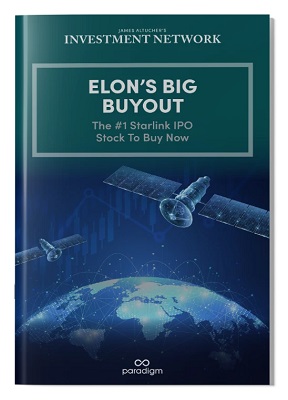
Altucher promotes a specific stock he believes can benefit from Starlink’s growth and any future IPO, which he calls his “#1 Starlink IPO stock” and links to the potential for “Elon’s Big Buyout.”
He lays out two main paths:
-
Indirect exposure through Destiny Tech100 (DXYZ)
-
DXYZ is a publicly traded fund on the NYSE that holds stakes in private tech companies, including SpaceX, Starlink’s parent, which is estimated to be around 38–50% of its portfolio.
-
Altucher sees DXYZ as a simple way for regular investors to gain partial exposure to Starlink’s success before an IPO.
-
-
The “Buyout Play” – a small direct‑to‑cell technology company
-
Altucher believes that to fully unlock Starlink’s potential, Musk will need to acquire a company that owns crucial direct‑to‑cell satellite technology.
-
This company, according to Altucher, has important patents and is the “missing piece” for turning Starlink satellites into full‑scale “floating cell towers” that work with ordinary phones.
-
He predicts a tens‑of‑billions‑dollar buyout could be announced around the time of the IPO, and that such a deal could send this smaller stock soaring.
-
Altucher keeps the ticker of this buyout candidate behind a paywall, available only inside his special report “Elon’s Big Buyout: The #1 Starlink IPO Stock To Buy Now.”
Altucher’s Broader 2026 Prediction: Quantum Computing + AI
Alongside Starlink, Altucher’s other big idea for 2026 centers on what he calls “convergence stocks” – companies that sit at the intersection of Quantum Computing and Artificial Intelligence (AI).
He calls the merging of these two technologies “the next mega‑wave” for investors.
-
Bank of America has been cited as forecasting that this convergence could unlock about 111 trillion dollars in new wealth, roughly four times the size of the U.S. economy.
-
AI alone has already helped create hundreds of thousands of new millionaires, but Altucher argues that current AI is limited by today’s conventional computer hardware.
-
Quantum Computing can process massive calculations at speeds that classical computers cannot match, breaking through data and performance bottlenecks.
When AI and Quantum Computing combine, Altucher believes it will open up entirely new business models and accelerate breakthroughs in areas like medicine, finance, logistics, cybersecurity, and more.
How Altucher Uses “Convergence” to Find Big Winners

Altucher’s “convergence” idea is based on how past technology pairings created huge winners.
He gives several examples:
-
Internet + mobile phones → smartphones (helped drive Apple’s iPhone and huge gains for shareholders).
-
AI + electric vehicles → self‑driving cars (boosting Tesla’s long‑term gains).
-
GPS + smartphones → ride‑share apps like Uber.
-
Social networking + software → platforms like Facebook/Meta.
-
Blockchain + internet → Bitcoin and other decentralized assets.
In each case, investors who recognized the convergence early had the chance to make very large returns on relatively small investments.
For 2026 and beyond, Altucher believes the most important convergence is:
Artificial Intelligence + Quantum Computing = the “Quantum‑AI” opportunity.
Why Altucher Thinks Quantum‑AI Matters in 2026
Altucher says that AI today is powerful but still limited, because it runs on classical chips that struggle with the exploding volume of data. Quantum Computing, by contrast, can work with quantum bits (qubits), which allow systems to explore many possibilities at once.
-
Quantum computers have already performed demonstrations where they solved complex problems in minutes that would take a traditional supercomputer thousands or even billions of years.
-
Big names like NVIDIA, Google, and Microsoft are investing heavily in quantum hardware, software, and cloud platforms, building data centers that are ready for quantum‑AI workloads.
Altucher’s prediction is that, as these tools mature, some companies at the center of this convergence could see stock prices rise extremely fast, similar to the early phases of past tech booms.
Early Quantum‑AI Winners Altucher Points To
To show that this shift is already starting, Altucher highlights three quantum‑related companies that have already seen big price jumps in the last two years: IONQ, QBTS, and QUBT.
-
IONQ has risen roughly 1,600%.
-
QBTS has risen roughly 2,000%.
-
QUBT has risen roughly 3,100%.
He notes that putting 5,000 dollars into each of these early movers could have grown to around 360,000 dollars in around two years.
His point is not that these exact stocks will keep climbing forever, but that the market is already rewarding some quantum‑AI plays, and the trend is still young.
Altucher’s Top Three “Convergence Stocks”
In his “Top Three Convergence Stocks” presentation, Altucher introduces three picks that he believes are positioned to benefit most from the AI + Quantum Computing wave.
He does not reveal the ticker symbols publicly, but he describes each one and gives them nicknames:
1. “NVIDIA’s Secret Quantum Partner”
This company is an established firm that Altucher claims is deeply involved in Quantum‑AI.
-
It works closely with NVIDIA and helps power AI training and quantum applications.
-
It has partnerships with organizations like the Cleveland Clinic, working on diseases such as cancer, Alzheimer’s, and diabetes, and with companies like Lockheed Martin for defense AI.
-
It is reportedly building what may become the world’s most powerful quantum computer, projected to be 20,000 times stronger than today’s best machines.
-
Its stock has already outperformed the overall market about four to one.
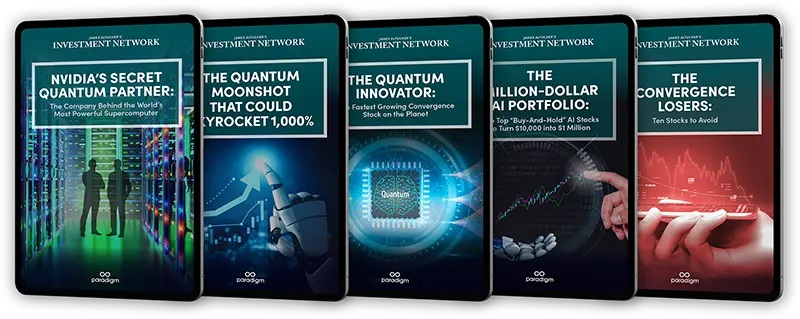
Altucher argues that as Quantum‑AI demand grows, this company is in a prime position to see dramatic revenue and profit growth. Full details are offered in his report “NVIDIA’s Secret Quantum Partner: The Company Behind the World’s Most Powerful Supercomputer.”
2. “The Quantum Moonshot”
The second stock is a smaller, high‑upside company that has launched a quantum cloud platform, similar to what Amazon Web Services did for cloud computing.
-
Over 1,000 companies have applied to use its quantum AI toolkits.
-
It already counts large clients like NASA, Google, Lockheed Martin, and Mastercard.
-
Altucher compares it to Amazon before AWS really took off, when a modest investment later turned into a large fortune.
He believes this “moonshot” could see 1,000% gains in the next three to five years, and possibly much more if quantum cloud services gain wider adoption.
Details and ticker are provided in his report “The Quantum Moonshot That Could Skyrocket 1,000%.”
3. “The Quantum Innovator”
The third convergence stock focuses on solving one of the biggest problems in Quantum Computing: error correction.
-
Quantum bits are very fragile and sensitive to noise; this company is working on ways to keep calculations stable and reliable.
-
Altucher notes that it has more than 1,000 patents and hundreds of customers, plus strong sales growth.
-
Analysts expect its sales to grow by roughly 1,823% by 2030.
More details are given in “The Quantum Innovator: The Fastest Growing Convergence Stock on the Planet.”
How Altucher Says Everyday Investors Can Participate
Altucher’s prediction for 2026 is not just about ideas; he also offers a practical path for investors through his subscription service, Altucher’s Investment Network.
What Altucher’s Investment Network Includes
Here’s a list with everything you’ll get:
-
Monthly research issues focused on major tech and market trends, with concrete stock recommendations.
-
Weekly model portfolio updates that show what is happening with open positions and whether to buy, hold, or sell.
-
Real‑time alerts when something urgent happens, such as a fast‑moving opportunity or an important risk.
-
A special reports library with detailed write‑ups on convergence stocks, Starlink plays, AI portfolios, and more.
-
Model portfolio access, so subscribers can see all tickers, recommended buy‑up prices, and performance in one place.
-
Quarterly Zoom or livestream calls to ask Altucher questions about current recommendations and broader trends. Just keep in mind he doesn’t offer personalized financial advice.
He positions the research service as a way for retail investors to access the kind of research and network that is usually reserved for hedge funds and big institutions.
Altucher’s Pricing and Guarantees
Altucher advertises a limited‑time offer with a discounted price and a strong refund policy.
-
The standard pricing of Altucher’s Investment Network is 299 dollars for six months.
-
Under the current promotion, new members can join for about 49 dollars for six months, which Altucher calls a heavily discounted introductory rate.
There is also a guarantee:
-
A 90‑day risk‑free refund window is offered, allowing new subscribers to get their money back if they are not satisfied, while keeping all the reports they received.
Altucher uses this guarantee to argue that people can test his ideas on Starlink and Quantum‑AI with limited financial risk.
The Upside Altucher Sees by 2026
Altucher’s prediction for 2026 is optimistic and focused on the upside potential of emerging technologies:
-
Starlink could become a historic IPO, potentially worth hundreds of billions of dollars, while select related plays (like the potential buyout target and funds such as DXYZ) could benefit before and after the listing.
-
Quantum‑AI convergence stocks could see large, rapid gains as quantum hardware and AI software combine to solve problems normal computers can’t handle, opening huge markets.
-
His “top three convergence stocks” are presented as prime candidates for this surge, with some of them already showing strong momentum.
He also reminds readers that past tech waves, like the rise of the internet, mobile, and cloud computing, could have turned relatively small investments into rare fortunes when people acted early and held over the long-term and through volatility.
Understand Altucher’s 2026 Prediction
To put everything in very simple terms:
-
Altucher thinks 2026 will be a key year where some of the biggest money is made in new technology.
-
He is especially excited about Starlink, Elon Musk’s satellite internet company, which he thinks could be the biggest stock market launch ever if it goes public.
-
Because regular investors cannot buy Starlink directly yet, he looks for “side doors” like funds that own Starlink’s parent company and small companies that might be bought by Starlink.
-
At the same time, he believes AI and Quantum Computing together will create the next wave of giant winners, just like smartphones, social media, and cloud computing did in the past.
-
He has picked three “convergence stocks” he believes are at the center of this new wave, but he only shares their names with paying subscribers.
In short, his prediction is that investors who understand these themes early and take carefully chosen risks may have a chance at very large returns over the next few years.
Practical Takeaways for Investors Thinking About 2026
If you are considering Altucher’s 2026 predictions from an investment point of view, here are the main actionable lessons:
-
Focus on big trends, not just single stocks: Starlink’s satellite internet and the AI + Quantum Computing convergence are themes, not one‑day events.
-
Understand pre‑IPO angles: Funds like Destiny Tech100 (DXYZ) show how some investors try to access private high‑growth companies before they list.
-
Be early, but also realistic: The examples Altucher points to (like Apple, Tesla, Bitcoin, Netflix) show that early investors can do very well, but only if they accept volatility and hold through downturns.
-
Use research, not hype: Altucher promotes deep research reports and structured alerts, reminding investors that blindly chasing headlines is not a reliable strategy.
-
Manage risk: Even the best ideas can fail, so diversification, position sizing, and clear time horizons remain important.
Going into 2026, Altucher’s message is that technology is changing fast, and the combination of Starlink’s rollout and Quantum‑AI breakthroughs could reshape markets. But investors must balance the chance for big gains with the reality of high risk and uncertainty.