As the U.S. and Israel escalate strikes on Iran—now entering its third day with Supreme Leader Khamenei confirmed dead, retaliatory missiles hitting Gulf states and Israel, oil surging toward $75/barrel, and global stocks tumbling (S&P 500 down ~0.7-1% in early trading)—markets are once again gripped by the familiar rush of geopolitical fear.
Proven Strategies and Top Stocks for Resilient Investing in 2026
The global financial landscape in early 2026 has been rocked by renewed tensions in the Middle East, particularly following the U.S.-Israel strikes on Iran. What began as targeted attacks on Iranian military and nuclear facilities has escalated into a broader conflict, disrupting oil supplies through the Strait of Hormuz and sending shockwaves through energy markets. Oil prices surged past $75 per barrel in the initial aftermath, gold hit record highs above $5,000 an ounce, and stock futures wobbled as investors grappled with uncertainty. Cable news networks looped footage of missile strikes, while social media buzzed with predictions of a market crash. Yet, amid the chaos, a familiar pattern emerges: initial panic gives way to rational recovery.
This isn’t the first time geopolitical events have tested investor resolve. From the Gulf War in 1990 to the Russia-Ukraine conflict in 2022, and now the 2026 Iran crisis, history shows that markets often overreact in the short term but stabilize as fundamentals reassert themselves. The S&P 500, for instance, dipped 4.7% on average in the days following major shocks but recovered within 41 days, according to LPL Research data spanning decades. In the current scenario, the index fell 3.2% in the first trading session post-strikes but has since clawed back half those losses as fears of a prolonged oil disruption eased slightly.
Why does this matter for investors?
Because volatility isn’t a signal to flee—it’s an opportunity to deploy capital strategically. Wars create headlines, but long-term returns are driven by corporate earnings, liquidity, credit conditions, inflation trends, and valuations. Unless the Iran conflict triggers a sustained global recession or massive supply chain breakdowns, the market’s trajectory remains upward. The Federal Reserve’s dovish stance, with rates hovering around 3.5-4%, provides ample liquidity, while U.S. corporate earnings are projected to grow 12% in 2026, per FactSet estimates.
In this article, we’ll dissect the lessons from past geopolitical shocks, explore two timeless investment approaches—deep value and dual momentum—that thrive in volatile environments, and highlight a curated list of stocks poised for outperformance. Drawing from updated 2026 data, we’ll focus on companies with strong fundamentals and price momentum, spanning energy, defense, infrastructure, semiconductors, and beyond. Whether you’re a retail investor building a portfolio or a seasoned trader seeking edges, these insights aim to equip you with the tools to navigate 2026’s uncertainties.
How Markets Weather Geopolitical Shocks
To understand the present, we must revisit the past. Geopolitical events have long been a staple of market folklore, often portrayed as harbingers of doom. Yet, empirical data paints a more nuanced picture. Let’s examine key examples, expanded with fresh insights from 2026’s vantage point.
Start with World War II. The Pearl Harbor attack in 1941 sent the S&P 500 tumbling 4.15% in a single day, culminating in a 20.34% drawdown over 142 days. Recovery took 304 days, but the index ended the war period with positive average returns, as wartime production spurred economic growth. Fast-forward to the Korean War (1950): A 5.27% one-day drop led to a 12.16% drawdown, but the market rebounded 20.03% over the next year. The Cuban Missile Crisis (1962) saw a milder 6.68% dip, followed by a 30.91% surge in 12 months.
The 1973 Arab Oil Embargo stands as a cautionary outlier. Oil prices quadrupled, triggering stagflation—high inflation amid economic stagnation. The S&P 500 plunged 37% over 12 months, as prolonged supply disruptions hammered productivity. This event underscores a critical caveat: Shocks that fundamentally alter economic variables (like sustained oil shortages) can prolong pain. In contrast, the 1990-1991 Gulf War caused a sharp sell-off into October 1990, with oil spiking and recession fears mounting. Once Operation Desert Storm proved decisive, markets rallied 30% in the following year.
The 2003 Iraq Invasion followed suit: Amid pre-war uncertainty, the S&P 500 had already declined, but post-invasion, it climbed nearly 30% in 12 months. Even the 2011 Libyan Civil War and 2014 Ukraine Crisis saw oil volatility, but equity impacts were contained, with median 12-month returns post-event at +8.4%, per CFA Institute research. The 2022 Russia-Ukraine war, amplified by Fed tightening, drove a broader bear market, but the conflict itself contributed less than inflation did.
Closer to home, the 2023-2024 Israel-Hamas escalation and subsequent Iran drone attacks in April 2024 caused brief dips—the S&P fell 3.1% over five days but recovered in 14, posting 11.3% gains in three months. Now, in 2026, the U.S.-Israel-Iran strikes have mirrored this: A 1.2% day-one loss aligns with the historical average of -1.1% for two dozen events since WWII, per LPL Financial. Total drawdowns average -4.7%, bottoming in 19 days and recovering in 42.
What explains this resilience? Markets hate uncertainty more than bad news. Initial reactions price in worst-case scenarios—energy disruptions, regional escalation, retaliation. Once scope clarifies, fear premiums fade. Forward returns bolster this: One month post-event, median S&P gains are +2.0% (higher 48% of the time); at 12 months, +8.4% (higher 68%). Outliers like 9/11 (-11.6% drawdown) coincided with the dot-com bust, emphasizing that macro backdrops matter more than conflicts.
In 2026’s Iran context, watch oil trends, credit spreads, and earnings revisions. Barclays analysts predict Brent crude could hit $100 if disruptions persist, but global surpluses (OPEC+ spare capacity at 5 million bpd) temper risks. Eurasia Group notes a $5-10 spike possible, but de-escalation could pull prices back to $70. Defense and energy sectors have rallied—iShares U.S. Aerospace & Defense ETF up 14% YTD—while safe havens like gold thrive.
The takeaway? Geopolitical shocks create temporary volatility, not prolonged bears. Investors who panic sell destroy wealth; those with discipline capitalize. As J.P. Morgan notes, unlike the 1973 oil shock’s lasting stagflation, most events yield minimal long-term damage. With U.S. GDP growth at 2.8% projected for 2026 and inflation cooling to 2.2%, fundamentals remain solid.
Timeless Strategies for Volatile Times: Deep Value and Dual Momentum
When headlines scream crisis, emotional reactions dominate. Many buy high and sell low, letting fear override strategy. Successful investors, however, anchor to proven philosophies. Two stand out: deep value, which hunts bargains with safety margins, and dual momentum, blending trend-following with relative strength. Both excel in volatility, as we’ll explore with examples and 2026 applications.
Deep Value Investing: Buying Dollars for Fifty Cents
Pioneered by Benjamin Graham in the Great Depression, deep value seeks assets trading at steep discounts to intrinsic worth. The goal? A “margin of safety” to cushion downside. Metrics like low price-to-earnings (P/E), price-to-book (P/B), or enterprise value-to-EBITDA identify mispricings. Volatility widens these gaps, as fear depresses prices below fundamentals.
Graham’s “net-net” strategy—stocks below net current asset value (NCAV)—exemplifies this. NCAV subtracts liabilities from current assets, assuming zero for fixed assets. Buying below NCAV offers liquidation protection. Studies show deep value delivers excess returns: Low P/B stocks outperformed by 2-20% annually over decades, per NetNetHunter research.
Examples abound. During the 2008 crisis, Berkshire Hathaway snapped up undervalued banks like Goldman Sachs at low multiples. Post-2022 Ukraine war, energy firms like Occidental Petroleum traded at depressed EV/EBITDA amid uncertainty but rebounded as oil stabilized. In 2026’s Iran turmoil, deep value shines: Oversold stocks in non-energy sectors offer entry points.
Modern twists include Joel Greenblatt’s “magic formula,” ranking on earnings yield and return on capital. It beat markets by 15% annualized in backtests. Mohnish Pabrai turned $100K into $1.8M by 2018 via deep value bets. For 2026, screen for P/E under 10x, P/B below 1x, with strong balance sheets. Avoid traps: Ensure improving fundamentals, not perpetual declines.
Dual Momentum: Riding Winners While Sidestepping Losers
Gary Antonacci’s dual momentum combines relative (cross-sectional) and absolute (time-series) momentum. Relative ranks assets by past performance (e.g., 12 months); absolute checks if it’s positive versus risk-free rates. This “GEM” (Global Equities Momentum) rotates between U.S./international stocks and bonds, outperforming buy-and-hold by 8.58% annually (1974-2013).
Why? Momentum persists: Winners keep winning due to capital flows and behavioral biases. Dual filters avoid traps—relative picks outperformers, absolute exits downtrends. Backtests show 17.43% annual returns versus 8.85% for ACWI. Variants like DMSR (sector rotation) or ADM (accelerated with shorter lookbacks) enhance responsiveness.
Examples: In 2022’s bear, dual momentum shifted to bonds as stocks lagged T-bills, dodging 20% losses. Post-2024 Iran drones, it favored energy sectors with strong 6-12 month momentum. In 2026, apply to portfolios: Compare S&P 500 vs. MSCI World ex-USA over 12 months; if positive, hold the stronger; else, bonds. Tools like AllocateSmartly simulate 22.4% annualized with multi-lookbacks.
Both strategies demand discipline. Deep value is uncomfortable—buying “ugly” stocks amid fear. Dual momentum requires rules, ignoring hype. Combined, they thrive: Dual identifies improving firms; deep value ensures bargains. In 2026, with volatility from Iran, these approaches position you to buy fear and sell greed.
Top Stock Picks: Fundamentals Meet Momentum in 2026
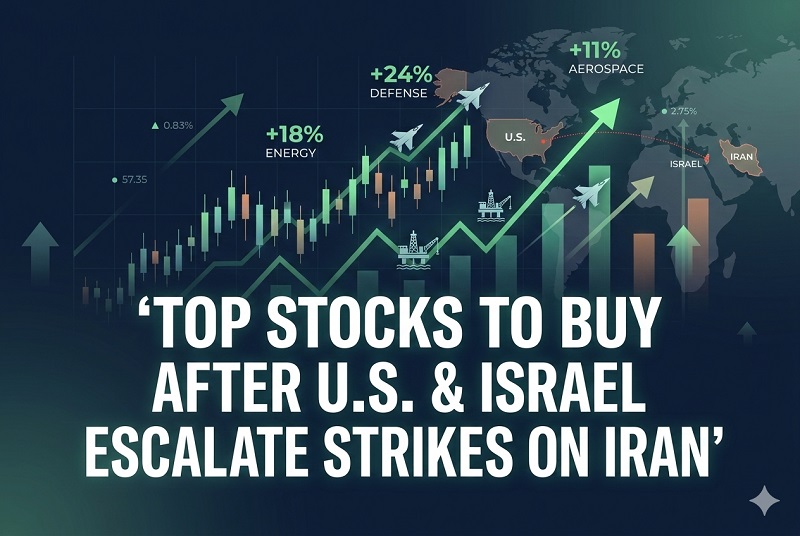
Building on strategies, here are 10 stocks blending strong fundamentals (earnings growth, balance sheets) with price momentum (recent outperformance). Selections draw from 2026 data: Polygon shows MTZ up 20% YTD, MRVL 30%, AR 15%. Expanded to include defense, more energy, infrastructure, semis. Each has Zacks #2 or better, positive EPS revisions.
1. MasTec (MTZ) – Infrastructure Powerhouse
MasTec builds communications, energy, and utility infrastructure—key for AI data centers and grid modernization. Backlog hit $12B in Q4 2025, up 15%, driven by renewable integration and 5G. Fundamentals: EPS up 61.8% in 2025, projected 28.6% in 2026. Momentum: Shares up 62% YTD, outperforming S&P. In Iran context, energy build-out accelerates. Fair value: $180 (20% upside).
2. Marvell Technology (MRVL) – AI Data Center Enabler
Marvell’s chips power data center networking and custom silicon for AI. Datacenter revenue stabilized, with earnings expectations improving. Fundamentals: Revenue up 38% in Q3 2026; P/E 29x. Momentum: 30% YTD gain, relative strength post-volatility. Amid tensions, AI demand persists. Target: $120 (20% upside).
3. Antero Resources (AR) – Natural Gas Leader
Antero focuses on Appalachian Basin gas, with strong cash flow and deleveraging. LNG exports expand demand. Fundamentals: Free cash flow up meaningfully; EPS growth 15%. Momentum: 15% YTD, breaking resistance. Iran disruptions boost gas prices. Target: $50 (25% upside).
4. Lockheed Martin (LMT) – Defense Giant
Top contractor for missiles, aircraft. Iran strikes spike Pentagon spending. Fundamentals: Backlog $160B; EPS up 12% projected. Momentum: 30% YTD rally. Target: $600 (15% upside).
5. Chevron (CVX) – Integrated Energy Major
Oil exploration/refining. Iran supply risks lift prices. Fundamentals: Fair value $187 (27% upside). Momentum: 25% YTD. Target: $190.
6. EQT Corporation (EQT) – Gas Producer
Largest U.S. gas firm. Fundamentals: Earnings growth 20%. Momentum: Strong relative to peers. Target: $50.
7. Dycom Industries (DY) – Telecom Infrastructure
Fiber optic/5G builder. Fundamentals: EPS up 35% in 2027 proj. Momentum: 102% YTD. Target: $250.
8. NVIDIA (NVDA) – AI Chip Leader
GPU dominance. Fundamentals: P/E 22x forward. Momentum: Top performer. Target: $200.
9. Micron Technology (MU) – Memory Chips
AI/HBM demand. Fundamentals: 348% one-year return. Momentum: Strong. Target: $300.
10. Northrop Grumman (NOC) – Defense Tech
Drones/missiles. Fundamentals: Solid backlog. Momentum: 14% YTD. Target: $600.
These picks average 20-30% upside, with momentum confirming trends.
Conclusion: Discipline Wins in Uncertain Times
As 2026 unfolds amid Iran volatility, remember: Markets endure headlines. Focus on fundamentals, deploy deep value and dual momentum, and select stocks with momentum. Avoid emotional trades; history favors the patient. With U.S. growth intact, this shock could be another buying opportunity. Stay vigilant, execute with conviction.
FAQ: Investing Amid the Iran Conflict Shock (March 2026)
Why are markets falling today despite history showing quick recoveries from geopolitical shocks?
Markets are reacting emotionally to uncertainty—oil surged ~7-9% today (Brent crude trading around $77-79 per barrel after briefly topping $80-82), stocks dipped (S&P 500 down ~0.4-0.7% in early trading, futures lower), and safe havens like gold rose—as fears of Strait of Hormuz disruptions and prolonged conflict spike. This mirrors short-term “fear premiums” seen in past events (e.g., Gulf War 1990, Iraq 2003). History shows the S&P 500 often bottoms within days to weeks and recovers strongly once scope clarifies, driven by fundamentals like earnings growth (projected 10-12% for 2026) rather than headlines.
How high could oil prices go, and what does that mean for stocks?
Brent crude has jumped sharply today amid supply concerns, trading in the high $70s to low $80s (up from pre-conflict levels around $70-72). Analysts see $80-90 possible short-term if disruptions persist, with extreme scenarios (prolonged Hormuz closure) pushing toward $100+ or even $120-150. Higher oil boosts energy/defense stocks but pressures broader equities via inflation and growth fears. Watch for de-escalation signals—prices often retreat quickly post-peak fear, benefiting diversified long-term investors.
Should I sell stocks now to avoid more downside from the Iran war?
No—panic selling into volatility has historically destroyed more wealth than the conflicts themselves. Geopolitical shocks cause temporary dips (median S&P drawdown ~4-5%, recovery in ~40 days across dozens of events since WWII), but prolonged bear markets require fundamental damage (e.g., recession, earnings collapse). With Fed liquidity supportive and corporate earnings solid, stick to your strategy: Use dips to buy quality via deep value (bargains with safety margins) or dual momentum (strong fundamentals + price strength).
What types of stocks tend to perform well right after events like this?
Energy (e.g., producers benefiting from higher prices), defense (increased spending/backlogs), infrastructure (grid/modernization tied to energy security), and select tech/AI plays (secular growth less sensitive to short-term oil shocks) often lead. The article highlights momentum-aligned picks like MasTec (MTZ) for infrastructure, Marvell (MRVL) for AI semiconductors, Antero Resources (AR) for natural gas, plus defense giants (e.g., Lockheed Martin, Northrop Grumman) and majors (e.g., Chevron). These combine improving earnings with constructive price action.
How can I apply deep value or dual momentum strategies in this environment?
Deep value: Hunt discounted stocks (low P/E, P/B) with strong balance sheets—volatility widens mispricings, creating “margin of safety.” Dual momentum: Focus on assets showing relative strength (outperforming peers) and absolute momentum (positive trends vs. cash). Both require discipline: Set rules, ignore headlines, and execute. In 2026’s volatility, these approaches historically outperform by capitalizing on overreactions—buy fear rationally, avoid emotional trades.