
As the holiday season approaches and another market year winds down, investors naturally start thinking less about shopping lists and more about portfolio clean‑up. December is a prime time to review holdings, harvest tax losses, and shed positions that no longer fit your thesis or risk tolerance. Even in a year when major indexes have generally rewarded patience, not every large‑cap stock has participated in the upside. Some names are limping into year‑end with deteriorating fundamentals, damaged technical setups, or new policy headwinds.
This is where disciplined selling becomes just as important as smart buying. Holding onto chronic underperformers can quietly drag on returns and tie up capital that could be redeployed into stronger opportunities. Below are five well‑known companies where the risk‑reward skew has turned unfavorable heading into 2026, and that many investors may want to consider trimming, exiting, or at least avoiding for now.
How to Think About “Sell” Decisions
Before diving into the individual names, it helps to frame what “sell” really means. Selling does not necessarily imply that a company is doomed or that its business will never recover. Instead, it often reflects an honest assessment that:
-
Near‑term fundamentals are worsening faster than the market seems to appreciate.
-
Technical signals point to persistent distribution rather than accumulation.
-
Policy or macro headwinds make the investment case highly uncertain.
-
Better opportunities exist elsewhere for the same risk budget.
In other words, selling is about opportunity cost and risk management, not emotional reactions. With that lens, let’s look at five large‑cap stocks that currently fit this bill.
5 Troubled Stocks to Dump for the New Year
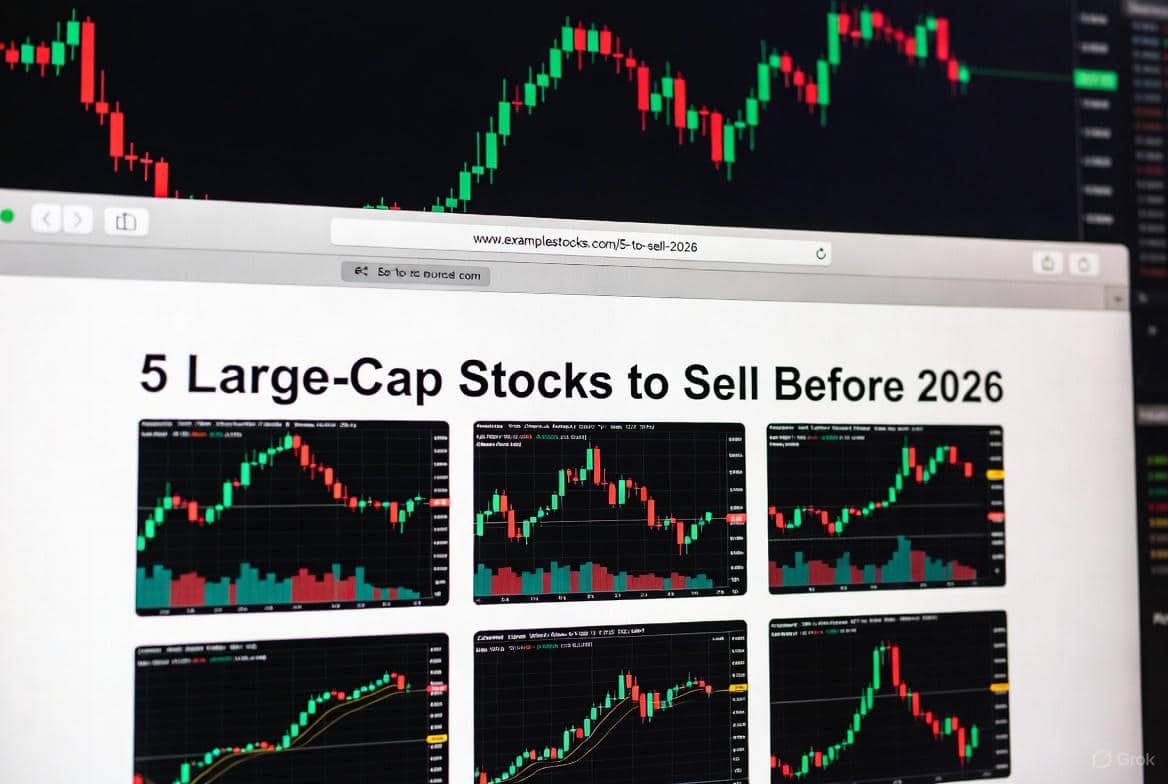
1. Target: Value Trap in a Competitive Retail Landscape
Fundamental pressures
On paper, Target screens like a bargain. The shares trade at a low earnings multiple and a depressed price‑to‑sales ratio, metrics that might normally attract value‑oriented investors. The problem is that the underlying business is not behaving like a healthy, temporarily mispriced retailer. Comparable sales recently fell, and management cut full‑year earnings guidance to a range that implies shrinking profitability rather than stabilization.
In an environment where U.S. consumers have continued to spend—albeit selectively—Target is one of the few major chains consistently missing expectations. Margins are under pressure from discounting, inventory missteps, and elevated operating costs. At the same time, a key rival has captured the mantle as the go‑to destination for value‑conscious shoppers, a shift that shows up both in store traffic and in stock performance.
Technical warning signs
The chart reflects this fundamental malaise. Since early‑year market peaks, the stock has been in a persistent downtrend. A once‑supportive 50‑day simple moving average (SMA) has flipped into overhead resistance, capping every attempt at a rally. Even when the relative strength index (RSI) dips into oversold territory—conditions that often trigger short‑term bounces—buyers have failed to produce durable upside.
That combination of eroding fundamentals and weak technical behavior is classic value‑trap territory: cheap for a reason, with no clear catalyst in sight. For investors, capital may be better deployed in retailers with stronger momentum and cleaner execution rather than waiting for a turnaround that keeps getting pushed further out.
2. Deere & Co.: Trade War Casualty With Mounting Headwinds
Tariffs and farm stress
Deere & Co. is a high‑quality industrial franchise with iconic brands in tractors, harvesters, and precision agriculture equipment. But even great companies can become poor stocks when macro forces and policy changes stack up against them. A renewed round of trade tensions and tariffs has hit Deere particularly hard, adding an estimated multi‑billion‑dollar headwind to its outlook before taxes over the coming year.
At the same time, farmers in key regions are facing lower crop prices, higher financing costs, and uncertainty about export markets, creating a brewing farm‑sector downturn. Even though Deere recently posted headline beats on revenue and earnings, management’s muted guidance highlighted how difficult the operating environment is likely to become in 2026.
Technical fatigue after a weak rally
From a technical perspective, the stock has tried to mount a comeback over the past several weeks but appears to be running out of steam. Following a prior “death cross” (when the 50‑day SMA falls below the 200‑day SMA), the longer‑term 200‑day SMA has acted as stiff resistance. The shares have struggled to reclaim the gap‑down level created after an earlier earnings report, suggesting that sellers still dominate.
Momentum indicators tell a similar story. The moving average convergence divergence (MACD) line has rolled over again after nearly two months of improvement, hinting that the recent rally may have been little more than a reflex bounce in a larger downtrend. With major policy and end‑market headwinds still in place, it’s hard to justify fresh capital here when so many other industrial names face cleaner setups.
3. Tesla: Lofty Valuation Meets Intensifying Competition
A stretched multiple with rising risks
Tesla has never been a stock for the faint of heart. The shares have historically commanded extreme valuation multiples, supported by rapid growth, strong margins, and a powerful narrative around electric vehicles (EVs), autonomy, and AI. Today, though, investors face a tougher calculus. The stock still trades at eye‑watering multiples of earnings, sales, and free cash flow—levels that assume years of flawless execution and outsized growth.
Meanwhile, competitive and regulatory pressures are mounting. In Europe, EV sales momentum has cooled, and rivals are gaining share. In China, a key growth market, domestic manufacturers are pressing their cost advantages, eroding Tesla’s leadership. In the U.S., the fading of generous EV tax credits and evolving emissions standards introduce additional uncertainty around demand and pricing.
Tesla is also increasingly leaning on its AI and software ambitions—such as autonomous driving and new AI products—to justify its market valuation. Yet in areas like robotaxis, leading technology competitors already appear ahead in road‑tested deployments, while Tesla’s own timelines and demos have been repeatedly pushed back or revised.
Technical setup hints at a momentum break
On the chart, Tesla’s price action suggests that the stock’s uptrend may be losing momentum. The 50‑day SMA, which had reliably acted as support for months, is now behaving more like resistance. A potential double‑top pattern has formed near recent highs, a classic sign that buying conviction is fading at those levels.
If the stock fails to convincingly break above the 50‑day SMA and that double‑top zone, the path of least resistance could shift to the downside, especially if macro conditions worsen or sentiment toward high‑multiple growth stocks cools. For investors who have enjoyed significant gains in prior years, the combination of stretched valuation, intensifying competition, and deteriorating technicals makes Tesla a prime candidate to trim heading into the new year.
4. UPS: Structural Challenges in a Tough Shipping Environment
Business model pressure and key customer risk
United Parcel Service might look appealing at first glance. The stock trades at a more modest valuation than many growth names, and its position as a global shipping and logistics leader carries intuitive appeal. Yet underneath the surface, UPS faces structural challenges that may limit upside in the near term.
Recent changes in tariff policies—including a clampdown on the de minimis exception that allowed low‑value imports to enter the U.S. with minimal customs friction—have complicated UPS’s operations. The company has been forced to devote significant resources to disentangling new compliance and logistics issues, which can weigh on efficiency and profitability.
Another concern is customer concentration and competitive dynamics. Shipping volume from a major e‑commerce platform partner has declined sharply, reducing a historically important revenue stream. Even though UPS has managed to beat earnings expectations on both revenue and profits in recent quarters, its forward guidance has been tepid. Rival carriers are also fighting aggressively for share, pressing pricing and squeezing margins.
Technical resistance and weakening momentum
UPS’s stock attempted to break higher in October, but the move ran headlong into resistance at the 200‑day SMA. Since then, repeated failures to clear that level have put additional psychological pressure on bulls. Meanwhile, the 50‑day and 200‑day SMAs are converging, reflecting a market still undecided about the long‑term trend.
Momentum indicators flash caution as well. The RSI has been creeping toward overbought territory even though price has struggled to break out, a divergence that often precedes a pullback. The MACD has also weakened, showing that bullish momentum is at its lowest level since late summer. For a stock already down significantly year‑to‑date, that combo of overhead resistance and fading momentum suggests that more downside is possible if macro conditions or company‑specific news disappoint.
5. Vistra: Fading Energy Tailwind With a Troubling Chart
Earnings miss and valuation reset
Energy and utility names tied to the “data center power” theme have enjoyed a massive run‑up as markets grapple with the electricity demands of AI, cloud computing, and digital infrastructure. Vistra has been one of the beneficiaries of that narrative. However, recent developments indicate that the easy part of the trade may be over.
In early November, Vistra delivered a notable earnings disappointment, missing revenue expectations by a wide margin. At the same time, volatility in natural gas prices threatens to compress margins, given the company’s exposure to fuel costs. Despite this growing uncertainty, the stock still trades at elevated multiples on key valuation metrics , including earnings, sales, and book value. That suggests expectations remain high even as fundamentals wobble.
Technical breakdown risk
From a technical standpoint, Vistra’s chart has gone from leadership to liability. The shares have dipped below the 50‑day SMA, a meaningful change in character for a former outperformer. The MACD has triggered a bearish crossover, indicating that downside momentum is building. The RSI has been trending lower since early autumn, confirming that the stock’s internal strength is eroding faster than the headline price behavior might imply.
The next major technical test looms at the 200‑day SMA. A decisive break below that longer‑term support level would likely draw in more sellers and could accelerate the downward move as trend followers exit. For investors who rode the initial wave of enthusiasm around power‑hungry data centers, the risk now is that staying too long in a late‑cycle trade turns a winning theme into a costly round trip.
Putting It All Together: When Selling Makes Sense
The case for proactive portfolio maintenance
Reviewing these five names—Target, Deere & Co., Tesla, UPS, and Vistra—reveals a shared pattern: each faces a mix of fundamental and technical challenges that make the near‑term outlook cloudy at best and hazardous at worst. Whether it’s margin pressure, new tariffs, intensifying competition, customer concentration risk, or late‑cycle valuation, the balance of risk and reward has tilted away from shareholders.
The end of the year offers a natural checkpoint. Tax‑loss harvesting can soften the blow of realized losses. Rotating out of laggards can free up capital for stronger opportunities, whether in more resilient sectors, higher‑quality compounders, or undervalued names with cleaner catalysts.
Avoiding emotional attachment
It’s easy to become emotionally attached to familiar brands or past winners. However, markets reward flexibility and a willingness to reassess. Selling a stock doesn’t mean you can never own it again. If fundamentals improve, valuations reset, or technicals repair, there may be a time to revisit. For now, the prudent move in these five cases is to recognize that the risk‑reward balance no longer favors holding, especially when better ideas are available.
Conclusion
Thoughtful selling is an underappreciated skill in investing. As the calendar turns toward 2026, evaluating whether stocks like Target, Deere, Tesla, UPS, and Vistra still deserve their place in your portfolio—or whether they’ve become dead weight—is a smart way to start the new year on stronger footing.
FAQ: 5 Weak Stocks to Cut From Your 2026 Portfolio
Should I sell all five of these stocks immediately?
Not necessarily. Every investor’s situation, cost basis, and risk tolerance are different. These stocks appear to have unfavorable near‑term risk‑reward profiles, but that doesn’t mandate an immediate liquidation. Consider your time horizon, tax implications, and available alternatives before deciding how much, if any, of each position to reduce.
How does tax-loss harvesting factor into selling decisions?
Tax‑loss harvesting allows you to realize losses in weaker positions and use them to offset capital gains elsewhere in your portfolio, potentially lowering your tax bill. Year‑end is a common time to identify underperformers for this purpose. Just be mindful of wash‑sale rules if you plan to buy back the same or substantially identical security within a short window.
What if I still believe in the long-term story for one of these companies?
You can separate the business from the stock. A company may have an attractive long‑term narrative but still be a poor near‑term holding due to valuation, macro risk, or technical weakness. One approach is to trim your position rather than exit completely, keeping some exposure while reducing risk.
Are these the only stocks worth selling before 2026?
No. These are examples of large‑cap names where multiple red flags align. A thorough portfolio review might uncover other candidates—companies with deteriorating earnings, repeated guidance cuts, broken charts, or themes that have run their course.
How important are technical indicators in sell decisions?
Technical indicators like moving averages, RSI, and MACD shouldn’t be the only basis for selling, but they can provide useful context about market psychology and trend strength. When technical weakness lines up with deteriorating fundamentals, the case for selling is much stronger.
Could any of these stocks rebound sharply in 2026?
Yes. Markets are inherently uncertain, and negative sentiment can sometimes overshoot to the downside. However, investing based solely on hope for a rebound—without clear catalysts or improving fundamentals—often leads to capital being trapped in laggards rather than working in stronger opportunities.
How do macro factors like tariffs and trade policy affect these names?
Tariffs, trade tensions, and regulatory changes can materially impact revenues, costs, and capital allocation for companies in retail, industrials, logistics, and energy. When management repeatedly cites policy headwinds and reduces guidance, it’s a sign that the operating environment is becoming more challenging, not less.
Is it risky to sell popular or widely followed stocks like Tesla?
Selling a widely followed name can feel uncomfortable, especially if it has a devoted investor base. But popularity doesn’t guarantee future returns. If the valuation is stretched and the competitive or regulatory landscape is shifting, taking profits—or capping downside—can be a rational decision.
What should I look for when redeploying capital from these sales?
Focus on businesses with resilient cash flows, strong balance sheets, reasonable valuations, and clear secular or cyclical tailwinds. It’s often better to pay a fair price for quality than a seemingly cheap price for a company facing structural problems.
How often should I review my portfolio for potential sells?
At a minimum, consider a formal review at least once or twice per year, with additional check‑ins around major life events or big market moves. Year‑end is a natural moment to reassess, but significant changes in a company’s fundamentals, guidance, or competitive landscape can warrant action at any time.